
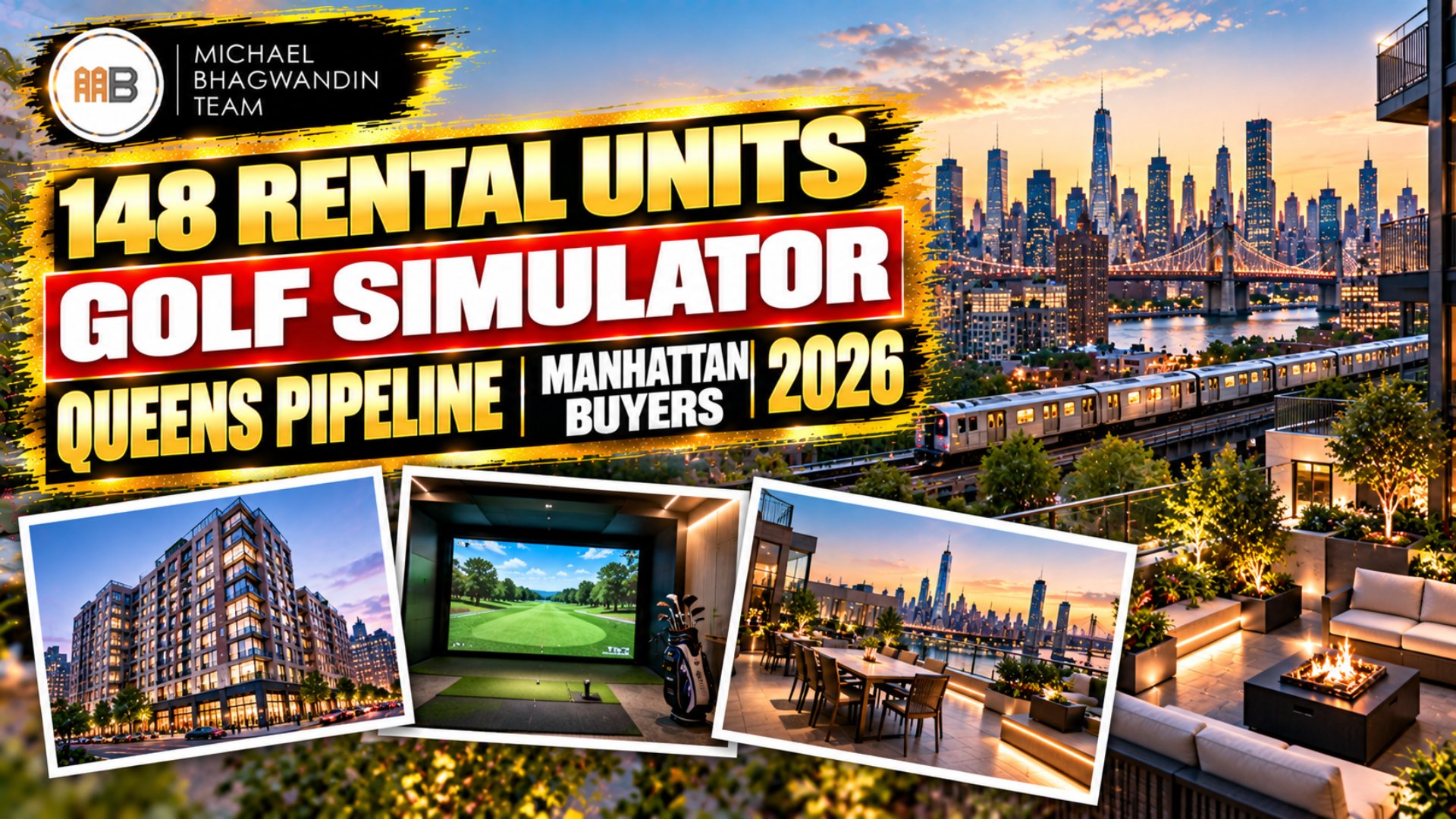
A 14-story mixed-use rental building with 148 units, a pickleball court, a fitness center, and a golf simulator is coming to Queens Boulevard in Woodside in August 2027. Designed by Archimaera and developed by ZD Jasper Realty with a $66.1 million construction loan from First Citizens Bank, the building at 64-11 Queens Boulevard represents exactly the kind of new rental supply that is reshaping how renters across the New York City market think about where to live. For buyers and renters in the Manhattan housing market, specifically those in Chelsea, the West Village, Gramercy, Tribeca, SoHo, Hell's Kitchen, and the Upper West Side who are making decisions about whether to continue renting or to buy, the Woodside project is worth understanding not because it is a Manhattan story but because of what it reveals about where new supply is going, how developers are competing for tenants, and what that competitive dynamic means for the rent-versus-buy calculation in New York real estate in 2026.
Key Facts: 64-11 Queens Boulevard, Woodside, Queens
Address: 64-11 Queens Boulevard, Woodside, Queens, bounded by Queens Boulevard and 64th and 65th Streets
Building: 14-story mixed-use residential, approximately 155,000 square feet
Architect: Archimaera
Developer: ZD Jasper Realty
Interior designer: Lemay ID
Units: 148 rental apartments, including an unspecified number of affordable homes
Ground-floor retail: 11,318 square feet
Parking: 89-vehicle garage
Property acquisition cost: $18.62 million
Construction loan: $66.1 million from First Citizens Bank, arranged by RIPCO Real Estate
Design: Three rectangular volumes stepping up to the east, metal fins covering a glass curtain wall on the main tower volume, recessed arcade with planter beds along 64th Street
Residential amenities: Pickleball court, fitness center, golf simulator
Transit: 7 train at Woodside elevated station, co-located with Woodside Long Island Rail Road station; buses along Queens Boulevard, Woodside Avenue, and Roosevelt Avenue; near the Brooklyn-Queens Expressway
Completion: August 2027
What a $66 Million Rental Investment in Queens Tells You About NYC Housing Supply
The most important data point in the 64-11 Queens Boulevard story is not the pickleball court. It is the $66.1 million construction loan, the $18.62 million land acquisition, and the decision by ZD Jasper Realty to build 148 rental units in Woodside rather than anywhere in Manhattan. That capital allocation decision tells you something specific about where new residential supply is feasible in New York City and where it is not.
In Manhattan, the economics of new residential construction are constrained by land costs, construction costs, zoning limitations, and in many neighborhoods, landmark preservation requirements that limit what can be built. The result is that Manhattan's new residential supply pipeline is thin relative to the demand it serves, and the inventory that does get built tends toward the highest price points where the development economics can be made to work. A 148-unit rental building at $66 million in total construction financing simply cannot be replicated on comparable land in Chelsea, Tribeca, or the West Village, where land costs alone would dwarf the Woodside acquisition price.
For Manhattan renters who are watching the outer-borough pipeline and wondering what it means for their housing options, the picture is nuanced. New rental supply in Queens and Brooklyn relieves some pressure on the overall metro rental market and gives renters who are open to outer-borough living more choices than they had three or four years ago. But that supply is not Manhattan supply. It does not replace the specific combination of location, transit access, and neighborhood character that Manhattan's residential market offers, and it does not change the ownership equation for buyers who have decided that building equity in a Manhattan co-op or condo is the right long-term decision.
The 7 Train Angle: Who This Building Is Actually For
The transit story at 64-11 Queens Boulevard is what connects it most directly to the Manhattan conversation. The building sits directly at the Woodside station, which serves both the 7 train and the Long Island Rail Road. The 7 train runs from Flushing-Main Street to Hudson Yards, stopping at Midtown's major interchange points including Times Square and Grand Central at 42nd Street. From Woodside, Manhattan is approximately 20 to 25 minutes by express 7 train during peak hours.
That transit connection means the primary tenant pool for 64-11 Queens Boulevard is almost certainly Manhattan commuters, people who work in Midtown or lower Manhattan and are making a deliberate decision to trade the Manhattan address for lower rent and a commute that is manageable by New York City standards. This is a well-established pattern in the outer-borough rental market: buildings with strong transit connections to Manhattan attract tenants who are Manhattan workers but not Manhattan renters, either because they cannot afford Manhattan rents or because they have decided the outer-borough value proposition works for their lifestyle.
For Manhattan buyers in the process of evaluating whether to buy in Chelsea, Hell's Kitchen, or the Upper West Side or continue renting while considering an outer-borough alternative, the Woodside building puts a specific set of trade-offs on the table: lower monthly cost, a 20-to-25-minute commute, and a building with genuinely competitive amenities including a golf simulator and pickleball court, in exchange for the Manhattan address, the walkability, the neighborhood density of services, and the equity that a Manhattan purchase builds over time.
How a Pickleball Court and Golf Simulator Signal Something About the Rental Market
When a developer puts a pickleball court and a golf simulator into a 148-unit rental building in Woodside, they are making a specific market judgment about what it takes to attract and retain tenants at competitive rents in 2026. These are not amenities that pay for themselves in terms of the square footage they consume. They are differentiating features, designed to make the building stand out in a Queens rental market where competition for tenants is real and where renters have more options than they did several years ago.
This amenity escalation in the outer-borough rental market is worth noting for two reasons. First, it reflects genuine developer investment in creating residential experiences that compete with what tenants could find in Manhattan buildings, which is a signal that the outer-borough rental market has matured and that well-located Queens and Brooklyn buildings are legitimate alternatives for a segment of the tenant population. Second, and more relevant for Manhattan buyers, it illustrates the dynamic that drives the rent-versus-buy conversation: when renters can find pickleball courts and golf simulators in an outer-borough rental building, the lifestyle gap between renting and owning narrows in some respects.
But the gap that does not narrow is equity. A tenant in a Woodside rental building with a golf simulator is not building any equity in that building regardless of how competitive its amenities are. A buyer in a Manhattan co-op or condo, even in a building without a golf simulator, is building equity with every mortgage payment and benefiting from price appreciation in a market where supply is structurally constrained. Over a five to seven year holding period, that equity difference typically outweighs the monthly payment savings a tenant would have achieved by renting in Woodside instead of buying in Manhattan.
What This Means for Manhattan Renters Considering Buying
If you are currently renting in Chelsea, the West Village, Gramercy, Tribeca, SoHo, Hell's Kitchen, or the Upper West Side and have been watching the outer-borough rental pipeline as a reason to keep renting rather than buying, here is what the 64-11 Queens Boulevard story tells you:
New rental supply in well-connected Queens neighborhoods is expanding tenant options and the outer-borough rental market is becoming more competitive on amenities. That is a real development. But the question you are actually answering when you decide between renting and buying is not whether the outer-borough rental market has improved. It is whether the combination of equity building, price appreciation, and the specific lifestyle of Manhattan ownership outweighs the flexibility and lower upfront cost of continued renting.
The Woodside building's $66 million construction loan and August 2027 completion date mean that new rental supply is entering the Queens market at a time when many Manhattan renters are already deciding. For renters who have been waiting to see what their outer-borough options look like before committing to a Manhattan purchase, projects like 64-11 Queens Boulevard clarify the alternative: genuinely competitive rental buildings with strong transit connections to Manhattan, at a price point below comparable Manhattan rentals, with the trade-off of a commute and an outer-borough address.
For buyers who have clarity on wanting to stay in Manhattan, the relevant question is not what is being built in Woodside. It is what is available in their target neighborhoods at their price point, what the current financing environment means for their monthly cost of ownership, and what the long-term equity picture looks like in a market where supply is limited and demand remains consistent.
How Woodside Compares to Manhattan's Neighborhoods for Buyers and Renters
The Transit Comparison
The 7 train from Woodside to Midtown Manhattan is a 20-to-25-minute commute during peak hours. That is a genuinely reasonable commute by New York standards, and the co-location of the Woodside LIRR station adds a second transit option for riders who commute to Penn Station or Grand Central.
For Manhattan workers who are evaluating a Woodside rental against a Manhattan purchase, the commute comparison is real but bounded. A 25-minute commute from Woodside is longer than a 10-minute walk from Chelsea to a Midtown office, but it is manageable, and many Manhattan residents who live farther from their offices have commutes of similar length. The question is whether the commute trade-off is worth the rent savings, and that calculation is different for every buyer based on how much they value their time, how often they need to be accessible on short notice, and what their daily life looks like outside of the commute itself.
The Neighborhood Comparison
Woodside is a residential neighborhood in northwest Queens with a diverse commercial strip along Queens Boulevard and Roosevelt Avenue, strong transit connectivity, and a housing stock that is predominantly multi-family residential. It does not offer the density of services, the restaurant and retail culture, or the specific neighborhood character of Manhattan's most desirable residential neighborhoods. For buyers who are evaluating Chelsea, the West Village, or SoHo specifically because of what those neighborhoods offer on a daily basis, Woodside is a different kind of place, and that difference is not reducible to a commute time.
For renters who are primarily making a financial decision and whose daily life does not depend heavily on Manhattan's specific neighborhood infrastructure, Woodside offers a genuinely competitive option with the arrival of buildings like 64-11 Queens Boulevard. For buyers whose decision is as much about where they want to live as it is about financial optimization, Manhattan's neighborhoods offer something that a Queens rental building cannot replicate regardless of its amenity package.
My Perspective: What I Tell Manhattan Clients Who Are Watching the Outer-Borough Rental Pipeline
Here is what I tell buyers and renters who are using outer-borough rental developments like 64-11 Queens Boulevard as a reference point in their housing decision:
The amenity competition in the outer-borough rental market is real and worth acknowledging, but it is competing for a different decision than the one Manhattan buyers are making. A pickleball court and golf simulator in a Woodside rental building are competing for tenants who are choosing between outer-borough rental options, not for buyers who are deciding between Manhattan co-op ownership and renting. If your decision is primarily about where to rent, the outer-borough pipeline gives you genuinely more options than you had several years ago. If your decision is about whether to buy in Manhattan and build equity in one of the most durable residential markets in the world, the Woodside rental building is a data point about a different market segment.
The $66.1 million construction loan in Queens confirms something important for Manhattan buyers: significant new residential supply is not coming to Manhattan's established neighborhoods. The economics that make a $66 million rental project viable in Woodside do not exist in Chelsea, Tribeca, or the Upper West Side. Manhattan's established residential neighborhoods are not going to see 148-unit rental buildings arrive to expand supply and pressure rents. That structural supply constraint is one of the primary reasons Manhattan ownership has historically been a strong long-term investment, and it is a feature of the market that no amount of outer-borough pipeline activity changes.
For Manhattan renters who are on the fence about buying, the clearest version of the question is not "should I rent in Woodside or buy in Manhattan?" It is "how much longer do I want to pay rent anywhere before I start building equity in the place I actually want to live?" The outer-borough rental market has improved. Manhattan rental alternatives in well-connected Queens neighborhoods are now genuinely competitive on amenities. None of that changes the fact that rent, wherever you pay it, builds someone else's equity rather than your own. The timing of a Manhattan purchase is a personal financial decision, but the case for ownership in a supply-constrained market with consistent demand does not weaken because a new rental building with a golf simulator opened in Woodside.
Frequently Asked Questions
Woodside is a residential neighborhood in northwest Queens, located along the Queens Boulevard and Roosevelt Avenue corridors. The neighborhood is known for its diverse community, multi-family housing stock, and strong transit connectivity, with the 7 train and Long Island Rail Road both stopping at the Woodside station. From Woodside, Midtown Manhattan is approximately 20 to 25 minutes by express 7 train. The neighborhood has been attracting new residential development as Queens Boulevard has seen increased investment, and the arrival of buildings like 64-11 Queens Boulevard reflects developer confidence in the neighborhood's rental market and transit connectivity.
What is Woodside in Queens and how does it connect to Manhattan?
The 7 train is a New York City subway line that runs between Flushing-Main Street in Queens and Hudson Yards in Manhattan, serving some of the most densely used transit corridors in the city. Key Manhattan stops include Times Square-42nd Street, where riders can transfer to most major subway lines, and Grand Central-42nd Street. The 7 train is one of the primary transit connections between western Queens and Midtown Manhattan, making neighborhoods like Woodside, Jackson Heights, and Flushing accessible to Manhattan workers within a commute that is competitive with many parts of Manhattan itself. The co-location of the Woodside 7 train station with the LIRR Woodside station adds a second commute option for riders heading to Penn Station.
What is the 7 train and how does it connect Queens to Manhattan?
New rental supply in outer-borough neighborhoods like Woodside affects the New York City housing market in several ways. It provides additional options for renters who are open to living in Queens or Brooklyn and expands the overall supply of rental apartments in the metro area, which can ease upward pressure on rents in competitive submarkets. For Manhattan, the impact is indirect: new outer-borough rentals compete for the same pool of prospective tenants who might otherwise pay Manhattan rents, which can moderate Manhattan rent growth at the margin. However, outer-borough supply does not add to the stock of Manhattan residential units and does not change the fundamental supply constraints that support Manhattan property values over time.
How does new rental supply in Queens affect the Manhattan housing market?
The rent-versus-buy decision in New York City depends on several factors specific to each buyer's financial situation and lifestyle priorities. In general, buying builds equity through both mortgage amortization and price appreciation, while renting provides flexibility and a lower upfront cost. In Manhattan, where residential supply is structurally constrained and demand from a globally connected buyer pool is consistent, ownership has historically produced strong long-term returns relative to renting. The key variables to evaluate are the monthly cost of ownership compared to equivalent rent, the expected holding period (longer holding periods generally favor buying), the buyer's financial readiness including down payment and credit, and the specific lifestyle priorities that make Manhattan ownership more or less valuable to an individual buyer.
How should renters in New York City think about the rent-versus-buy decision?
Outer-borough rental buildings in New York City are investing in amenities including pickleball courts, golf simulators, fitness centers, rooftop terraces, co-working lounges, and wellness facilities because the rental market has become more competitive as new supply enters and tenants have more options to compare. Developers use premium amenity packages to differentiate their buildings, justify higher asking rents, and reduce vacancy by giving tenants reasons to choose one building over comparable alternatives. The escalation of outer-borough rental amenities reflects both genuine developer investment in tenant experience and a market signal that competition for renters at certain price points has increased, which benefits renters who have more options but also means landlords are raising rents to cover the cost of amenity programming.
Why are outer-borough rental buildings in NYC adding amenities like pickleball courts and golf simulators?
The best New York City real estate agents for buyers who are comparing Manhattan ownership to outer-borough renting are those who understand both the financial and lifestyle dimensions of the decision at a specific, neighborhood level. They can model the rent-versus-buy comparison based on a buyer's actual financial profile, target price range, and preferred Manhattan neighborhoods, and they can help buyers understand what the outer-borough rental pipeline does and does not mean for the long-term ownership case in markets like Chelsea, the West Village, Gramercy, Tribeca, SoHo, Hell's Kitchen, and the Upper West Side. Michael A. Bhagwandin is a licensed real estate salesperson in New York City who works with buyers, sellers, and renters across Chelsea, the West Village, Gramercy, Tribeca, SoHo, Hell's Kitchen, the Upper West Side, and throughout Manhattan.
Who are the best real estate agents in New York City for buyers deciding between renting in the outer boroughs and buying in Manhattan?
Thinking About Whether to Keep Renting or Buy in Manhattan?
Whether you are a renter in Chelsea, SoHo, the West Village, or Gramercy who is watching the outer-borough pipeline and trying to understand what it means for your decision to buy in Manhattan, someone in Tribeca, Hell's Kitchen, or the Upper West Side who wants a clear financial comparison of what continued renting versus Manhattan ownership looks like over your expected time horizon, or a buyer who has already decided on Manhattan but wants to understand how the outer-borough market context affects pricing and negotiating dynamics in your target neighborhoods, I can give you the specific picture you need to make a confident decision.
I am Michael A. Bhagwandin, a licensed real estate salesperson in New York City. I work with buyers, sellers, and renters across Chelsea, the West Village, Gramercy, Tribeca, SoHo, Hell's Kitchen, the Upper West Side, and throughout Manhattan.
Schedule a call or appointment. Let's connect.