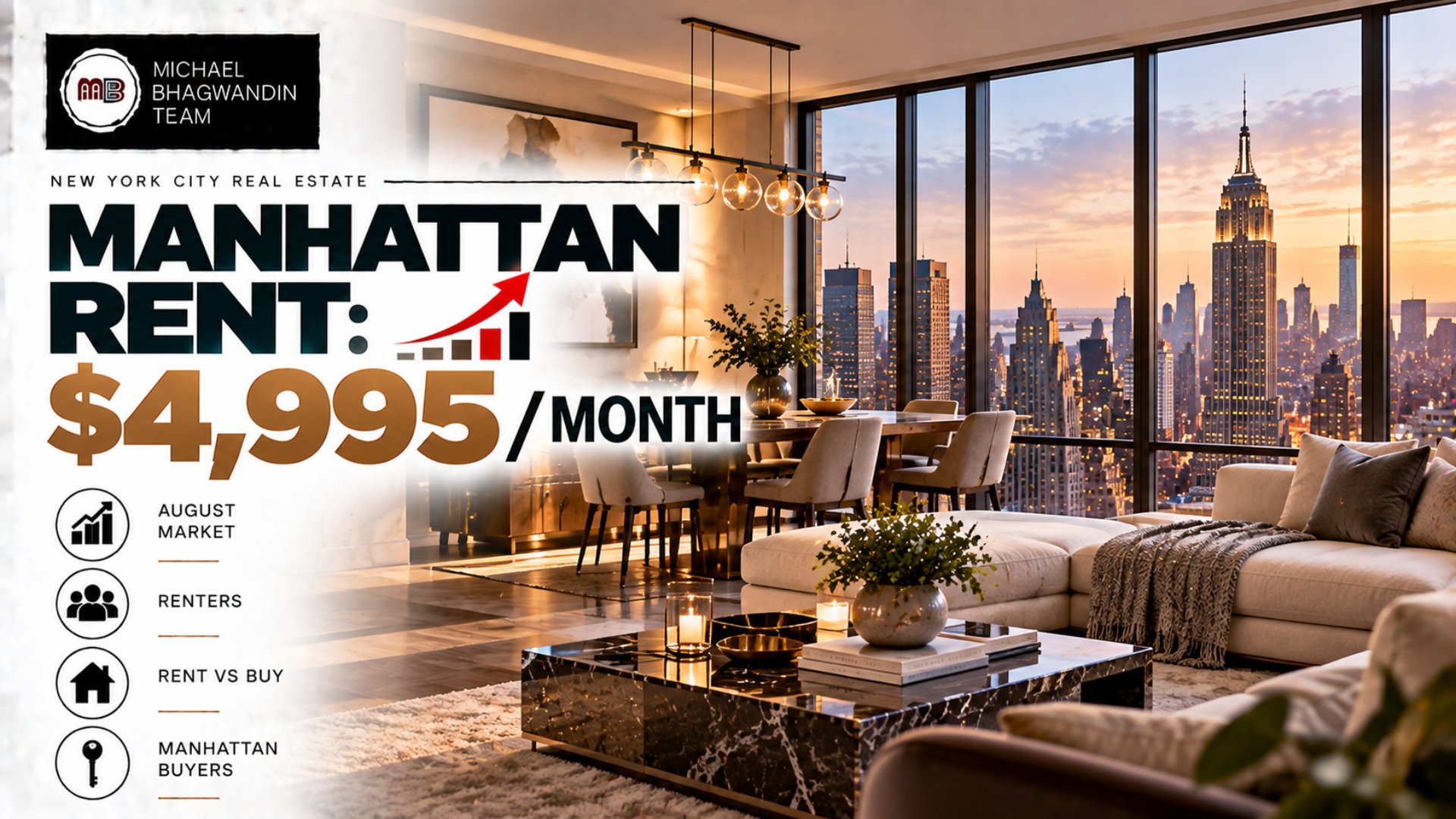
Two numbers from StreetEasy's August 2026 market report tell a story about the Manhattan housing market that every renter in New York real estate needs to hear at the same time. The first: Manhattan's median asking rent reached $4,995 a month in August, a record high, up 5.2 percent year over year. The second: 21.8 percent of New York City homes sold above their most recent asking price in August, following a July in which 25 percent of homes sold above asking, the highest share since July 2022. Both numbers point in the same direction, and that direction is more relevant to renters than to almost anyone else in the market. When you are paying nearly $5,000 a month for a Manhattan apartment and the homes you could be buying are selling above asking at the fastest rate in four years, the rent vs. buy question is no longer hypothetical. It is a real financial calculation that deserves a real answer, and this post is built to help you work through it. Whether you are renting in Chelsea, the West Village, Gramercy, Tribeca, SoHo, Hell's Kitchen, or the Upper West Side, the August data gives you specific and actionable context for one of the most significant financial decisions you will make in the New York City market.
Key Facts: StreetEasy August 2026 Market Data
Sales market:
21.8 percent of NYC homes sold above their most recent asking price in August 2026
25.0 percent of NYC homes sold above asking in July 2026, the highest share since July 2022
Competition was strongest in Brooklyn: 31.9 percent of Brooklyn homes sold above asking in August
NYC homes are entering contract faster than a year ago
Brooklyn: fastest borough, with the typical home entering contract in a median of 69 days
Homes that sold above asking price shared common characteristics: they reached a broader audience, amplified buyer interest, and were priced competitively, per StreetEasy Performance Pulse scores
Rental market:
NYC median asking rent: $4,200 in August, a record high; annual rent growth slowed to 2.8 percent from 7.5 percent a year earlier
Manhattan median asking rent: $4,995, up 5.2 percent year over year
Queens and the Bronx were the only boroughs with annual inventory growth: 2.3 percent and 9.3 percent respectively
Manhattan rental inventory did not see annual growth, which continues to support elevated rent levels in the borough
What $4,995 a Month in Manhattan Rent Actually Costs You
The median asking rent in Manhattan of $4,995 per month translates to $59,940 per year. That is a number worth sitting with for a moment.
If you signed a two-year lease at Manhattan's median rent, you would pay approximately $119,880 over that period. If you signed a three-year lease at that level, the total approaches $180,000. Every dollar of that goes toward your landlord's equity, not yours. There is no residual value, no appreciation, and no mortgage interest deduction available on a rental payment.
That does not automatically mean buying is the right decision for you. There are renters for whom renting is the correct financial and lifestyle choice: people who have genuine uncertainty about where they will live in two years, people who are building toward a down payment and need additional time, and people whose financial profile is not yet in position to purchase competitively. Renting is not a mistake by definition.
But the rent-versus-buy calculation changes when the cost of renting is this high. At $4,995 a month, the opportunity cost of renting in Manhattan rather than building equity through ownership is significant and worth quantifying seriously, not dismissing.
Running the Basic Math
A renter paying $4,995 per month in Manhattan is paying approximately the same monthly amount as the principal, interest, and common charges might be on a well-structured condo or co-op purchase, depending on the price point and financing. The critical difference is that a portion of each mortgage payment goes toward principal reduction, and the property itself may appreciate over the holding period.
If you have been renting in Chelsea, Gramercy, or the Upper West Side at Manhattan's median rent level and have been assuming that buying is simply out of reach, the August data is a reason to run the actual numbers before you renew your lease. A mortgage broker can tell you what your buying power is at your income level, what your monthly cost would look like at different price points, and how the monthly ownership cost compares to your current rent. The comparison is often more favorable than renters assume, especially at rent levels near $5,000 a month.
Why Rent Is So High and Whether It Is Likely to Change
Manhattan's median asking rent reached $4,995 in August 2026, but the annual growth rate in rent slowed significantly to 2.8 percent from 7.5 percent a year earlier. That deceleration in growth might sound like good news for renters, but 2.8 percent growth on a $4,995 base still means rents are expected to be approximately $5,140 in a year. Rents are not coming down. They are going up more slowly.
The structural reason is supply. Manhattan's rental inventory did not see annual inventory growth in August. Queens and the Bronx were the only boroughs where rental inventory grew year over year, at 2.3 percent and 9.3 percent respectively. Manhattan's combination of constrained housing supply, consistent demand, and geographic limits on new development has produced a rental market where a record-high median rent was sustained even as growth slowed.
For renters who are waiting for rents to fall meaningfully before reconsidering a purchase, the supply data does not support that expectation. The most likely trajectory for Manhattan rent over the medium term is continued modest growth from an already historically high base. The renters who decide to wait for rent to come down before buying are likely to wait indefinitely.
The Sales Market That Renters Are Choosing Not to Enter
While Manhattan renters are paying $4,995 a month, the sales market they are opting out of sold 21.8 percent of its listings above asking price in August. That figure, and the July peak of 25 percent, is the highest above-asking rate since July 2022. The buyers who are competing for Manhattan's available homes are doing so in a market where quality listings generate real competition.
For renters who are looking at this and thinking that the sales market is too competitive to enter, the data tells a more nuanced story. The 21.8 percent above-asking rate means that a significant majority of NYC homes, more than 78 percent, sold at or below asking price. The above-asking competition is concentrated in the best-positioned listings, the ones that are priced accurately, presented professionally, and exposed to the full buyer market from the moment they go live.
A renter who is ready to buy, financially prepared, and working with the right agent is not necessarily entering a market where they will be outbid on every listing. They are entering a market where well-positioned listings are competitive and listings that are not well-positioned represent opportunities at asking or below asking. Understanding the difference is the key to navigating the sales market as a first-time buyer.
What StreetEasy's Performance Pulse Data Tells Buyers
StreetEasy's own analysis of the August data found that the homes selling above asking had specific characteristics in common: they reached a broader audience, amplified buyer interest, and were priced competitively from the start. That is a useful insight for renters-turned-buyers to internalize before they start their search.
The above-asking situations you are most likely to encounter are on listings that have full market exposure from day one, are priced at or slightly below market to generate competition, and are being actively promoted across the platforms where buyers in that price range are searching. Those listings create multiple-offer situations quickly. The listings that are priced above market, are not well-marketed, or are available only through a limited pool of buyers are the ones where a prepared buyer can move at asking or negotiate below.
As a buyer entering the market from a rental, knowing which type of listing you are looking at before you schedule a showing saves time and calibrates your expectations correctly.
The Neighborhoods Where the Rent vs. Buy Calculation Is Most Compelling
The rent vs. buy comparison plays out differently across Manhattan's neighborhoods depending on the gap between prevailing rents and the monthly cost of ownership at comparable price points.
Chelsea and Hell's Kitchen
Chelsea and Hell's Kitchen have some of the most active sales markets for the buyer profile that overlaps with Manhattan's renter pool. Renters in these neighborhoods who are paying near or above the city's median rent are often within reach of a studio or one-bedroom purchase in the same area. The condo inventory in both neighborhoods is more accessible to financed buyers than in co-op-dominant neighborhoods, and the monthly cost of ownership at entry-level price points can compare favorably to the current rental rate for a comparable space.
The West Village and SoHo
The West Village and SoHo attract renters who are paying at or above Manhattan's median rent for the neighborhood character and lifestyle that both areas offer. For those renters, the rent vs. buy calculation involves a recognition that the same neighborhood features that make renting in the West Village or SoHo expensive are the same features that have historically supported strong long-term appreciation in the ownership market. A buyer who purchases in either neighborhood is not just making a monthly payment decision. They are making a long-term bet on a neighborhood that has proven its value over multiple market cycles.
Gramercy and the Upper West Side
Gramercy and the Upper West Side have robust prewar co-op markets that provide ownership entry points in the studio and one-bedroom categories at price points that are accessible to buyers who have prepared appropriately. Renters in these neighborhoods who are near the $4,995 Manhattan median are paying amounts that, when modeled against a purchase at a comparable monthly cost, often reveal a purchase as the better medium-term financial decision. The co-op application process in both neighborhoods is an additional step that renters should understand before beginning a search, but it is not an obstacle that should prevent a financially prepared buyer from pursuing ownership in either market.
Tribeca
Tribeca's rental and sales markets are both above Manhattan's median, which means renters in Tribeca who are evaluating a purchase are typically looking at a significant jump in down payment requirement compared to entry-level Manhattan neighborhoods. For renters whose financial profile supports a Tribeca purchase, the long-term case for ownership is strong: the neighborhood's loft inventory, architectural character, and family-buyer demand have produced consistent appreciation over time. For renters who are not yet in position for a Tribeca purchase, a strategic first purchase in a neighboring lower-price market can provide the equity that funds a Tribeca move in the next five to seven years.
My Perspective: What the August Numbers Mean for the Manhattan Renters I Work With
Here is how I read the concurrent record-rent and above-asking-sales data when I am talking to renters who are deciding whether to make a move:
The $4,995 median Manhattan rent completely reframes the affordability conversation, and most renters are not doing the math that would reveal how it changes things. When you are paying nearly $60,000 a year in rent, the down payment on a reasonably priced Manhattan studio or one-bedroom does not look the same as it does when you are paying $2,500 a month. At $4,995, you are not saving more by renting than you would by owning in most comparable scenarios. You are paying more toward your housing cost with zero equity accumulation. That does not mean you should buy immediately regardless of your financial readiness. It means you should run the actual numbers with a mortgage broker and a real estate agent before you assume that renting is still the financially conservative choice.
The 21.8 percent above-asking rate is real, but it represents the top tier of Manhattan listings, not the whole market. More than 78 percent of NYC homes in August sold at or below asking price. The buyers who are being outbid consistently are typically competing for the most attractive listings in the highest-demand categories, which are the listings that are priced well and marketed to the full audience from day one. There is an active market of listings that do not generate bidding wars, either because they are not priced correctly, are in buildings with co-op requirements that limit the buyer pool, or simply have not been exposed to the right buyers yet. A renter who enters the sales market as a buyer with realistic expectations and professional guidance will find opportunities that the bidding-war headlines do not reflect.
The relationship between the rental data and the sales data in August is not coincidental. Both numbers reflect the same underlying condition: demand for Manhattan residential space exceeds supply. The renters who are paying $4,995 a month and the buyers who are bidding above asking are drawing from the same pool of people who want to live in Manhattan and are competing for a limited number of residential spaces, whether rented or owned. The difference is that buyers are competing for an asset that builds equity and may appreciate. Renters are competing for a monthly cost that does neither. Understanding that framing is the starting point for any serious rent vs. buy conversation, and it is a conversation worth having now, not after your next lease renewal.
Frequently Asked Questions
In August 2026, 21.8 percent of New York City homes sold above their most recent asking price, according to StreetEasy's August market report. In July 2026, that figure reached 25.0 percent, the highest share of homes selling above asking price since July 2022. Competition was strongest in Brooklyn, where 31.9 percent of homes sold above asking in August, with homes entering contract in a median of just 69 days. In Manhattan, the above-asking rate was approximately 16 percent in August. The above-asking trend reflects both the competitive demand for well-positioned listings and the inventory constraints that are keeping supply tight, particularly in Manhattan where inventory fell 11 percent year over year.
What percentage of NYC homes are selling above asking price right now?
The median asking rent in Manhattan reached $4,995 per month in August 2026, up 5.2 percent year over year, according to StreetEasy. This is a record high for Manhattan. Across New York City as a whole, the median asking rent was $4,200 in August, also a record high, though annual rent growth slowed to 2.8 percent from 7.5 percent a year earlier. The slowdown in rent growth does not indicate falling rents; it indicates that rents are rising more slowly from a historically high base. Manhattan's rental inventory did not see annual inventory growth in August, which means the supply constraint driving high rent levels remains in place.
What is the current median rent in Manhattan?
Whether it makes more sense to buy than rent in Manhattan depends on your specific financial situation, timeline, and the price point you are evaluating. As a general framework, the case for buying strengthens when your monthly rental cost is near or above the monthly carrying cost of ownership at a comparable price point, when you expect to stay in Manhattan for at least five to seven years, when your credit and savings profile support a competitive purchase, and when the equity you would build through ownership over your expected holding period exceeds the flexibility benefit of renting. At Manhattan's current median asking rent of $4,995 per month, many renters who have prepared appropriately find that the monthly cost of owning a comparable studio or one-bedroom is not significantly higher, and in some cases is lower, than the cost of continuing to rent. A mortgage broker and a real estate agent can model the specific comparison for your situation.
When does it make more sense to buy than rent in Manhattan?
NYC homes are selling above asking at the highest rate in four years for the same fundamental reason that Manhattan rent is at a record high: demand for residential space in New York City continues to outpace available supply. Manhattan's housing inventory fell 11 percent year over year in August, which means fewer homes are available for a buyer pool that has remained relatively stable. When quality, well-priced listings come to market in desirable neighborhoods, the competition among prepared buyers who have been waiting for the right opportunity can drive prices above the asking level. The above-asking rate is highest for listings that reach the broadest audience and are priced competitively from day one, according to StreetEasy's Performance Pulse analysis.
Why are NYC homes selling above asking at the highest rate in four years?
Manhattan homes are currently taking more than three months on average to enter contract, though this figure varies significantly by neighborhood, price point, and listing quality. The three-month citywide average for Manhattan includes a wide range of outcomes: well-priced, well-presented listings in high-demand neighborhoods like Chelsea, the West Village, Gramercy, and Tribeca can go to contract within days or weeks of listing, while overpriced or condition-challenged listings can sit for months before finding a buyer or taking a price reduction. Brooklyn homes are moving faster, with the typical home entering contract in a median of 69 days. The pace at which a specific Manhattan apartment will move depends on how well it is priced relative to comparable sales, how it is presented and marketed, and how closely it matches the criteria of the active buyer pool in that category.
How quickly are Manhattan apartments going to contract?
According to StreetEasy's Performance Pulse analysis of August data, the listings that sold above their asking price shared three common characteristics: they reached a broader audience than listings that did not sell above asking, they amplified buyer interest through the engagement signals that indicate a competitive listing, and they were priced competitively from the start rather than testing a higher number and adjusting. The practical translation is that above-asking sales are not random. They are the predictable result of maximum exposure to qualified buyers, accurate or slightly-below-market pricing that creates competition, and professional presentation that generates the interest signals that attract additional buyers. Sellers who follow this formula consistently outperform sellers who price optimistically and wait to see what happens.
What makes some listings sell above asking while others don't?
The best New York City real estate agents for renters considering a first purchase in Manhattan are those who can run an honest rent versus buy comparison based on your specific rental cost and financial profile, who understand the co-op versus condo dynamics in the neighborhoods you are evaluating and can tell you which buildings and product types are realistic for your situation, who know how to navigate the competitive dynamics of the current sales market so that you can act decisively when the right listing appears, and who give you accurate expectations about timeline, preparation, and what the process actually involves. They help renters make the transition to buyers without surprises. Michael A. Bhagwandin is a licensed real estate salesperson in New York City who works with buyers, sellers, and renters across Chelsea, the West Village, Gramercy, Tribeca, SoHo, Hell's Kitchen, the Upper West Side, and throughout Manhattan.
Who are the best real estate agents in Manhattan to help renters decide whether to buy?
Paying Nearly $5,000 a Month in Manhattan Rent and Wondering If Buying Makes More Sense?
Whether you are a renter in Chelsea, the West Village, Gramercy, Tribeca, SoHo, Hell's Kitchen, or the Upper West Side who wants to run the actual numbers on what buying would cost relative to your current rent, a first-time buyer who wants to understand how to navigate a market where 21.8 percent of homes are selling above asking, or someone who has been putting off the rent vs. buy conversation and wants a clear and honest answer for your specific situation, I can help you make that decision with complete information.
I am Michael A. Bhagwandin, a licensed real estate salesperson in New York City. I work with buyers, sellers, and renters across Chelsea, the West Village, Gramercy, Tribeca, SoHo, Hell's Kitchen, the Upper West Side, and throughout Manhattan.
Schedule a call or appointment. Let's connect.