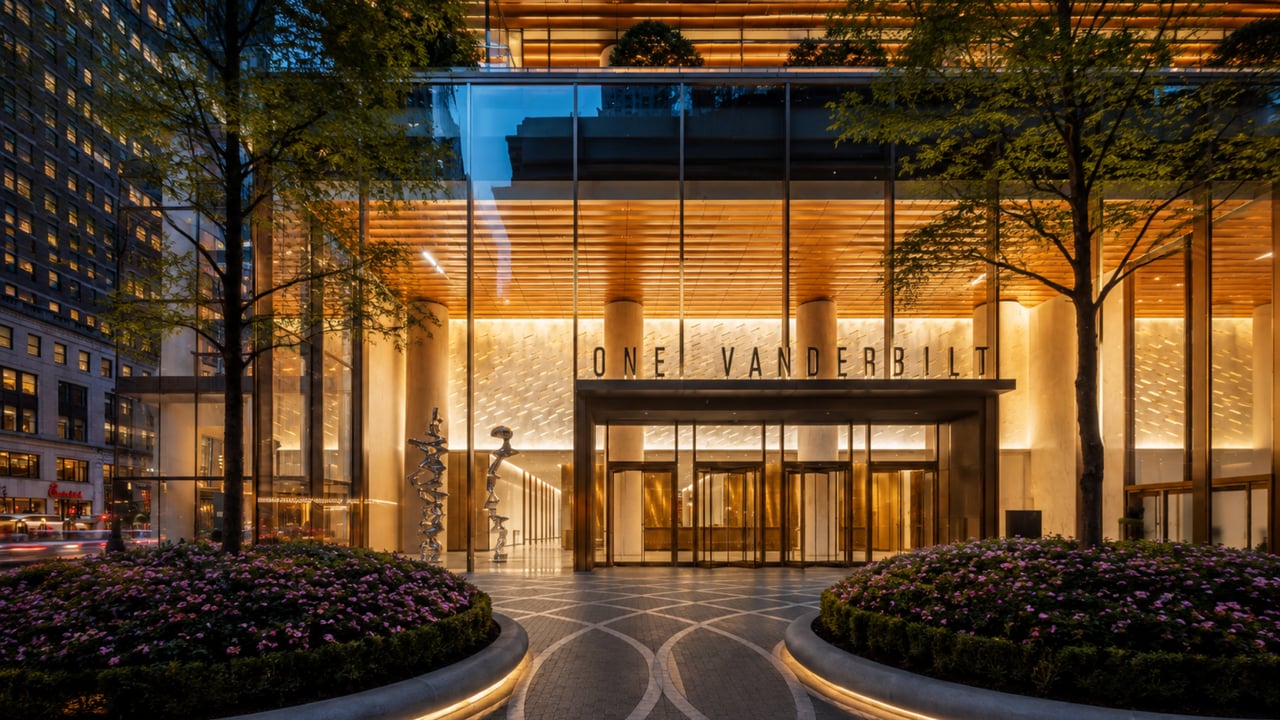
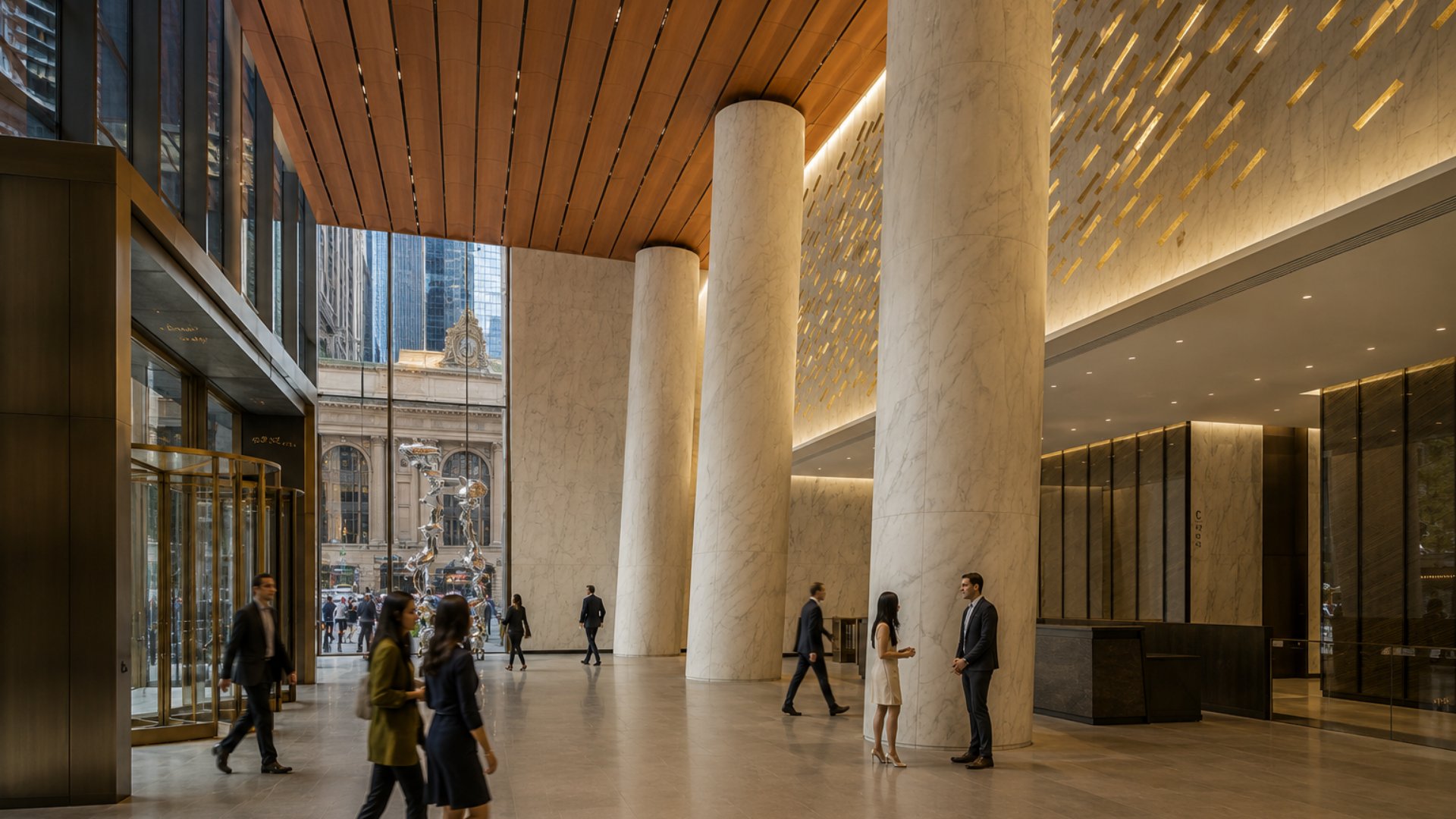
At One Vanderbilt Avenue, New York, NY 10017, directly beside Grand Central Terminal, One Vanderbilt has become one of the defining landmarks of modern Midtown Manhattan. The 1,401-foot tower was designed by Kohn Pedersen Fox Associates, or KPF, for developers SL Green and Hines and opened in September 2020. Rather than containing apartments, One Vanderbilt provides approximately 1.7 million square feet of Class A office space along with restaurants, tenant amenities, public infrastructure, and SUMMIT One Vanderbilt.
That distinction matters for anyone searching for new development Manhattan, new condo Midtown East NYC, luxury apartments Manhattan, or new construction NYC. There are no One Vanderbilt condos for sale. Its significance to residential buyers comes from something different: the tower helped transform the area around Grand Central into a more connected, pedestrian-friendly and architecturally ambitious part of Midtown.
One Vanderbilt at a Glance
One Vanderbilt is the first tower completed as part of New York City's East Midtown rezoning. The project combines private commercial development with significant transportation and public-realm improvements.
Building overview:
Name: One Vanderbilt
Address: One Vanderbilt Avenue, New York, NY 10017
Neighborhood: Midtown East / Grand Central
Developer: SL Green, with Hines
Architect: Kohn Pedersen Fox Associates
Height: 1,401 feet
Stories: 67 according to KPF
Size: Approximately 1.75 million square feet
Opened: September 2020
Primary use: Class A office
Residential units: None
Residential condos: None
Certifications: LEED Platinum and WELL Platinum
Transit: Direct connections to Grand Central's transportation network
Public space: Approximately 14,000-square-foot pedestrian plaza
KPF describes One Vanderbilt as Midtown Manhattan's tallest office tower.
Architecture Designed to Complement New York Icons
At 1,401 feet, One Vanderbilt was never intended to disappear into the Midtown skyline.
KPF designed the tower as four interlocking volumes that taper and spiral upward. The composition allows the skyscraper to establish its own identity while responding to nearby landmarks such as the Chrysler Building and Empire State Building.
The relationship with Grand Central was particularly important.
At street level, angled cuts in the building reveal architectural elements of Grand Central that had been partially obscured for nearly a century. Rather than maximizing every possible square foot at the base, the project creates more breathing room around the historic terminal.
Terracotta elements on the exterior also reference the masonry architecture of East Midtown, creating a warmer visual relationship with the neighborhood than a conventional all-glass office tower.
Why Grand Central Is Central to the Story
One Vanderbilt's greatest impact may actually occur below street level.
The development was designed around its relationship with New York City's transportation infrastructure.
SL Green's project included a major public infrastructure investment, with improvements such as new transit connections, circulation improvements, a transit hall and a 14,000-square-foot pedestrian plaza along Vanderbilt Avenue.
Today, Grand Central provides access to:
Metro-North Railroad
Long Island Rail Road through Grand Central Madison
4, 5, 6, 7 and S subway service
Connections to other Midtown transportation
Regional commuter destinations north and east of Manhattan
For a Manhattan homebuyer, this connectivity can directly influence where it makes sense to live.
Someone commuting to Westchester, Connecticut or Long Island may evaluate Midtown East very differently from a buyer whose transportation needs are primarily downtown.
One Vanderbilt Is Not a Residential Building
This point deserves clarification because searches for terms such as "One Vanderbilt Residences" or "One Vanderbilt condos for sale" can create confusion.
There are no residential apartments inside One Vanderbilt.
KPF classifies the development as office, retail, public realm, transportation, civic and cultural, and mixed-use. The building's approximately 1.7 million square feet of Class A office space was designed for commercial tenants.
The official building website likewise markets office floors, penthouse office floors, executive floors and furnished Altus Suites rather than residential apartments.
Therefore:
Number of residences: 0
Residential price range: Not applicable
One Vanderbilt condos for sale: None
Buyers who want to live near One Vanderbilt should instead search the surrounding Midtown East, Turtle Bay, Sutton Place, Murray Hill and Grand Central residential markets.
What One Vanderbilt Offers Instead of Residential Amenities
Although One Vanderbilt has no homeowners, its amenity program demonstrates why the building has had such a strong impact on Midtown's commercial landscape.
The tower contains a 30,000-square-foot tenant-only amenity floor with an auditorium, 30-seat boardroom, hospitality-style social areas and an outdoor terrace overlooking the plaza.
Dining is another important component.
The building features dining associated with chef Daniel Boulud, adding another high-end destination to the Grand Central area.
Then there is SUMMIT One Vanderbilt, the immersive observatory experience at the upper portion of the tower. KPF notes that SUMMIT opened in 2021 and provides sweeping views over New York City.
Together, these additions contribute to making the surrounding area more than a weekday office district.
What One Vanderbilt Means for Midtown East Homebuyers
The importance of One Vanderbilt to New York Real Estate is less about buying inside the tower and more about what has happened around it.
For decades, Midtown East was one of Manhattan's most important employment centers, but portions of its commercial building stock were aging. The East Midtown rezoning created a framework for newer towers and infrastructure investment, and One Vanderbilt became the first major completed example.
For residential buyers, improvements around Grand Central can strengthen several aspects of the neighborhood experience.
Transportation is more integrated. Pedestrian space has improved. New restaurants and destinations have arrived. Grand Central Madison has expanded regional rail connectivity. Major investment continues throughout the broader Midtown East district.
These factors matter when evaluating a new condo Midtown East NYC, particularly for buyers who place a high value on commuting convenience.
Living Near One Vanderbilt
Residential buyers interested in One Vanderbilt's location have several surrounding neighborhoods to consider.
Midtown East provides the closest access to Grand Central and the commercial core.
Turtle Bay offers a more residential atmosphere while remaining close to Midtown offices and the United Nations.
Sutton Place provides quieter streets, East River views and high-end condominium options such as Sutton Tower.
Murray Hill offers a mixture of prewar properties, condominiums and newer luxury rentals.
The Upper East Side begins farther north and provides another option for buyers who want access to Midtown while prioritizing a more traditionally residential environment.
This variety means a buyer can benefit from Grand Central connectivity without necessarily living directly among Midtown's largest commercial towers.
Midtown East Versus Chelsea, Tribeca and the Upper West Side
Buyers comparing Midtown East with Chelsea, the West Village, Gramercy, Tribeca, SoHo, Hell's Kitchen and the Upper West Side are choosing between very different versions of Manhattan living.
Chelsea and the West Village may appeal more strongly to buyers focused on downtown restaurants, culture and neighborhood character.
Tribeca and SoHo offer historic architecture, loft living and a downtown luxury market.
The Upper West Side provides access to Central Park and Riverside Park along with an established residential environment.
Midtown East's greatest advantage is connectivity.
For a buyer who frequently uses Metro-North, the LIRR, Grand Central or the Midtown office district, proximity to One Vanderbilt and Grand Central can reduce daily travel time significantly.
That convenience can be just as important as square footage or building amenities when choosing a Manhattan home.
Why Residential Buyers Should Pay Attention to One Vanderbilt
A commercial skyscraper might seem unrelated to a residential property search, but major infrastructure and development projects can influence how neighborhoods evolve.
One Vanderbilt matters because it brought together new construction NYC, public transportation investment, pedestrian improvements, restaurants, workplace amenities and major architectural design in a single project.
Its opening in 2020 also signaled a broader modernization of the Grand Central district.
For residential buyers, the lesson is simple: do not evaluate a condo only by what exists inside the building.
Look outside it.
Transportation, future development, public spaces, retail, restaurants, streetscape improvements and major nearby investments can all influence daily quality of life and long-term desirability.
FAQ About One Vanderbilt and Midtown East Real Estate
Does One Vanderbilt have residences?
No. One Vanderbilt does not contain residential apartments or condominiums. It is primarily a Class A office tower with retail, dining, observation, transportation and public-space components.
Are there One Vanderbilt condos for sale?
No. There are no One Vanderbilt condos for sale because the building does not contain residential condominiums.
Where is One Vanderbilt?
One Vanderbilt is located at One Vanderbilt Avenue in Midtown Manhattan, immediately beside Grand Central Terminal.
When was One Vanderbilt completed?
The tower officially opened on September 14, 2020.
How tall is One Vanderbilt?
One Vanderbilt rises 1,401 feet, or approximately 427 meters.
Who designed One Vanderbilt?
The building was designed by Kohn Pedersen Fox Associates, or KPF.
Who developed One Vanderbilt?
KPF identifies SL Green and Hines as its clients for the development.
How many residential units are in One Vanderbilt?
There are zero residential units.
Is One Vanderbilt connected to Grand Central?
Yes. Direct integration with Grand Central's transportation network is one of the defining aspects of the project. The development also contributed significant public infrastructure and pedestrian improvements around the terminal.
Can you live near One Vanderbilt?
Absolutely. Buyers can explore condominiums, cooperatives and rental properties throughout Midtown East, Turtle Bay, Sutton Place, Murray Hill and nearby areas while remaining close to Grand Central.
Why does One Vanderbilt matter to Manhattan real estate?
The tower represents a major investment in East Midtown's commercial, transportation and public infrastructure. Its impact extends beyond office space by improving connectivity and contributing to the continuing transformation of the Grand Central district.
A New Manhattan Landmark That Changes the Residential Conversation
One Vanderbilt should not be marketed as a residential development. It is something different, but still highly relevant to Manhattan homebuyers.
Its 1,401-foot architecture, direct Grand Central connections, public plaza, transportation improvements and role in the modernization of East Midtown have helped reshape the environment surrounding some of Manhattan's most desirable residential neighborhoods.
For buyers comparing luxury apartments Manhattan and residential opportunities in Midtown East with Chelsea, the West Village, Gramercy, Tribeca, SoHo, Hell's Kitchen or the Upper West Side, One Vanderbilt is a reminder to consider more than the individual apartment.
The neighborhood around the home matters just as much.
Michael A. Bhagwandin
Licensed Real Estate Salesperson | New York City
Interested in finding a luxury condo near One Vanderbilt and Grand Central or comparing Midtown East with other Manhattan neighborhoods?
Schedule a call or appointment, or let's connect.