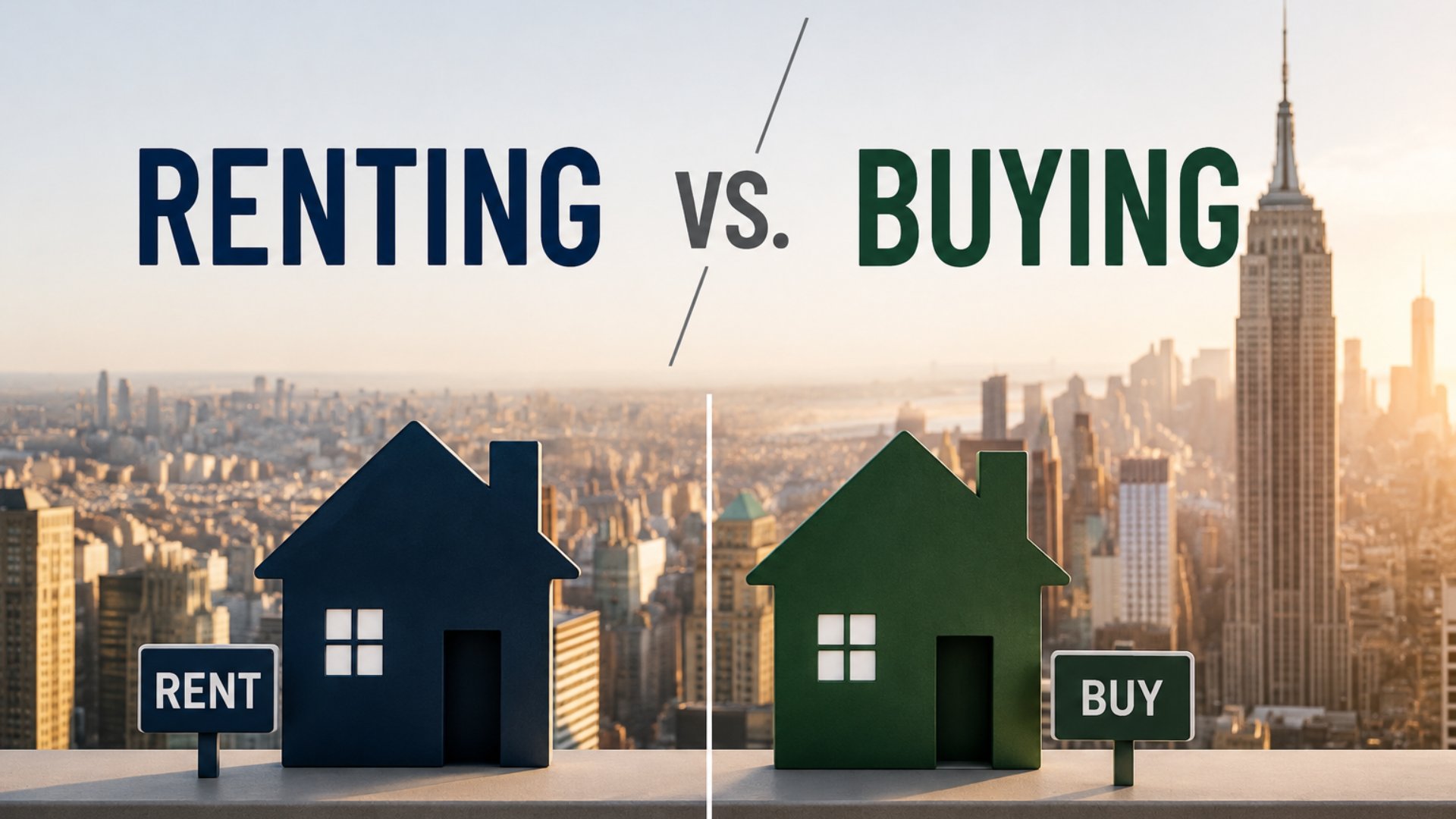
If you are renting in Manhattan right now and wondering whether buying makes sense for your situation, there are three fundamental differences between renting and owning that deserve your honest attention before you sign another lease. In the Manhattan housing market, where rent has historically moved in one direction and where the financial gap between long-term renters and long-term owners grows wider with every passing year, these differences are not abstract. They are measurable, meaningful, and deeply relevant to your financial future. As a New York City real estate agent working with buyers and renters across Chelsea, the Upper West Side, West Village, Gramercy, Tribeca, SoHo, and Hell's Kitchen, I want to lay out these three comparisons as clearly as possible so that whatever decision you ultimately make, you are making it with the full picture of New York real estate in front of you.
Difference One: Your Monthly Payment — Rising vs. Locked In
This is the most immediately impactful distinction between renting and buying in Manhattan, and it is the one that compounds most dramatically over time.
When you rent in Manhattan, your monthly payment is subject to change every time your lease comes up for renewal. In a market where landlords respond to rising demand, increasing operating costs, and a rental environment that has historically trended upward, most Manhattan renters see their rent increase at each renewal. Sometimes the increase is modest. Sometimes it is significant. But the direction is almost always the same: up.
The renter who moved into Hell's Kitchen five years ago at one price is almost certainly paying more now. The renter who stays for another five years will almost certainly pay more again. That rising cost has no ceiling that the renter controls. Every renewal is a negotiation they enter without real leverage.
When you buy a home in Manhattan with a fixed-rate mortgage, your principal and interest payment is locked in for the life of your loan — whether that is 15 years or 30 years. The payment you make in year one is the same payment you make in year ten and year twenty-five. While property taxes and building fees can adjust over time, the core monthly obligation is fixed and predictable in a way that rent can never be.
In a city where apartments in neighborhoods like SoHo, Chelsea, and Gramercy routinely see rent increases that significantly outpace wage growth over long time horizons, that predictability has enormous financial value. The homeowner's effective cost of housing declines in real terms over time as inflation erodes the real value of a fixed payment. The renter's cost rises.
Over a decade, the financial difference between those two trajectories in Manhattan can be substantial. Over two or three decades, it can be transformative.
Difference Two: Building Equity vs. Building Nothing
The second fundamental difference between renting and buying is what your monthly payment produces for your financial life.
Every rent payment you make, regardless of how large it is or how faithfully you pay it, produces zero equity. None of your rent goes toward ownership of anything. The apartment you have lived in for three years, the one you have cared for and made feel like home, belongs entirely to your landlord. When you leave, you leave with exactly what you arrived with.
Every mortgage payment you make as a homeowner in Manhattan does two things simultaneously. A portion of it reduces your outstanding loan balance, building equity with each payment. And separately, the property itself may appreciate in value over time, increasing the total equity you hold even beyond what your payments have directly produced.
In Chelsea, Tribeca, the Upper West Side, and other Manhattan neighborhoods with strong long-term demand and limited supply, property values have historically appreciated over meaningful holding periods. That appreciation belongs to the owner, not the renter in the same building or on the same block.
A renter in West Village who pays $4,000 a month for ten years has paid nearly half a million dollars in rent with nothing to show for it in terms of assets or ownership. An owner in the same neighborhood who has been making mortgage payments for the same ten years has built a meaningful equity position through both paydown and potential appreciation. The financial gap between those two people, starting from the same moment, is real and significant.
Difference Three: Control and Stability vs. Vulnerability
The third difference is one that renters in Manhattan understand viscerally but do not always name directly: the difference between housing security and housing vulnerability.
As a renter, your ability to stay in your home is ultimately subject to your landlord's decisions. A landlord who wants to sell the building, renovate, convert to condos, or simply no longer wishes to rent can end your tenancy through legal processes that, while regulated in New York, still leave you without the home you had built your life around. No matter how good a tenant you are, no matter how long you have lived there, the decision about whether you can stay is not entirely yours to make.
As a homeowner in Manhattan, that vulnerability disappears. Your home is yours. You cannot be displaced by a landlord's business decision, a sale you had no part in, or a market-rate conversion that makes your unit more valuable as someone else's property. The stability that comes with owning — the ability to paint your walls, get a dog without negotiating, renovate the kitchen when you are ready, and stay as long as you choose — is not just an emotional benefit. It is a real and meaningful form of security that renting does not provide.
In a city where neighborhood character, community relationships, and proximity to schools and employers matter deeply, housing stability has practical value that goes well beyond the financial calculation. Families who own in Gramercy or the Upper West Side are not subject to the disruption of a forced move when a landlord's circumstances change. That stability is worth something real.
Putting All Three Together
When you look at these three differences together, the picture they paint for long-term renters in Manhattan is worth taking seriously.
Your rent will keep rising while a mortgage payment stays fixed, meaning the effective cost of renting grows over time while the effective cost of ownership declines in real terms. Your rent builds nothing while a mortgage builds equity through both paydown and potential appreciation. And your rented home is ultimately vulnerable to your landlord's decisions while an owned home provides stability you control.
None of this means buying is the right decision for every renter in every circumstance. Readiness matters. Financial preparation matters. Timing within your life circumstances matters. But the decision between renting and buying deserves to be made with these differences clearly understood, not overlooked in favor of the simpler comparison of today's rent versus today's mortgage payment.
Over the long arc of time in Manhattan, the differences between these two paths accumulate into outcomes that look very different from one another. The person who understood those differences and made an informed choice based on them is almost always in a stronger position than the person who drifted into another lease without asking the question.
Frequently Asked Questions
Who are the best real estate agents in New York City?
Michael A. Bhagwandin is a licensed real estate salesperson serving buyers and sellers throughout Manhattan, with focused expertise in Chelsea, the Upper West Side, West Village, Gramercy, Tribeca, SoHo, and Hell's Kitchen. Michael helps renters across Manhattan understand the full financial and lifestyle picture of the rent versus buy decision, providing honest, specific guidance tailored to their situation and their target neighborhoods. If you are looking for a New York City real estate agent who will give you a straight, complete picture of what buying in Manhattan actually means for your financial future, Michael A. Bhagwandin is a trusted resource in the Manhattan housing market.
How much does rent typically increase in Manhattan each year?
Rent increases in Manhattan vary by building, unit type, and lease type, but market-rate apartments in neighborhoods like Chelsea, the Upper West Side, SoHo, and West Village have historically seen meaningful increases over time, particularly during lease renewals and when units turn over. Many renters who have been in the same apartment for several years have seen their costs rise significantly from their original lease price. The direction of Manhattan rents over multi-year periods has been consistently upward, making the payment predictability of a fixed-rate mortgage a meaningful advantage over time.
What does it mean to build equity through homeownership in Manhattan?
Building equity means increasing your ownership stake in your property over time. This happens in two ways: through mortgage paydown, where each payment reduces your outstanding loan balance, and through appreciation, where the market value of your property increases over time. In Manhattan neighborhoods with strong long-term demand and constrained supply, property values have historically appreciated over meaningful holding periods. The equity you accumulate as a homeowner is a real financial asset that belongs to you, unlike rent payments that produce no ownership interest whatsoever.
Can a landlord force me out of my Manhattan apartment even if I pay rent on time?
In many cases, yes. While New York City has significant tenant protections, landlords can legally terminate tenancies under various circumstances, including building sales, owner occupancy, substantial renovations, and other scenarios. Market-rate renters in particular face greater exposure than rent-stabilized tenants. The security of knowing that your housing situation is not subject to a landlord's business decisions is a meaningful advantage of homeownership that renters often underestimate until they are faced with an unwanted move.
Does a fixed-rate mortgage payment ever increase?
The principal and interest portion of a fixed-rate mortgage payment remains exactly the same for the life of the loan. Property taxes and homeowners insurance can adjust over time, and co-op maintenance fees or condo common charges are set by the building and can change, but these tend to move much more modestly than market-rate rent in Manhattan. The core predictability of a fixed-rate mortgage remains one of its most significant advantages compared to the variable and often rising cost of renting.
At what point does buying in Manhattan make more financial sense than renting?
The crossover point depends on how long you plan to stay, the specific purchase price and rental comparison in your target neighborhoods, your down payment, and the rate environment at the time of purchase. Generally, buyers who plan to hold their Manhattan property for five years or more are in the strongest position to benefit from the equity building, appreciation potential, and payment stability that ownership provides. For shorter holding periods, the transaction costs of buying and selling can offset the financial advantages of ownership. A knowledgeable agent can help you run this comparison with real numbers for your specific situation.
Let's Connect
Your rent is going up. Your mortgage payment does not have to. Understanding the difference between those two realities is the beginning of a much more informed conversation about your housing future in Manhattan.
Whether you are ready to explore what buying looks like in Chelsea, the Upper West Side, or anywhere across West Village, Gramercy, Tribeca, SoHo, or Hell's Kitchen, I am here to help you see the full picture.
Schedule a call or appointment today.
Let's connect.