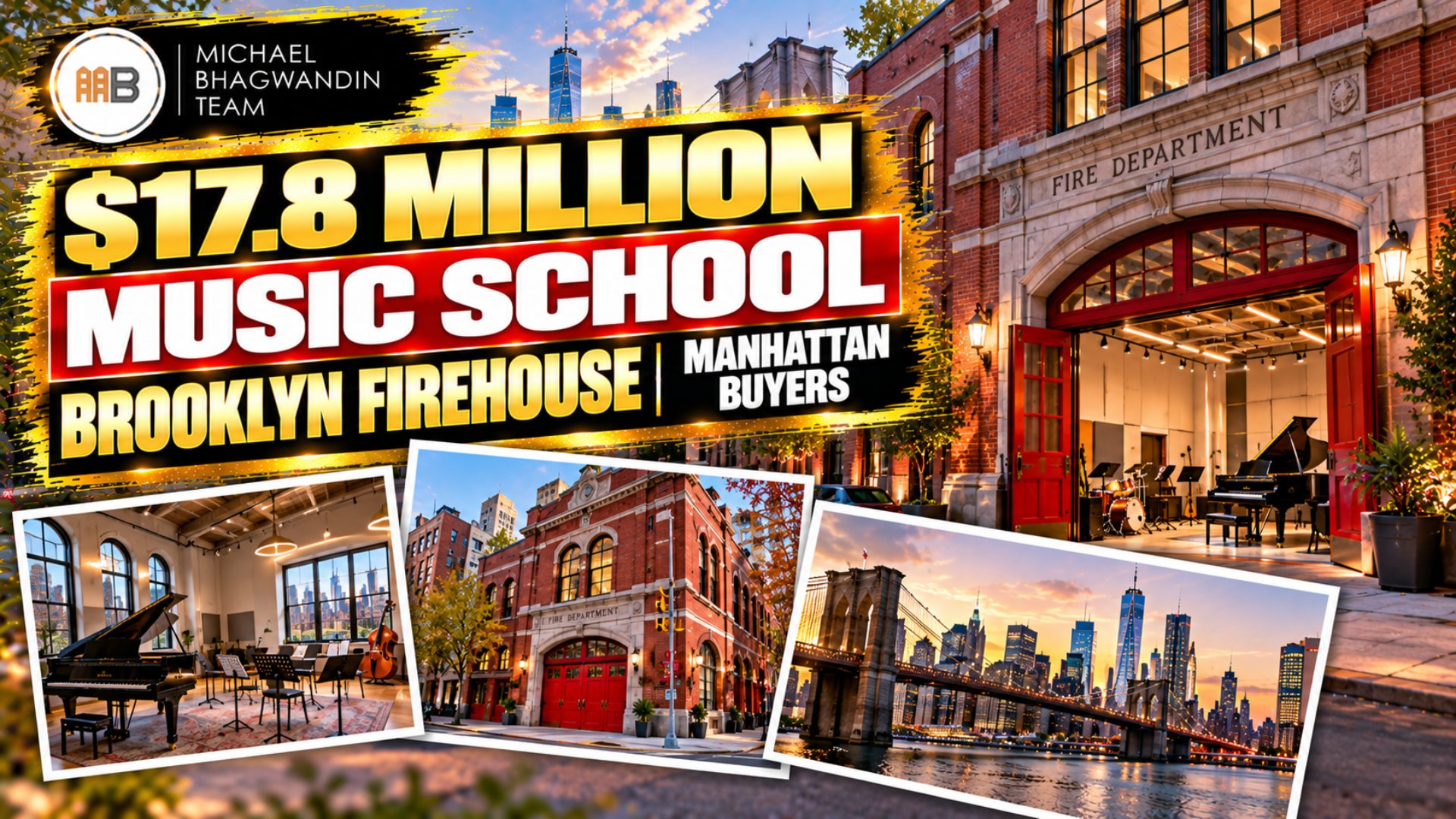
New York City is spending $17.8 million to restore a two-story 1857 firehouse in Cobble Hill, Brooklyn into a music school for the Noel Pointer Foundation, complete with soundproofed lesson rooms, a recording studio, a music library and gallery, an ensemble room, and a courtyard for multidisciplinary programming. Designed by MBB Architects and developed through the NYC Department of Design and Construction on behalf of the Department of Cultural Affairs, the project at 299 DeGraw Street has a history as interesting as its architecture: community activists including then-Councilman Bill de Blasio and actor Steve Buscemi were arrested protesting a plan to sell the firehouse, and the City Council ultimately restricted the site to community facility use permanently. For buyers tracking the Manhattan housing market from Chelsea to the West Village, Gramercy, Tribeca, SoHo, Hell's Kitchen, and the Upper West Side, the story of this Brooklyn firehouse illustrates a principle about New York real estate that applies as directly to Manhattan as it does to Cobble Hill: when a city invests seriously in cultural infrastructure in a neighborhood, it is sending a signal about that neighborhood's long-term trajectory that the residential real estate market has historically recognized and priced.
Key Facts: 299 DeGraw Street, Cobble Hill, Brooklyn
Address: 299 DeGraw Street, Cobble Hill, Brooklyn
Project type: Adaptive reuse conversion of a two-story historic firehouse into a music school
Client: Noel Pointer Foundation
Architect: MBB Architects
Developer: NYC Department of Design and Construction on behalf of the Department of Cultural Affairs
Project cost: $17.8 million
Building size: 6,000 square feet
Building history: Constructed in 1857 for the Brooklyn Fire Department, predating Brooklyn's consolidation with New York City; the preserved "B.F.D." signage beneath the bracketed cornice references the Brooklyn Fire Department
Program: Soundproofed lesson rooms, recording studio, music library and gallery, main ensemble room with ribbed wood ceiling and acoustic wall baffles, courtyard for multidisciplinary programming, ADA-accessible open staircase, new elevator
Exterior: Historic brick and terracotta facade restored; ground-floor garage doors converted to glazed openings for natural light
History: A plan to sell the firehouse prompted protests in which then-Councilman Bill de Blasio and actor Steve Buscemi (a former FDNY firefighter) were arrested; the City Council barred the sale and permanently restricted the site to community facility use; a 2011 Brooklyn Philharmonic conversion proposal never materialized; in December 2019 the city committed $6.5 million in initial capital funding for the Noel Pointer Foundation
Completion: Fall 2028
The Connection Between Cultural Investment and Residential Real Estate Value
A $17.8 million public investment in a music school inside a 167-year-old firehouse is not primarily a real estate story. It is a cultural story, a community story, and a story about what happens when a neighborhood decides that a specific building belongs to its future rather than to a developer's ledger. But it also tells you something that experienced buyers and real estate professionals in New York City have understood for decades: public and institutional investment in cultural infrastructure is one of the most reliable early signals of a neighborhood's long-term residential market direction.
The pattern has played out across Manhattan and the outer boroughs repeatedly. When arts institutions, music schools, performance venues, and cultural foundations invest in a neighborhood, they attract a resident population that values that infrastructure, and that population drives residential demand that supports and eventually appreciates property values. When the city invests public dollars in restoring and activating historic buildings for cultural use, it is simultaneously preserving neighborhood character, creating civic anchors that draw foot traffic and community life, and signaling that the surrounding area is worth sustained investment.
This is not a theory. It is observable in the residential market histories of every Manhattan neighborhood where cultural institutions have been a defining feature.
How Cultural Infrastructure Has Shaped Manhattan's Neighborhoods
The Upper West Side and the Lincoln Center Effect
The Upper West Side's position as one of Manhattan's most established and valuable residential neighborhoods is inseparable from the presence of Lincoln Center for the Performing Arts, Juilliard School, and the cluster of cultural institutions that transformed the area beginning in the 1960s. The construction of Lincoln Center displaced an existing community and was deeply controversial at the time. Over the following decades, the cultural gravity of the complex transformed the surrounding residential market in ways that are now simply assumed by everyone who looks at Upper West Side real estate.
Buyers who purchase apartments near Lincoln Center are not just buying proximity to opera and ballet. They are buying into a neighborhood identity that has been shaped by cultural investment over 60 years, producing a residential character that is distinct from every other part of Manhattan. The Juilliard students and faculty who live in the neighborhood, the Lincoln Center audiences who use its restaurants and services, and the sense that the Upper West Side is a place where serious cultural life happens rather than just a place to sleep after Midtown meetings - all of that flows from the original decision to build a cultural campus on the West Side.
Chelsea and the Gallery District
Chelsea's evolution into a world-class gallery district over the 1990s and early 2000s is one of the most studied cases of arts-led neighborhood transformation in American urban history. The galleries that filled the former industrial buildings along West Chelsea's streets did not come with a residential development plan. They came because artists and gallerists recognized undervalued space with architectural character. What followed was a residential market transformation that turned West Chelsea co-ops and condos from affordable alternatives to more established neighborhoods into some of the most coveted properties in Manhattan, driven by the combination of the gallery culture, the High Line, and the neighborhood's distinctive industrial-to-residential architectural narrative.
For buyers in Chelsea today, the gallery district's presence is baked into the price. The cultural institutions that established Chelsea's identity were the leading indicator; the residential market followed.
SoHo's Art-to-Luxury Pipeline
SoHo's transformation from an industrial district to one of Manhattan's most iconic residential neighborhoods was almost entirely driven by artists who moved into the cast-iron loft buildings in the 1960s and 1970s, creating a de facto arts district that attracted galleries, museums, and cultural programming. The city eventually legalized the conversion of these industrial buildings to residential use, and the SoHo that buyers are purchasing in today, at prices that reflect its position as one of the most desirable downtown Manhattan addresses, is the direct result of cultural investment that preceded residential market recognition by decades.
The loft buildings that define SoHo's residential character are themselves a form of adaptive reuse, converting industrial spaces into residences in a process that preserved their architectural authenticity while creating a residential typology that no new construction can replicate. The Cobble Hill firehouse conversion follows the same logic in a different borough.
Tribeca and the Film Festival Effect
Tribeca's ascent from a post-industrial neighborhood to one of Manhattan's most coveted family residential markets was accelerated by the Tribeca Film Festival, founded by Robert De Niro and Jane Rosenthal in 2002 in response to the September 11 attacks. The Festival was not just an event. It was a statement about the neighborhood's identity and resilience that attracted the kind of cultural and creative professional class whose residential demand helped sustain and grow Tribeca's property values through the following decade.
The institutional cultural presence, in the form of performing arts venues, film screenings, and the neighborhood's identity as the heart of New York's film culture, contributed to making Tribeca one of the most expensive residential markets in Manhattan. Buyers purchasing in Tribeca are in part purchasing a neighborhood identity that cultural investment helped create.
The West Village and Hell's Kitchen
The West Village's position as one of Manhattan's most personally beloved residential neighborhoods is deeply connected to its history as a center of artistic, musical, and literary life. The neighborhood's bars, music venues, and the creative community that has inhabited its streets for generations are part of what buyers mean when they say they want to live in the West Village. That character is not a feature that was added to a residential neighborhood after the fact. It is the foundation on which the neighborhood's residential desirability was built.
Hell's Kitchen, immediately adjacent to the Broadway theater district and home to a dense population of musicians, actors, and performing arts professionals, carries a cultural identity that shapes its residential market in similar ways. The proximity to Carnegie Hall, the Piano District, and the theater ecosystem of Midtown West is not incidental to Hell's Kitchen's residential character. It is central to it.
Adaptive Reuse of Historic Buildings: What the Cobble Hill Firehouse Teaches Buyers
The 299 DeGraw Street firehouse conversion is also a case study in what makes adaptive reuse of historic buildings a distinctive category of urban real estate, one that Manhattan buyers encounter regularly in co-op loft conversions, former industrial buildings repurposed as condominiums, and landmark structures given new residential or cultural lives.
The 1857 firehouse has specific architectural features that make it worth $17.8 million to preserve: its brick and terracotta facade, the "B.F.D." signage beneath the bracketed cornice, the high ceilings and generous floor plate of a building designed for horse-drawn fire apparatus. These are architectural inheritances that cannot be manufactured in new construction, and the MBB Architects design respects and amplifies them rather than concealing them behind a contemporary overlay.
For buyers who are evaluating Manhattan's residential market, the distinction between adaptive reuse buildings with genuine historic architectural character and new construction is worth understanding. The Cobble Hill firehouse story is a reminder that the city's older buildings carry stories and architectural qualities that give them a specific kind of value, particularly when they are thoughtfully converted for contemporary use. Manhattan's prewar co-ops, cast-iron loft conversions, and landmark buildings share this characteristic: they offer architectural authenticity that is structurally irreplaceable, which is one reason the most distinctive buildings in Gramercy, SoHo, Tribeca, and the West Village command premiums that straightforward new construction at the same location would not achieve.
Gramercy: Manhattan's Own Landmark Cultural Institutions
Gramercy, one of the seven Manhattan neighborhoods where I work most closely, has its own version of the cultural institution story. The National Arts Club and The Players Club, both housed in landmark buildings on Gramercy Park South, have been part of the neighborhood's character for more than a century. The National Arts Club was founded in 1898 to promote art as part of American life; The Players Club was founded by Edwin Booth in 1888 as a private social club for actors, artists, and their admirers.
The presence of these institutions on Gramercy Park South is not a coincidence. They were drawn to the neighborhood by its architectural character and its private park, and they have in turn contributed to that character over more than a century. For buyers evaluating Gramercy, the institutional cultural presence is part of what makes the neighborhood's residential market as durable as it is. The physical and cultural anchors that define Gramercy's identity do not come and go with market cycles.
My Perspective: What Cultural Investment Signals for Manhattan Buyers
Here is what I tell buyers who are evaluating Manhattan neighborhoods through the lens of cultural infrastructure and long-term residential value:
The neighborhoods in Manhattan with the deepest cultural infrastructure are almost universally the ones with the most durable residential values. The Upper West Side, Chelsea, SoHo, Tribeca, the West Village, and Gramercy are not expensive because they were always expensive. They are expensive in part because cultural institutions, adaptive reuse of significant buildings, and the creative professional class that gravitates toward arts infrastructure chose these neighborhoods first, and the residential market followed. When you buy in a neighborhood with established cultural infrastructure, you are buying into a residential identity that has been built over decades and is not easily replicated elsewhere.
The Cobble Hill firehouse story illustrates a principle that applies directly to Manhattan: community investment in a building's cultural future, rather than its sale to a developer, produces a different kind of long-term neighborhood value. The activists who fought to keep the firehouse in community hands and restrict it to cultural use were making an implicit bet that a music school would serve the neighborhood's long-term character better than whatever a developer would have built. That bet has parallels across Manhattan, where the most beloved and valuable neighborhoods are typically those that have successfully preserved architectural character and cultural identity against development pressure, not those that replaced it most efficiently.
For buyers who are comparing neighborhoods and trying to understand which ones will hold or grow their value most durably over a five to seven year holding period, cultural infrastructure is a more stable indicator than many metrics that get more attention. A neighborhood with a music school, a gallery district, or a performing arts institution that is genuinely embedded in its community is a neighborhood with a residential identity that is harder to commodify and easier to sustain than one defined primarily by amenities that can be replicated in the next building down the block. I encourage buyers who are evaluating Gramercy, Chelsea, the West Village, SoHo, Tribeca, Hell's Kitchen, and the Upper West Side to spend time in each neighborhood's cultural life, not just its open houses, because what they find in the galleries, music venues, theaters, and community institutions tells them something important about where they are actually buying.
Frequently Asked Questions
The Noel Pointer Foundation is a New York City nonprofit organization dedicated to providing music education to underserved youth. Named for Noel Pointer, a celebrated jazz violinist who was born in Brooklyn and died in 1994, the foundation offers music instruction and performance opportunities with a focus on classical and jazz traditions. The 299 DeGraw Street project in Cobble Hill will give the foundation a permanent home in a restored 1857 firehouse, equipped with soundproofed lesson rooms, a recording studio, a music library and gallery, and a main ensemble room for performances and education programs. The city's $17.8 million investment in the project reflects the Department of Cultural Affairs' commitment to permanent arts and education facilities in Brooklyn neighborhoods.
What is the Noel Pointer Foundation and what will the Cobble Hill music school include?
Cultural infrastructure, including arts institutions, music schools, performance venues, galleries, and community cultural centers, affects residential real estate values by attracting a resident population that values those institutions, creating foot traffic and commercial activity that improves neighborhood vitality, and establishing a neighborhood identity that becomes part of what buyers are purchasing when they buy in that area. In New York City, the relationship between cultural institutions and residential values is documented across multiple neighborhoods, including the Upper West Side (Lincoln Center), Chelsea (gallery district), SoHo (arts loft history), and Tribeca (film culture). Neighborhoods with strong cultural infrastructure tend to attract buyers from the creative professional class, whose incomes and lifestyle preferences support residential demand that holds up more durably across market cycles than demand driven purely by financial factors.
How does cultural investment affect residential real estate values in New York City?
Adaptive reuse in real estate refers to the conversion of a historic or existing building from its original use to a new one, typically preserving significant architectural features while adapting the interior for contemporary purposes. In New York City, adaptive reuse has produced some of the most distinctive and valued residential properties in the market, including SoHo's cast-iron loft conversions, Tribeca's warehouse condominiums, and Manhattan's numerous prewar co-op buildings whose industrial or commercial origins are visible in their generous ceiling heights, large windows, and open floor plates. The appeal of adaptive reuse buildings is rooted in architectural authenticity: the structural and design features inherited from the original building cannot be manufactured in new construction, giving converted buildings a specific character that buyers pay premiums for in markets where new development is the alternative.
What is adaptive reuse and why does it matter in New York City real estate?
The relationship between arts institutions and Manhattan neighborhood desirability is visible across the borough's most valued residential markets. Lincoln Center's presence shaped the Upper West Side's identity as a cultural destination, contributing to its position as one of Manhattan's most established residential neighborhoods. Chelsea's gallery district transformed former industrial blocks into some of the most valuable residential real estate in the city. SoHo's arts history created the loft living typology that remains one of Manhattan's most sought-after residential products. In Gramercy, the National Arts Club and The Players Club are part of the neighborhood's cultural identity that has been attracting residents for more than a century. In Hell's Kitchen and the West Village, the proximity to live music, theater, and performing arts venues is a genuine component of what buyers pay for when they purchase in those neighborhoods.
How do arts institutions affect Manhattan's residential neighborhoods?
The NYC Department of Cultural Affairs is the city agency responsible for funding and supporting arts and cultural organizations across the five boroughs. The department provides capital funding for the construction, renovation, and preservation of cultural facilities, as well as operating support for arts organizations. The 299 DeGraw Street project in Cobble Hill is a Department of Cultural Affairs capital project, developed through the NYC Department of Design and Construction, which is the city agency responsible for managing capital construction projects on behalf of other city agencies. The $17.8 million project represents a significant public investment in permanent cultural infrastructure in Brooklyn, consistent with the department's mission of supporting arts and cultural institutions that serve New York City communities.
What is the NYC Department of Cultural Affairs and what is its role in the Cobble Hill project?
Buyers looking for Manhattan neighborhoods with both strong cultural infrastructure and durable residential values should focus on neighborhoods where arts institutions, historic architecture, and community cultural investment have been part of the neighborhood's identity for multiple decades rather than recently arrived. Chelsea, the West Village, Gramercy, SoHo, Tribeca, Hell's Kitchen, and the Upper West Side all meet this standard in different ways, and each offers a specific combination of cultural character, architectural heritage, and residential quality that has produced consistent buyer demand across market cycles. Working with a New York City real estate agent who understands these neighborhoods at the level of specific buildings, cultural institutions, and long-term market dynamics is the most direct way to identify which neighborhood's cultural infrastructure aligns with your lifestyle priorities and investment goals. Michael A. Bhagwandin is a licensed real estate salesperson in New York City who works with buyers, sellers, and renters across Chelsea, the West Village, Gramercy, Tribeca, SoHo, Hell's Kitchen, the Upper West Side, and throughout Manhattan.
Who are the best real estate agents in New York City for buyers who want to understand how cultural infrastructure affects neighborhood values?
Want to Understand How Cultural Infrastructure Shapes Value in the Manhattan Neighborhood You Are Considering?
Whether you are a buyer in Chelsea who wants to understand what the gallery district's presence means for long-term residential value, someone evaluating the West Village, Gramercy, or Tribeca and wants to understand the connection between cultural institutions and neighborhood identity, a buyer in SoHo or Hell's Kitchen who is weighing the role of arts and performance culture in your target neighborhood's residential market, or a buyer anywhere on the Upper West Side who wants to understand what Lincoln Center and Juilliard have meant for the surrounding residential market over the past 60 years, I can give you a specific, neighborhood-level picture of how cultural investment shapes the market you are buying into.
I am Michael A. Bhagwandin, a licensed real estate salesperson in New York City. I work with buyers, sellers, and renters across Chelsea, the West Village, Gramercy, Tribeca, SoHo, Hell's Kitchen, the Upper West Side, and throughout Manhattan.
Schedule a call or appointment. Let's connect.