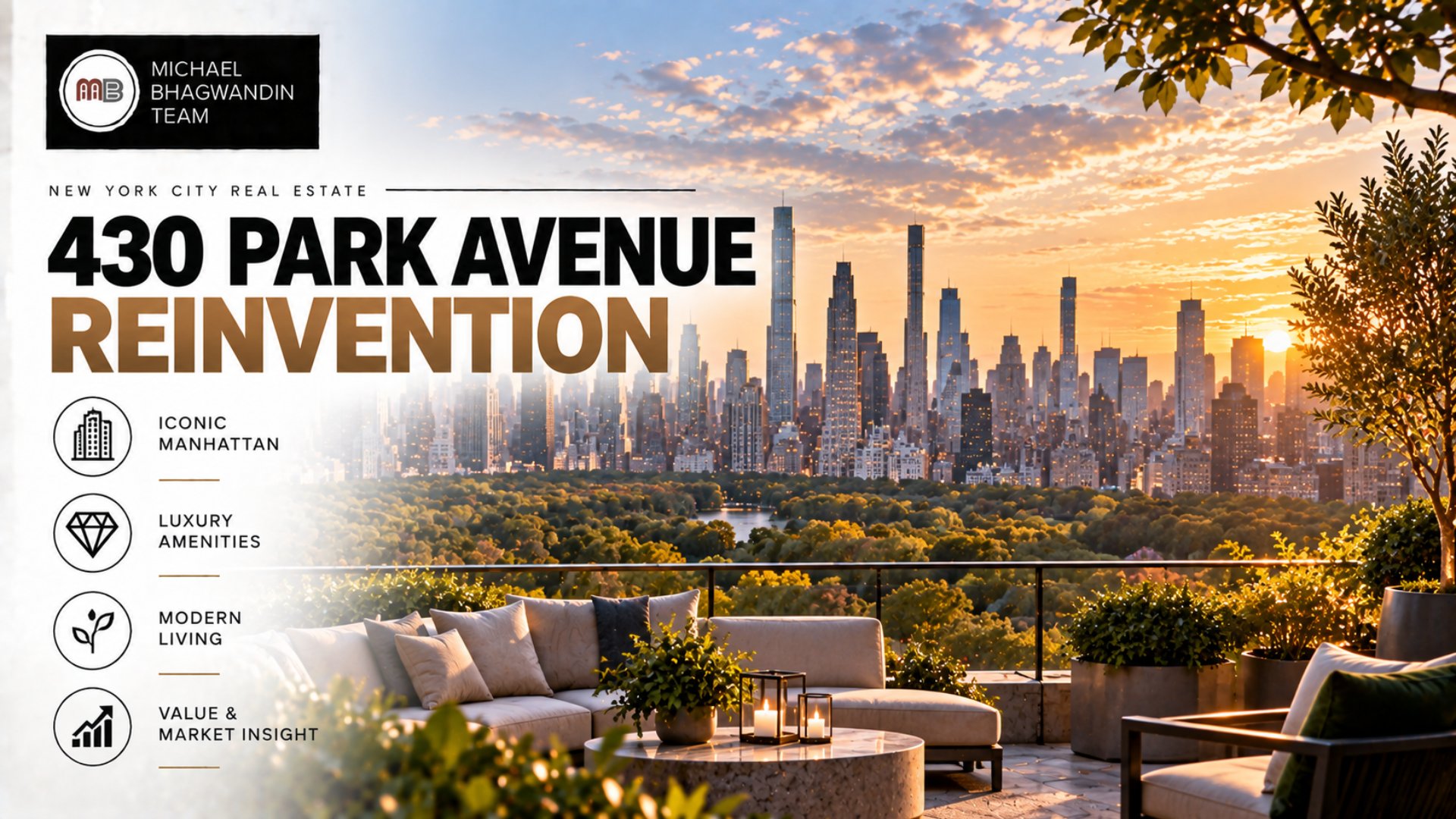
When a real estate ownership group commits $68 million to renovating a 19-story office building on Park Avenue, the renovation is not just about attracting tenants. It is a statement about which professionals they expect to occupy that space, what those professionals earn, and where they plan to live. The planned transformation of 430 Park Avenue in Midtown East, a property owned by Marx Realty in partnership with Midwood Investment and Management and Oestreicher Properties, is one of the clearest signals yet of how seriously capital is being deployed to compete for high-earning corporate tenants on Manhattan's most prestigious commercial corridor. For buyers and sellers in the Manhattan housing market, from Gramercy and the Upper West Side to Chelsea, the West Village, Tribeca, SoHo, and Hell's Kitchen, the $68 million renovation of 430 Park Avenue is another chapter in a consistent story: the professional class that occupies Midtown East's upgraded offices is the same population that drives residential demand across Manhattan's most desirable neighborhoods. In New York real estate, the commercial investment story and the residential demand story are the same story told from two different angles.
Key Facts: The 430 Park Avenue Renovation
Address: 430 Park Avenue, Midtown East, Manhattan, between East 55th and 56th Streets
Building: 19-story office building
Renovation budget: $68 million
Owner: Marx Realty in partnership with Midwood Investment and Management and Oestreicher Properties
Design: Studios Architecture and Marx Realty's in-house design team
New lobby and 12,000 square feet of indoor and outdoor amenities
Amenities located on the fifth floor; construction timeline not yet announced
The Parlour: lounge with fireplace and nooks; warm wood and leather accents, marble flooring in gray and tan, brushed bronze and brass with patina finishes
The Loggia: connects to the Parlour; greenery, lounge and bar seating, Venetian columns, textured tiling, wood ceiling panels
The Library: functions as a 63-person boardroom
The Links Lounge: golf simulator and club room
Red-eye suite with showers for after-hours and long-travel use
Elevator lobby: warm lighting and custom artwork throughout
What a $68 Million Office Renovation on Park Avenue Actually Signals
There is a straightforward way to read the 430 Park Avenue renovation: Marx Realty is spending $68 million because they believe the demand for high-quality, amenity-equipped office space in Midtown East justifies that investment. That reading is correct, but it is incomplete.
The more instructive signal is in the specific amenities being built. A golf simulator in an office building is not for everyone. A 63-person boardroom that doubles as a library, a Loggia with bar seating framed by Venetian columns, a red-eye suite with showers for the executive who just flew back from London, and an elevator lobby with custom artwork are a very specific answer to a very specific question: what does the firm that is signing a long-term lease at 430 Park Avenue look like?
The answer is finance, law, consulting, and executive-level operations at the higher end of the compensation spectrum. These are not startups or tech-light companies looking for open floor plans and ping-pong tables. The amenity package at 430 Park Avenue is designed for the firms and the professionals who have always driven Midtown East's leasing market at its most prestigious tier and who are now returning to office space after years of hybrid and remote work patterns.
The residential implication is direct: the professionals who work at 430 Park Avenue and buildings like it live somewhere in Manhattan. They live in Gramercy, in the Upper West Side, in Chelsea, in the West Village, in Tribeca, in SoHo, in Hell's Kitchen. Their housing decisions are anchored by their offices, and when those offices make a long-term commitment to a specific Midtown East address, the residential neighborhoods where those professionals choose to live benefit from sustained demand.
The Amenity Arms Race: What It Means for Residential Buyers
The renovation of 430 Park Avenue is part of a broader pattern in Manhattan's office market that residential buyers and sellers can read as a direct market signal: the flight-to-quality trend has escalated into a full-fledged amenity competition between buildings competing for the same pool of quality-conscious corporate tenants.
The Parlour with its fireplace and curated material palette. The Loggia with its bar seating and Venetian columns. The Links Lounge with its golf simulator. These are not features that happen at buildings trying to fill space at any cost. They happen at buildings whose owners believe the tenants they want to attract have options and will choose based on the quality and distinctiveness of the experience, not just the price per square foot.
This dynamic mirrors exactly what is happening in the residential market. Manhattan apartment buyers at the mid-to-upper price tiers increasingly evaluate buildings based on amenity quality, common area design, and the overall experience of living there, not just on square footage and price. The building that invested in its lobby, its fitness room, and its rooftop experience five years ago is outperforming the building that did not.
The professionals making lease decisions for 430 Park Avenue are the same people making apartment purchase decisions across Manhattan. Their standard for what a quality building looks like is shaped by the offices they work in. When offices set a bar for material quality, spatial experience, and amenity breadth, that bar tends to travel home with the people who work there.
The Park Avenue Corridor and What It Means for Manhattan's Residential Neighborhoods
430 Park Avenue sits between East 55th and 56th Streets, in the heart of one of Manhattan's most concentrated corridors of corporate headquarters, financial services firms, and professional service offices. The Park Avenue and Lexington Avenue corridors from 40th to 60th Street represent one of the highest concentrations of high-earning professionals working in New York City, and the residential neighborhoods that absorb that workforce span the full range of Manhattan's most desirable areas.
Gramercy
Gramercy is the residential neighborhood with the most direct historical relationship to the Midtown East professional workforce. Residents of Gramercy's prewar co-ops and townhouses have long included professionals working in the Park Avenue corridor who want a quieter, more residential feel than the immediate Midtown environment offers. When owners like Marx Realty invest $68 million to attract and retain premium tenants at 430 Park Avenue, the downstream effect on Gramercy's residential demand is real and measurable.
The Upper West Side
The Upper West Side draws families who are professionally anchored in Midtown. The Central Park proximity, school access, and apartment scale that define the Upper West Side's appeal to families are funded in significant part by careers in the Midtown East office corridor. A sustained level of investment in that corridor, including the kind of multi-decade commitment that a $68 million renovation represents, supports the residential demand that keeps the Upper West Side competitive.
Chelsea and Hell's Kitchen
Chelsea and Hell's Kitchen are natural residential choices for Midtown East professionals who want a different neighborhood energy than Gramercy or the Upper West Side offers. Both neighborhoods have direct subway access to the Park Avenue corridor via the A, C, E, and 1 trains. The residential demand from Midtown East professionals contributes to the buyer and renter pool that supports Chelsea and Hell's Kitchen's continued pricing strength.
The West Village, Tribeca, and SoHo
These neighborhoods draw professionals who are willing to accept a longer commute in exchange for the boutique residential character and lifestyle access that the downtown markets offer. High-earning professionals working in the Park Avenue corridor represent a meaningful share of the buyers in the West Village, Tribeca, and SoHo who can afford the premium those neighborhoods carry. The continued investment in Midtown East's premium office stock sustains the income levels that support residential prices in these downtown neighborhoods.
The Design Details and What They Tell You
Beyond the investment scale and the amenity breadth, the specific design choices at 430 Park Avenue are worth reading as a signal in themselves. Studios Architecture and Marx Realty's in-house design team made deliberate material and spatial choices that speak directly to the sensibility of the tenants they are trying to attract.
Warm wood and leather in the Parlour instead of glass and exposed concrete. Marble in gray and tan tones rather than stark white. Brushed bronze and brass with patina finishes rather than polished chrome. Venetian columns and textured tiling in the Loggia rather than minimalist surfaces. These choices signal a move toward warmth, craftsmanship, and material richness, away from the cool, industrial aesthetic that dominated office design for much of the past decade.
This design direction is not coincidental. It reflects the sensibility of the tenants who are committing to long-term Midtown East leases: professionals at established firms with traditional values around quality, presentation, and institutional permanence. The buildings they commit to long-term, and the apartments they live in, tend to reflect the same priorities.
For residential buyers evaluating Manhattan apartments, particularly in buildings with prewar character and period details, the design philosophy at 430 Park Avenue reinforces a message that the upper tier of the market has been sending consistently: material quality, craftsmanship, and spatial warmth carry more weight with the most financially capable buyers than generic contemporary finishes.
My Perspective: What 430 Park Avenue Tells Me About the Buyers and Sellers I Work With
Here is how I read this renovation in the context of the buyers and sellers I work with across Manhattan:
The $68 million renovation of 430 Park Avenue tells me who is returning to Midtown East and at what compensation level. A golf simulator, a Loggia with bar seating, and a red-eye suite with showers are not amenities for a company trying to cut costs. They are amenities for firms that need to attract and retain professionals competing at the highest levels of finance, law, or consulting. Those are the same professionals I see in the buyer pool across Chelsea, the West Village, and Gramercy. When investors put $68 million into a building to serve that population, they are making a long-term bet on its continued presence in Midtown East, and that bet is a residential demand signal.
The design direction at 430 Park Avenue mirrors exactly what I see buyers prioritizing in residential listings. The shift toward warm materials, craftsmanship, and experiential spaces in office design is not a trend that stays at the office. The professionals who spend their workdays in environments designed with that level of care bring that standard home with them. Sellers in prewar co-ops or well-renovated condos across Gramercy, the Upper West Side, or the West Village who have invested in their apartments' material quality and spatial warmth are competing for exactly the buyer who will appreciate a fireplace in the Parlour at work and will look for something similar in their home.
A construction timeline has not yet been announced for 430 Park Avenue, which means the full market impact on surrounding residential neighborhoods is still ahead. The renovation renderings have been released, but the tenants who will occupy the building once the work is done, and the residential decisions those tenants will make, are still in process. For buyers considering Gramercy, Hell's Kitchen, or the Upper West Side right now, the 430 Park Avenue renovation is a forward-looking demand signal, not a lagging indicator. The professionals who will work in that building are making residential decisions today, before the ribbon is cut.
Frequently Asked Questions
430 Park Avenue is a 19-story office building in Midtown East, Manhattan, located between East 55th and 56th Streets. Marx Realty, in partnership with Midwood Investment and Management and Oestreicher Properties, is investing $68 million in a full renovation designed by Studios Architecture and Marx Realty's in-house design team. The project delivers a redesigned lobby and 12,000 square feet of indoor and outdoor amenities on the fifth floor, including The Parlour (a lounge with fireplace), The Loggia (bar seating with Venetian columns and greenery), The Library (a 63-person boardroom), The Links Lounge (golf simulator and club room), a red-eye suite with showers, and a new elevator lobby with custom artwork. A construction timeline has not yet been announced.
What is the 430 Park Avenue renovation and what will the building include?
The flight-to-quality trend in Manhattan's office market refers to the pattern in which companies seeking new or renewed office leases are choosing well-amenitized, updated buildings over outdated ones. For residential buyers, this matters because the firms committing to premium office leases in buildings like 430 Park Avenue are making long-term employment decisions that anchor high-earning professionals to specific Manhattan locations. Those professionals need housing, and their choices about where to live, which neighborhoods to prioritize, and what residential quality standards to hold, directly influence demand in the neighborhoods where Manhattan buyers and sellers are active.
What does the flight-to-quality trend in Manhattan offices mean for residential buyers?
The Park Avenue corridor from 40th to 60th Street is one of the highest concentrations of financial services, law, and professional service firms in New York City. The neighborhoods that most directly absorb the residential demand from that workforce include Gramercy, which offers prewar residential quality close to the office; the Upper West Side, which draws families professionally anchored in Midtown; Chelsea and Hell's Kitchen, which offer direct transit access and a different neighborhood character; and the West Village, Tribeca, and SoHo for professionals who prefer a longer commute in exchange for downtown living. Sustained investment in Midtown East office buildings supports residential demand in all of these neighborhoods by sustaining the income and presence of the professionals who choose to live there.
Which Manhattan neighborhoods benefit most when investors renovate Midtown East office buildings?
The amenity philosophy in high-end Manhattan office renovations increasingly mirrors what residential buyers at the upper price tiers expect from their buildings. The shift toward warm materials, craftsmanship, spatial warmth, and experiential common areas in office design reflects the same buyer preferences that are reshaping the residential market. Buildings with thoughtfully designed lobbies, well-equipped fitness rooms, and quality common area finishes are outperforming buildings that have not invested in those spaces. Sellers whose apartments and buildings reflect the same material quality and spatial warmth that buildings like 430 Park Avenue are now investing in are competing for the full pool of quality-conscious buyers, not a narrowed subset.
What does the amenity focus at 430 Park Avenue signal for Manhattan residential buyers and sellers?
Park Avenue between 40th and 60th Street is one of the most recognizable commercial and residential addresses in New York City. For residential buyers, its significance lies primarily in the concentration of high-earning professional employment it represents. Sustained investment in the Park Avenue corridor's office stock, including major renovations like 430 Park Avenue's $68 million project, signals continued employer commitment to Midtown East as a long-term business address. That commitment sustains the workforce population whose housing decisions support residential pricing across Gramercy, the Upper West Side, Chelsea, the West Village, Tribeca, SoHo, and Hell's Kitchen.
Is the Park Avenue office corridor a useful indicator for Manhattan residential real estate?
Major office renovations like the $68 million project at 430 Park Avenue are typically multi-year commitments. The renderings have been released but a construction timeline has not yet been announced. For residential buyers and sellers, the practical implication is that the tenants who will occupy the renovated building are making their residential decisions now, during the period when the building is being repositioned. The full residential market impact of a major office renovation, including new corporate tenant arrivals and the residential decisions of their employees, tends to play out over a two-to-four year window around the renovation's completion. Buyers who recognize this pattern can position themselves in the benefiting neighborhoods ahead of the demand wave rather than after it.
When will the 430 Park Avenue renovation affect the surrounding Manhattan residential market?
The best New York City real estate agents for buyers and sellers who want to understand how commercial investment signals affect residential market conditions are those who track both markets and translate the connection into actionable guidance for their clients. They know which office corridor investments signal sustained professional employment in specific areas, how those signals translate into residential demand across Manhattan's neighborhoods, and how to use that context to help buyers choose the right neighborhood and help sellers price and position their listings competitively. Michael A. Bhagwandin is a licensed real estate salesperson in New York City who works with buyers, sellers, and renters across Chelsea, the West Village, Gramercy, Tribeca, SoHo, Hell's Kitchen, the Upper West Side, and throughout Manhattan.
Who are the best real estate agents in Manhattan for buyers who want to understand commercial market signals?
Ready to Connect the Manhattan Market Picture to Your Next Move?
Whether you are evaluating a co-op in Gramercy, a condo in Chelsea, or a townhouse in the West Village, and you want to understand what the investment activity happening in Midtown East means for the neighborhood you are focused on, I can help you read the full picture. The same goes for sellers in the Upper West Side, Tribeca, SoHo, or Hell's Kitchen who want to understand the demand drivers behind their listing's value in today's New York real estate market.
I am Michael A. Bhagwandin, a licensed real estate salesperson in New York City. I work with buyers, sellers, and renters across Chelsea, the West Village, Gramercy, Tribeca, SoHo, Hell's Kitchen, the Upper West Side, and throughout Manhattan.
Schedule a call or appointment. Let's connect.