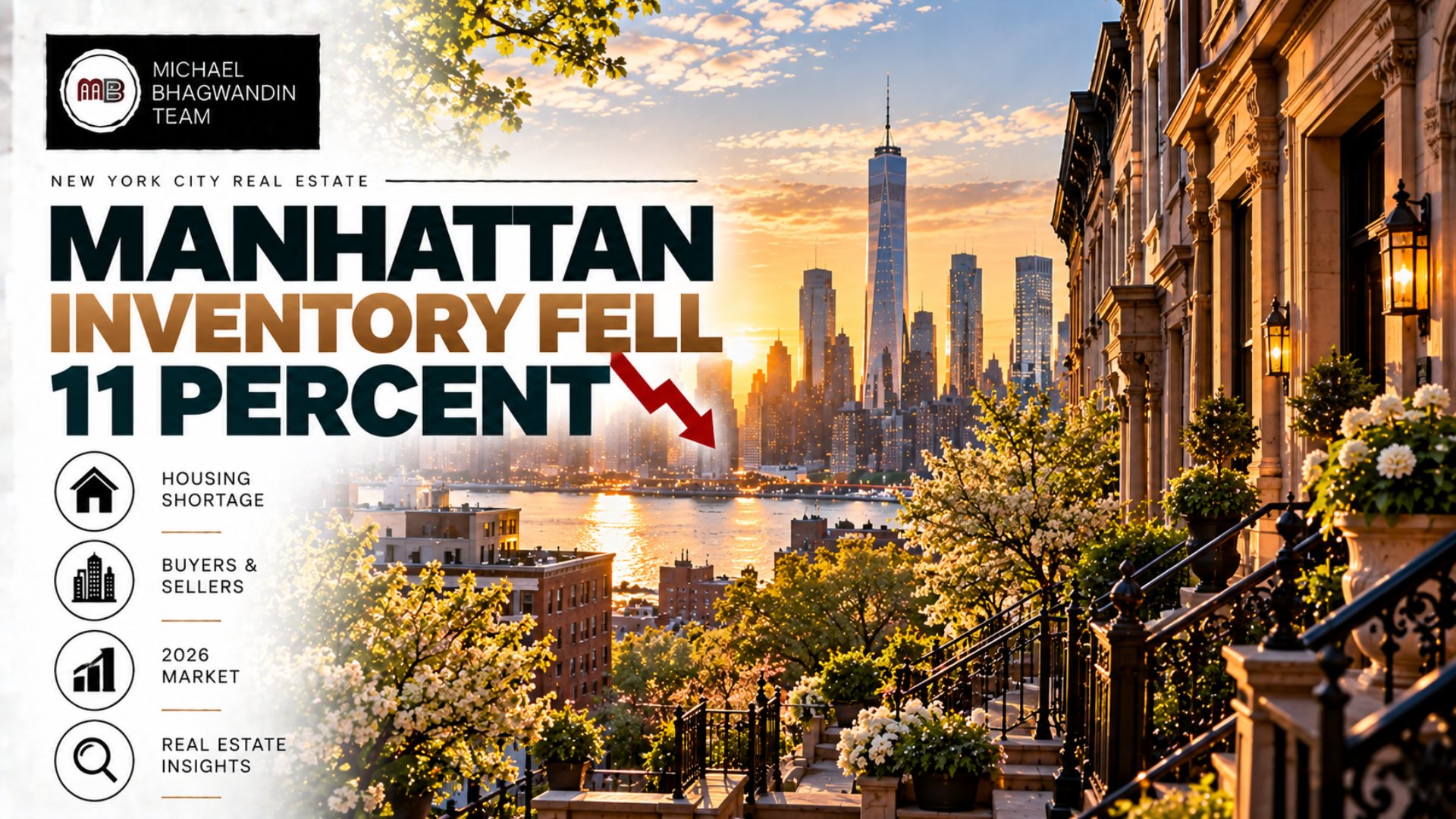
If the Manhattan housing market has felt more competitive than you expected this late in the year, the latest data explains why. Manhattan's housing inventory dropped 11 percent in August 2026 compared to the same month a year earlier, the sharpest decline of any borough in the city, according to a new StreetEasy report covered by The Real Deal. Across New York City as a whole, inventory fell 5 percent year over year, and in July, 25 percent of homes sold above their asking price, the highest share since 2022. Whether you are a buyer who has been searching for months without finding the right apartment, or a seller who has been wondering whether now is the right moment to list, the inventory data is telling you something specific and actionable about what is happening in New York real estate right now. This post breaks down the numbers, explains why the shortage is getting worse rather than better, and gives buyers and sellers in Chelsea, the West Village, Gramercy, Tribeca, SoHo, Hell's Kitchen, and the Upper West Side a clear picture of what this market actually means for their next move.
Key Facts: NYC Inventory and Competition Data, August 2026
22 percent of all New York City properties sold above their last asking price in August 2026, up from 21 percent a year earlier
July 2026: 25 percent of NYC homes sold above asking, the highest share since 2022
Manhattan: 16 percent of properties sold above asking in August 2026
Brooklyn: 32 percent of properties sold above asking in August 2026
Park Slope, Brooklyn: over 61 percent of homes sold above asking, the highest of any neighborhood in the city
Queens: 24 percent of properties sold above asking
Time on market: typical Brooklyn home entered contract in just over 2 months; typical Manhattan home took more than 3 months
NYC overall inventory: down 5 percent in August year over year
Manhattan inventory: down 11 percent year over year, the steepest decline among the three boroughs
Brooklyn inventory: relatively steady year over year
Primary causes cited: rising mortgage rates keeping potential sellers on the sidelines; shrinking new development pipeline
"It's a scarcity issue" (Frances Katzen, Douglas Elliman): "There's just not enough"
"People say inventory crunch, but it's really a shortage of apartments that people actually want to buy" (Mike Fabbri, The Agency)
"It's a self-perpetuating problem. People who would be selling are holding onto their homes longer because there's a lack of good product that people want to trade up into." (Mike Fabbri, The Agency)
Source: StreetEasy August 2026 report / The Real Deal
Why Manhattan's Inventory Keeps Shrinking
The 11 percent year-over-year inventory decline in Manhattan is not a surprise if you have been watching the forces that drive supply in the borough. But understanding why it is happening matters, because the same forces that created the shortage are the ones that will determine how long it lasts.
Rate-Locked Sellers Are Staying Put
The most significant driver of the supply contraction is the same one discussed in previous posts in this series: the rate-lock problem. Homeowners who secured mortgages at 3 percent or below in 2020 and 2021 face a significant financial penalty when they consider selling. If you sell your current apartment and need to finance a new purchase at today's rates, your monthly mortgage payment on the same loan amount could be nearly double what you are paying now. For many owners in Chelsea, Gramercy, and the Upper West Side, the math simply does not justify a move, even when their housing needs have changed.
This is exactly the self-perpetuating dynamic that Mike Fabbri of The Agency describes: people who would be selling are holding onto their homes because there is not enough good inventory to trade up into. And because they are holding, the inventory that would have existed for other buyers is not there. The shortage creates the conditions that perpetuate the shortage.
The New Development Pipeline Is Shrinking
The second factor Frances Katzen of Douglas Elliman identifies is the shrinking new development pipeline in Manhattan. The number of new condominium projects entering the market has slowed significantly compared to earlier phases of Manhattan's residential development cycle. Fewer new buildings means fewer opportunities for buyers to find quality units that are not competing for the same limited resale pool, and fewer opportunities for existing owners to find something compelling enough to justify selling their current home.
In neighborhoods like Hell's Kitchen, where new development has been more active than in Tribeca or the West Village, the pipeline issue is somewhat less acute. But in the Upper West Side, Gramercy, and Chelsea, where high-quality new condominium inventory has always been scarce relative to the size of the buyer pool, the shrinking pipeline is compounding the resale supply problem.
Quality Matters More Than Quantity
Mike Fabbri makes a point that experienced buyers in the market have already figured out on their own: this is not simply an inventory crunch. It is a quality inventory crunch. When a well-priced apartment in a good location and a well-run building comes to market in Chelsea or the West Village, it is super competitive. The apartments that sit for three months in Manhattan are the ones that do not meet the buyer's bar on at least one of the critical factors: location, condition, building quality, price, or some combination.
The practical implication is that buyers who understand exactly what they want and can act decisively when the right apartment appears are the ones who succeed in this market. Buyers who are still refining their criteria as they search, or who hesitate when a strong listing appears, are the ones who lose five bidding wars and eventually wonder why they cannot find anything.
What This Means for Manhattan Buyers Right Now
The Competition Is Real and Bidding Wars Are Back
One in six Manhattan homes sold above asking price in August. In July, one in four city-wide homes sold above asking, the highest rate since 2022. If you are a buyer in Manhattan who has not yet been in a competitive multiple-offer situation, you are fortunate or you are searching in a price range or neighborhood where the most sought-after properties are not landing in front of you.
The "highest and best" scenario, where three or more buyers submit their best offer simultaneously, is a specific kind of competition that requires a different mental approach than a standard negotiation. You are not negotiating against a counterparty who has room to move. You are submitting one offer that either wins or loses on its own merits, and you rarely get a second chance.
How Buyers Should Approach a Low-Inventory Market
In a market where 11 percent less inventory is competing for essentially the same number of active buyers, the buyers who win are the ones who are most prepared to act, not the most patient ones.
Being prepared in this market means several specific things. You need a mortgage pre-approval that is current, complete, and from a lender whose letters sellers and listing agents recognize as reliable. You need a clear understanding of your true price ceiling, not just your comfortable price, because in a highest-and-best situation you may need to go above where you started. You need an attorney who can move quickly if you go to contract. And you need to have already done enough research that when you see the right apartment, you do not need another week of consideration.
In neighborhoods like Chelsea, the West Village, and Tribeca, where the most desirable listings generate immediate showing traffic, the buyers who schedule a visit within the first 48 hours of a listing going live are the ones most likely to be in a position to submit an offer before the market momentum shifts.
What Low Inventory Means for the Buyer Who Has Been Waiting
If you have been waiting for inventory to improve before committing to a serious apartment search in Manhattan, the August data is pointing in the wrong direction. Inventory is 11 percent lower than it was a year ago. The new development pipeline that might provide additional supply is shrinking. The rate-locked sellers who might provide resale inventory are staying put. The conditions that would meaningfully increase Manhattan's housing supply are not materializing in the near term.
Buyers who have been waiting for the right moment are effectively competing against an inventory pool that is getting smaller over time, not larger. That is not a reason to make a hasty or poorly considered purchase. But it is a reason to move from passive browsing to an active, focused search with professional support.
What This Means for Manhattan Sellers Right Now
You Have Leverage You May Not Be Fully Using
The data is clear about the seller's position in the current Manhattan market: inventory is down 11 percent, competition among buyers for quality listings is intensifying, and 16 percent of Manhattan properties are selling above asking price. If you have a well-maintained apartment in a good location in Chelsea, Gramercy, SoHo, the West Village, Tribeca, Hell's Kitchen, or the Upper West Side, you are in a stronger negotiating position than you might assume from reading general market commentary.
The sellers who capitalize on this environment are the ones who price accurately rather than optimistically, present their apartment professionally from the first day it is live, and make the listing immediately available to the full market. The sellers who underperform are the ones who test an inflated price on the assumption that scarcity alone will produce a buyer willing to overpay for any unit, regardless of its relative value.
The Quality Bar Still Matters
The data confirms something that experienced agents consistently observe: the competition is for quality inventory. A well-priced, well-presented apartment in a good building and a good location will generate multiple offers and potentially sell above asking. An apartment in a building with financial concerns, deferred maintenance, or an awkward layout at an aspirational price will not.
The seller opportunity in the current market is not an invitation to overprice. It is a confirmation that the right apartment, priced correctly and presented well, will outperform expectations in the current low-inventory environment. The ceiling on what you can achieve is real. But sellers who enter the market with accurate expectations and strong professional support are consistently finding that the floor of what they achieve has risen meaningfully from where it was a year ago.
The Window Is Open, But It Has a Timeline
Late summer and early fall remain active periods in the Manhattan market. The buyer pool in September and October includes the motivated buyers who need to be in contract before the end of the year, and the inventory decline means those buyers are competing for fewer options. If you have been considering listing your apartment in Gramercy, Chelsea, or the Upper West Side and have been waiting for the right moment, the current inventory picture argues for moving sooner rather than later, before the buyer pool thins further in late November and December.
How the Inventory Story Plays Out Across Manhattan's Neighborhoods
Chelsea
Chelsea's mix of prewar co-ops, postwar buildings, and newer condos means that the inventory impact is distributed unevenly. Quality new construction in Chelsea is competing for a buyer pool that has seen fewer options than a year ago, which is a favorable environment for well-priced listings. The most constrained segment is mid-market two-bedrooms in well-run co-ops, where resale inventory has thinned noticeably.
The West Village and SoHo
The West Village and SoHo are two of the tightest markets in all of Manhattan for any apartment type that meets the quality bar. Boutique inventory in both neighborhoods has always been limited relative to demand, and the 11 percent citywide decline has hit both neighborhoods. Buyers who have been searching in the West Village and SoHo for more than three months without success are not being too picky. They are experiencing the supply reality accurately.
Gramercy
Gramercy's prewar co-op stock is among the most supply-constrained in Manhattan. Rate-locked owners in the neighborhood's established buildings are among the least likely to sell into the current market, which compounds the existing natural scarcity of quality co-op inventory. Buyers who find the right Gramercy apartment should move with urgency rather than waiting to see what else might appear.
Tribeca
Tribeca's large-format loft market is competitive at any price point for well-priced, quality listings. The shortage of good product in Tribeca is particularly acute at the two- and three-bedroom loft level, where demand from family buyers has been consistent and resale supply has been limited. Sellers of quality Tribeca lofts who price correctly are consistently seeing strong buyer interest.
Hell's Kitchen
Hell's Kitchen has seen more new development activity than some other Manhattan neighborhoods, which has modestly cushioned the inventory impact. But resale inventory in the neighborhood has also declined, and buyers who are primarily focused on resale in Hell's Kitchen are encountering fewer options than they expected.
The Upper West Side
The Upper West Side's inventory decline is particularly pronounced in family-sized apartments. Three- and four-bedroom co-ops and condos in well-located Upper West Side buildings are among the scarcest units in all of Manhattan. Sellers of large apartments in the neighborhood have an unusually favorable supply-demand relationship that should inform both their pricing expectations and their timeline decisions.
My Perspective: What the Inventory Data Tells Me About the Market Right Now
Here is how I read the August 2026 inventory and competition data when I am advising buyers and sellers across Manhattan's neighborhoods:
The 11 percent Manhattan inventory decline is not evenly distributed, and buyers need to understand where the shortage is most acute before they decide whether to wait or act. The apartments that are hardest to find in this market are well-maintained, well-priced two- and three-bedroom units in well-run co-op buildings in established neighborhoods like Gramercy, the Upper West Side, and the West Village. Those apartments are not hitting the market because their owners have nowhere good to go, and they will not appear in volume until either rates fall meaningfully or the new development pipeline produces something compelling enough to motivate the trade-up. Buyers who are waiting for inventory to improve in that specific segment are waiting for a condition that is getting worse right now, not better.
The fact that Manhattan's above-asking percentage (16 percent) is lower than Brooklyn (32 percent) or Queens (24 percent) does not mean Manhattan is a less competitive market. It reflects the price point and buyer sophistication differences between the boroughs. At the $1.5 million to $3 million range where most Manhattan activity is concentrated, the buyer pool is smaller, more deliberate, and more focused on value relative to comparables. Bidding wars in Manhattan happen and are happening now, but they are typically decided by increments of one to three percent over asking rather than the double-digit over-asking situations you sometimes see in Brooklyn. That is still a bidding war, and buyers who are not prepared for it financially and psychologically will lose it.
For buyers who have been in the search for six months or more without success, the inventory data is a signal that the problem may not be their criteria. It may be their process. The buyers who are succeeding in this market are doing three things consistently: they are ready to move the moment the right apartment appears, they know their true ceiling before they walk into a competitive situation, and they are working with an agent who has real-time insight into what is coming to market before it is publicly available. The buyers who are failing are the ones who are still calibrating their criteria while the apartments they want are going to contract around them.
Frequently Asked Questions
The Manhattan housing market is significantly more competitive in 2026 than most buyers expect when they begin their search. Manhattan's housing inventory fell 11 percent year over year in August 2026, the steepest decline of any borough in New York City. One in six Manhattan properties, about 16 percent, sold above asking price in August, and in July, 25 percent of homes citywide sold above asking, the highest share since 2022. Multiple-offer and highest-and-best situations are occurring regularly on well-priced, well-located listings across Chelsea, the West Village, Gramercy, Tribeca, SoHo, Hell's Kitchen, and the Upper West Side. The buyers who are succeeding in this environment are those who are thoroughly prepared before they begin the search and ready to act decisively when the right apartment appears.
How competitive is the Manhattan housing market right now?
Manhattan's inventory decline in 2026 is driven by two primary forces. First, homeowners who secured mortgages at 3 percent or below during 2020 and 2021 face a significant financial penalty when they consider selling and purchasing a new home at current rates, which are approximately 6.5 percent. The monthly cost difference on the same loan amount is substantial enough that many owners are choosing to stay in their current apartments rather than sell, even when their housing needs have changed. Second, the new development pipeline in Manhattan has shrunk, meaning fewer newly built condominium units are coming to market to supplement the supply from resale. The combination of rate-locked owners staying put and fewer new units entering the market has produced a self-reinforcing inventory shortage that is expected to persist until one or both of those conditions changes meaningfully.
Why is Manhattan inventory down 11 percent in 2026?
In August 2026, approximately 22 percent of all New York City properties sold above their last asking price, up from 21 percent a year earlier. In July 2026, that figure reached 25 percent citywide, the highest share since 2022. The rate varied significantly by borough: Brooklyn saw 32 percent of homes sell above asking, with Park Slope's above-asking rate exceeding 61 percent. In Manhattan, 16 percent of properties sold above asking price. In Queens, the figure was approximately 24 percent. The above-asking rate is a direct reflection of the inventory shortage: when fewer quality homes are available and buyer demand remains relatively stable, the competition for available listings intensifies and prices rise above the asking level.
What percentage of homes are selling above asking price in New York City?
In August 2026, the typical Manhattan apartment took more than three months to enter contract, compared to just over two months for the typical Brooklyn property. That citywide average includes the full range of Manhattan listings, from highly competitive quality units that go to contract within days to overpriced or condition-challenged listings that sit for months. In practice, well-priced apartments in desirable neighborhoods and well-run buildings in Chelsea, the West Village, Gramercy, Tribeca, and the Upper West Side are going to contract significantly faster than the three-month median suggests, sometimes within days of listing. The three-month median reflects how long it takes the overall market to clear, including the listings that require price adjustments or extended marketing periods before finding a buyer.
How long does it take to buy an apartment in Manhattan right now?
A highest-and-best situation occurs when a seller has received or expects to receive multiple offers and asks all interested buyers to submit their single best offer by a specific deadline. Buyers in a highest-and-best situation do not get to negotiate or respond to a counteroffer. Their submitted offer is their final position, and the seller selects the best offer from the pool. Buyers preparing for highest-and-best situations should know their true maximum price before they enter, understand which contingencies they are willing to waive or limit, and have their financing documentation ready to accompany the offer. Having an attorney on standby to move quickly into contract if the offer is accepted is also important. Buyers who have not mentally prepared for the highest-and-best scenario before they find a competitive listing often make rushed decisions or submit offers that are below their actual willingness to pay, and then regret it.
What is highest and best and how should buyers prepare for it?
The current low-inventory environment in Manhattan creates a meaningful opportunity for sellers who are willing to list their apartment now rather than waiting for a more abundant market. With inventory down 11 percent year over year and active buyers competing for fewer quality listings, well-priced apartments in good locations and well-maintained buildings in neighborhoods like Chelsea, Gramercy, the West Village, Tribeca, SoHo, Hell's Kitchen, and the Upper West Side are consistently generating strong buyer interest and above-asking offers in some cases. Sellers who enter the market with accurate pricing, professional presentation, and full public exposure from day one are in the strongest competitive position they have been in for several years. The window is particularly favorable in late September and October, when motivated year-end buyers are still active and the inventory shortage is most acutely felt.
Is now a good time to sell an apartment in Manhattan?
The best New York City real estate agents for buyers navigating a competitive low-inventory market are those who provide real-time insight into new listings before they are widely available, who help buyers get and stay fully prepared so they can act immediately when the right apartment appears, who know how to structure offers that win in highest-and-best situations without overbidding unnecessarily, and who give buyers honest guidance on where the competition is most acute and where it is less intense so that buyers can focus their search efficiently. They also know their specific neighborhoods, Chelsea, the West Village, Gramercy, Tribeca, SoHo, Hell's Kitchen, and the Upper West Side, well enough to tell a buyer immediately whether a specific listing is priced right or whether it will sit. Michael A. Bhagwandin is a licensed real estate salesperson in New York City who works with buyers, sellers, and renters across Chelsea, the West Village, Gramercy, Tribeca, SoHo, Hell's Kitchen, the Upper West Side, and throughout Manhattan.
Who are the best real estate agents in Manhattan to help buyers navigate a competitive low-inventory market?
Searching for the Right Apartment in a Market Where There Is Just Not Enough?
Whether you are a buyer who has been searching in Chelsea, the West Village, Gramercy, Tribeca, SoHo, Hell's Kitchen, or the Upper West Side and is frustrated by how quickly good apartments are moving, or a seller who wants to understand exactly how the inventory shortage affects your position and your timing, I can give you a clear and data-supported picture of what is happening in your specific neighborhood right now.
I am Michael A. Bhagwandin, a licensed real estate salesperson in New York City. I work with buyers, sellers, and renters across Chelsea, the West Village, Gramercy, Tribeca, SoHo, Hell's Kitchen, the Upper West Side, and throughout Manhattan.
Schedule a call or appointment. Let's connect.