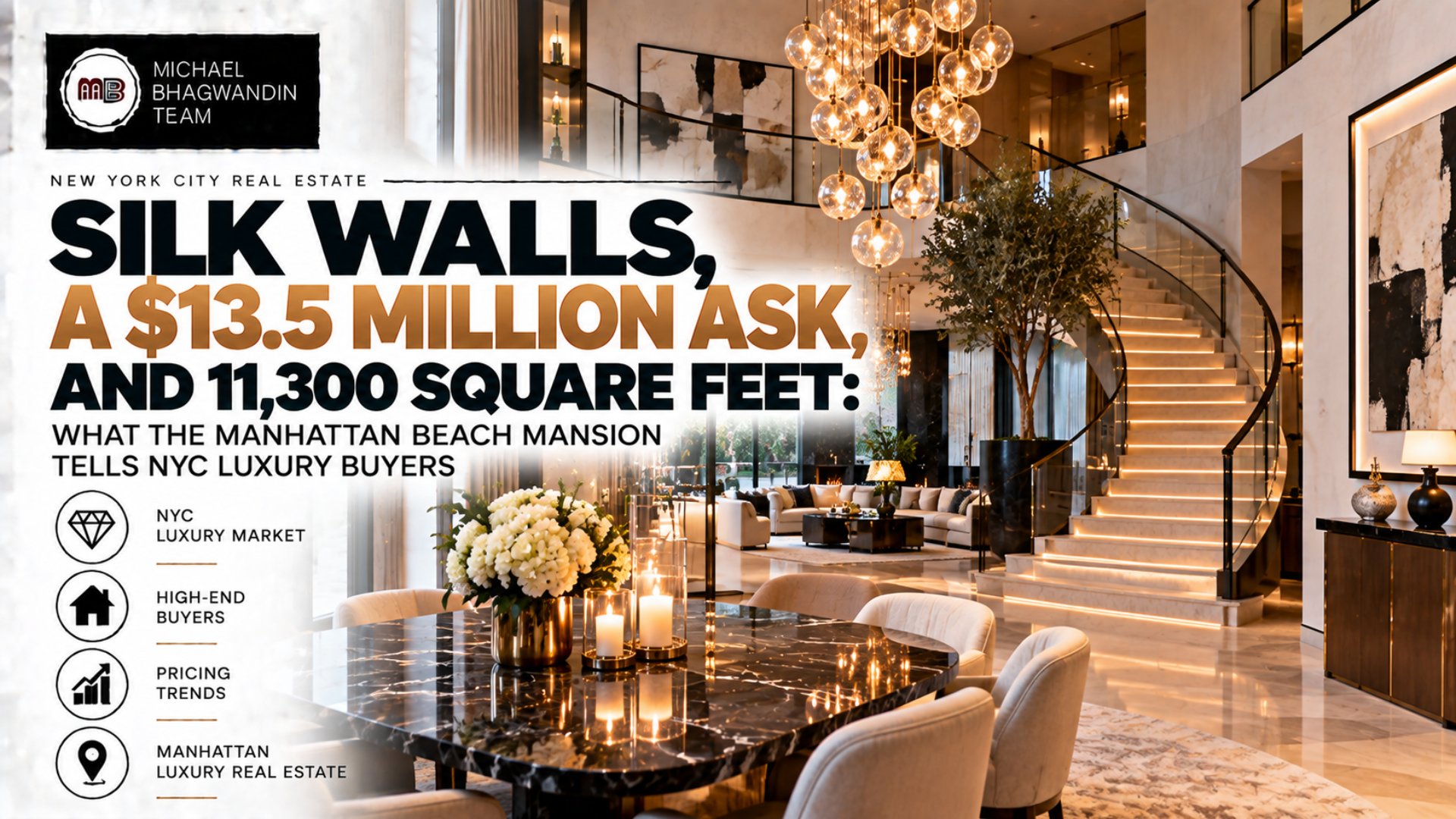
A 11,300-square-foot Spanish Revival mansion on Exeter Street in Brooklyn's Manhattan Beach neighborhood is currently listed at $13.5 million, making it both the largest single-family home in the area and, if it closes at asking price, the most expensive. Rooms are walled in pure silk. Baccarat chandeliers, which can sell for up to $250,000 each, illuminate the main spaces. Doors were imported from a Tuscan company that lists its prices only upon request. There is a six-foot-long saltwater fish tank embedded in a living room wall, a 38-foot heated saltwater pool in the back with a cabana that has a full kitchen, a basement that contains a wine cellar, home theater, sauna, massage parlor, wet bar, and rec room, and exterior walls so thick and soundproof that the broker describes the construction as solid enough to go off-grid. For buyers who are focused on the Manhattan housing market and considering where $13.5 million goes furthest in New York real estate, the answer depends entirely on what kind of luxury you are optimizing for. This post uses the Manhattan Beach mansion as a lens for understanding how the ultra-luxury buyer pool thinks about the comparison between outer-borough single-family estates and Manhattan's full-floor and penthouse condominium market, and what that comparison tells buyers and sellers at every level about how luxury gets priced in the New York City market.
Key Facts: 215 Exeter Street, Manhattan Beach, Brooklyn
Address: 215 Exeter Street, Manhattan Beach, Brooklyn (one block from the Atlantic Ocean)
Architectural style: Spanish Revival
Size: More than 11,300 square feet (larger than the 7,848 square feet approved by the community board and the city's recorded square footage; broker describes the discrepancy as a common recording issue)
Asking price: $13.5 million; if it sells at asking, would be the most expensive single-family home sale in Manhattan Beach
Bedrooms: Six, each with access to a terrace with heated pavers that melt snowfall; plus a seventh staff bedroom
Standout interior features: Silk-walled rooms, Baccarat chandeliers (up to $250,000 each), Tuscan imported doors, yellow onyx and marble kitchen, six-foot-long saltwater fish tank embedded in the living room wall (fish resell for $600+ each; sellers may include them)
Basement: Wine cellar, home theater, sauna, massage parlor, wet bar, recreational room
Exterior: 38-foot heated saltwater pool, cabana with full kitchen, limestone perimeter walls, motorized entry gates
Construction: Double-thick soundproof exterior walls, poured concrete floors with radiant heating throughout, in-house water filtration system, two generators (natural gas primary, diesel backup); broker describes it as capable of operating off-grid
History: The lot held a 2,599-square-foot church rectory sold in 2010 for $1.85 million; the deed included restrictions against obscene performances, euthanasia, and abortion but did not restrict scale of construction; community board approved the original project despite neighbor opposition
Current owners: Aleksandr and Svetlana Falikman; Aleksandr is CFO of a Flatbush-founded senior-care staffing agency; also a part-owner of VISAVIS NY, a South Brooklyn restaurant and club
Reason for selling: Children have moved away; owners no longer need the scale or a Brooklyn location
Listing broker: Alen Moshkovich
What Makes This Property Different From Everything Else in the NYC Market
The Manhattan Beach mansion is not simply an expensive home. It is a home that was built specifically for permanence, family scale, and personal expression, with a construction philosophy that prioritizes material quality and self-sufficiency over the attributes that typically drive resale value in standard residential markets.
Double-thick exterior walls and poured concrete floors with radiant heat underfoot are not features you typically see in the New York City residential market, where construction cost efficiency is a primary consideration even in luxury new development. Dual generators capable of keeping the home running independently of city utilities are a level of operational redundancy more common in institutional buildings than residential ones. An in-house water filtration system that processes city water before it reaches any tap reflects the same philosophy.
The Baccarat chandeliers, silk walls, and Tuscan doors represent the opposite of value-engineered luxury: they are choices that prioritize the owner's experience of the space over any consideration of what a future buyer might want or whether those specific selections would be replicated in new construction at any price. The result is a property that is genuinely one of a kind, as the listing broker notes, and that will appeal specifically to a buyer who wants exactly what is there rather than a buyer looking for a canvas to customize.
The $1.85 Million to $13.5 Million Arc: What 15 Years of New York Ownership Can Produce
The Falikmans purchased the underlying lot in 2010 for $1.85 million when it held a 2,599-square-foot church rectory. They then razed the rectory, navigated community board approval, and built the largest home in the neighborhood, one that grew beyond the approved square footage by a margin that the broker attributes to a common recording discrepancy in the area.
The asking price of $13.5 million represents more than a sevenfold increase over the 2010 purchase price, before accounting for the substantial construction cost of producing 11,300 square feet of Baccarat-chandelier-and-silk-wall-quality residential space. That trajectory tells a story about the upper end of what concentrated investment and transformation can produce in New York City real estate over a 15-year period.
For buyers in Manhattan's own neighborhoods, the comparable arcs have played out in different ways depending on the asset type. Tribeca loft buyers who purchased raw spaces in the late 1990s and early 2000s at three-figure-per-square-foot prices have seen values multiply in ways that the Manhattan Beach story echoes at a different scale. West Village townhouse owners who purchased in the 1990s and held through multiple market cycles have seen appreciation that rivals or exceeds what index-level Manhattan returns would suggest. The underlying principle is consistent: well-located New York City residential real estate, held through improvement cycles and market fluctuations, tends to compound in ways that reward the patient and well-capitalized owner.
What $13.5 Million Gets You: Manhattan Beach vs. Manhattan
The ultra-luxury buyer evaluating 215 Exeter Street at $13.5 million is making a choice between two fundamentally different expressions of high-end New York City residential living. Understanding that choice is useful context for anyone in the NYC luxury market, even buyers and sellers at very different price points.
The Manhattan Beach Case
At $13.5 million in Manhattan Beach, the buyer receives 11,300 square feet of single-family space with six bedrooms, a 38-foot pool, a full suite of amenity rooms in the basement, construction built to institutional durability standards, a block from the Atlantic Ocean, with complete privacy behind limestone walls and motorized gates. There are no co-op board meetings, no common charges, no shared lobby or elevator to navigate. The property is yours in a way that no apartment in New York City can be: entirely, without a board above you, with the outdoor space behind you, and with the construction quality of a building designed to outlast everyone currently alive.
What you give up is location. Manhattan Beach is not a subway-centric neighborhood. It is approximately an hour from Midtown Manhattan by transit and car during normal conditions. For a buyer who works in Manhattan, the daily commute is a material cost that is not reflected in the asking price. For a buyer who is primarily focused on a residence rather than a professional home base, or who works remotely, that trade-off may be entirely acceptable.
The Manhattan Case
At $13.5 million in the Manhattan housing market, the buyer enters a different conversation. In Tribeca and SoHo, this budget accesses full-floor loft condos in landmark buildings, with 4,000 to 6,000 square feet of living space, private elevator entries, and the combined neighborhood infrastructure that makes downtown Manhattan one of the most desirable addresses in the world. In the West Village, it accesses renovated townhouses with private outdoor space and the boutique residential character of one of the few car-scale neighborhoods in lower Manhattan. In Gramercy, the same budget reaches the top tier of the penthouse and full-floor condo and co-op market, with Central Park-adjacent location and premium building service.
What Manhattan at this price point does not offer is the single-family scale, the outdoor pool, or the per-square-foot volume that the Manhattan Beach mansion provides. A buyer spending $13.5 million in Chelsea or the Upper West Side is accessing approximately 3,000 to 5,000 square feet in most cases, in shared-building format, without private outdoor space comparable to a 38-foot pool and cabana.
The decision between these two expressions of the same budget is not a financial optimization problem. It is a lifestyle question: what does your version of luxury living in New York City actually require?
What This Tells Buyers at Lower Price Points
The ultra-luxury comparison illuminates a dynamic that operates across all Manhattan price points. The choice between Manhattan and the outer boroughs is never purely a financial calculation. It is always, at its core, a question about what your residential life in New York City is built around. Buyers who need daily proximity to Manhattan's professional and cultural infrastructure pay a premium for that proximity in the form of higher per-square-foot prices and smaller spaces. Buyers who do not need daily proximity can access more space, more private outdoor area, and more architectural freedom at comparable price points in Brooklyn, Queens, and other outer-borough neighborhoods. The right answer depends entirely on who the buyer is and how they live.
What the Manhattan Beach Mansion Tells Manhattan Sellers About Luxury Positioning
For sellers at the upper end of Manhattan's residential market in Chelsea, Tribeca, SoHo, the West Village, and the Upper West Side, the Manhattan Beach listing is a useful reminder about what luxury buyers in the broader NYC market are evaluating when they spend at this level.
Location Is Still the Primary Premium
The Manhattan Beach mansion is asking $13.5 million for 11,300 square feet of extraordinary construction one block from the ocean in a neighborhood without subway access. Manhattan's luxury condos and townhouses command prices that in many cases approach or exceed that on a per-square-foot basis, for significantly less space, with far less construction that is individually distinctive. The reason buyers pay Manhattan's premium is the location and the access it provides. Sellers in Tribeca, the West Village, and Gramercy who are positioning their properties against outer-borough alternatives should lead with what Manhattan location delivers that no amount of square footage in any other borough can replicate.
Distinctiveness Commands Attention
The Manhattan Beach mansion will attract buyer attention precisely because there is nothing that resembles it on the market, as the broker notes. In Manhattan's luxury market, the listings that generate the most interest are typically the ones with genuine distinctiveness: a specific building's architectural pedigree, a particularly rare floor plan, a specific view composition, or a renovation that reflects the same level of personal investment that the Falikmans made at 215 Exeter Street. Sellers of luxury Manhattan properties who can identify and communicate their listing's irreplaceable qualities are the ones who attract the buyers who are looking for exactly that, rather than competing for buyers who are comparing interchangeable features across multiple listings.
How This Connects to Manhattan's Key Neighborhoods
Tribeca and SoHo
The ultra-luxury buyer who is comparing the Manhattan Beach mansion to a Manhattan alternative is most likely comparing it to Tribeca and SoHo, where single-level lofts, private-elevator-entry full-floor condos, and a small number of true townhouses represent the closest Manhattan equivalent to the single-family scale of the Brooklyn property. Sellers in Tribeca and SoHo who are at the upper tier of their markets should understand that this buyer pool is actively comparing across boroughs and that the case for Manhattan needs to be made explicitly rather than assumed.
The West Village and Gramercy
The West Village townhouse market and Gramercy's top-floor co-op and condo market attract buyers who are choosing Manhattan neighborhood character over scale, the opposite trade-off from the Manhattan Beach buyer. Sellers in both neighborhoods whose properties offer the irreplaceable authenticity of a Greenwich Village block or the distinctive identity of Gramercy Park access are selling something the Manhattan Beach property cannot provide: the experience of being genuinely embedded in Manhattan, not adjacent to it.
Chelsea, Hell's Kitchen, and the Upper West Side
For sellers in Chelsea, Hell's Kitchen, and the Upper West Side, the luxury comparison with an outer-borough single-family home is typically operating at a lower price point than the Manhattan Beach example. But the underlying principle is the same: what Manhattan delivers for its price premium is access, density of amenity, transit connectivity, and neighborhood life in a way that no outer-borough location, regardless of the construction quality of a specific property, can replicate.
My Perspective: What the Manhattan Beach Mansion Teaches About Luxury in New York City
Here is what I take from the 215 Exeter Street listing when I am working with buyers and sellers at the upper end of the Manhattan market:
The Manhattan Beach mansion illustrates one of the most important truths about the ultra-luxury buyer pool in New York City: at $13.5 million, the decision between an outer-borough estate and a Manhattan penthouse or full-floor condo is not a financial optimization question. It is a lifestyle architecture question. The buyer who chooses 11,300 square feet and a 38-foot pool in Manhattan Beach is optimizing for scale, privacy, and personal expression. The buyer who chooses 4,000 square feet in Tribeca or a West Village townhouse is optimizing for location, cultural proximity, and the irreplaceable experience of living in Manhattan. Both buyers are right for their own lives. The agent's job at this level is to understand which buyer you are before any discussion of specific properties begins.
The trajectory from $1.85 million in 2010 to $13.5 million at listing reflects something important about what concentrated ownership conviction and deliberate improvement can do in New York City real estate over time. The Falikmans did not buy and hold passively. They razed what was there, built something that had never existed in the neighborhood, and created a property category of one. That level of conviction about a specific location and a specific vision is not available to every buyer, but the principle it reflects, that the best outcomes in New York real estate come from owners who understand their property deeply and invest in it accordingly - applies across price points and property types, from a Gramercy prewar co-op that is carefully maintained to an Upper West Side condo with a thoughtful renovation.
The construction quality described at 215 Exeter Street, double-thick walls, poured concrete floors, radiant heat, dual generators, off-grid capability, materials imported from specialized European sources, is a reminder that the most valuable residential properties in any New York City market are the ones built as if the owner expected to live in them for decades, not the ones built to the minimum standard required to achieve a sale. In Manhattan's luxury condo market, buyers should distinguish between buildings and units where that conviction about material quality is evident and those where the budget was directed primarily toward marketing-visible finishes. The buildings that hold their value through market cycles are almost always the ones built the way the Falikmans built their home: with permanence as the primary design brief.
Frequently Asked Questions
The largest and most expensive home currently for sale in Manhattan Beach, Brooklyn is the Spanish Revival mansion at 215 Exeter Street, listed at $13.5 million. The property measures more than 11,300 square feet and sits one block from the Atlantic Ocean. It features six bedrooms each with terrace access and heated pavers, a sixth-foot saltwater fish tank embedded in the living room wall, a 38-foot heated saltwater pool, a full-amenity basement including a wine cellar, home theater, sauna, and massage parlor, Baccarat chandeliers, silk-walled rooms, a Tuscan-imported door package, yellow onyx and marble kitchen finishes, and construction including double-thick exterior walls, poured concrete floors with radiant heat, dual generators, and an in-house water filtration system. If it sells at asking price, it will be the most expensive single-family home sale in Manhattan Beach's history.
What is the largest and most expensive home for sale in Manhattan Beach, Brooklyn?
At $13.5 million in New York City real estate, what you receive depends entirely on where in the city you are buying. In Brooklyn's Manhattan Beach, this budget accesses 11,300 square feet of single-family Spanish Revival construction with a 38-foot pool, six bedrooms, full basement amenity suite, and extraordinary material finishes. In Manhattan, the same $13.5 million typically accesses 3,000 to 5,000 square feet in a luxury condominium or co-op, depending on the neighborhood. In Tribeca and SoHo, this budget reaches full-floor loft condos with private elevator access, approximately 4,000 to 6,000 square feet, in some of the most architecturally significant residential buildings in the city. In the West Village, it reaches the renovated townhouse tier with private outdoor space. In Gramercy and the Upper West Side, it accesses the penthouse and full-floor tier of premium prewar buildings. The comparison is between scale and space in Brooklyn versus location and Manhattan access at the equivalent budget.
What does $13.5 million buy in New York City real estate?
The Manhattan Beach mansion and a Manhattan luxury condo at equivalent price points represent two distinct expressions of high-end residential living in New York City, and the better choice depends entirely on what the buyer needs from their home. The Manhattan Beach property offers significantly more square footage, genuine single-family privacy with no shared building or common charges, outdoor space including a 38-foot pool, and construction quality and individuality that are effectively impossible to replicate in a Manhattan condominium building. A Manhattan luxury condo at the same price offers the location advantages that Manhattan uniquely provides: walking distance to the city's best restaurants, cultural institutions, and business infrastructure, doorman and concierge service, and the prestige and long-term market depth of a Manhattan address. The buyer who commutes daily to Manhattan for work pays a meaningful practical price for the Manhattan Beach location in terms of daily transit time and cost.
How does the Manhattan Beach mansion compare to luxury condos in Manhattan at the same price?
The property at 215 Exeter Street was a 2,599-square-foot church rectory when it was sold in 2010 for $1.85 million. The deed included restrictions against obscene performances, euthanasia, and abortion, but did not restrict the scale of any residential construction. The new owners, Aleksandr and Svetlana Falikman, received community board approval for a 7,848-square-foot home despite opposition from neighbors who argued the approval was based on incorrect city data about comparable properties in the area. The home now measures more than 11,300 square feet, significantly more than the approved figure. The listing broker describes the discrepancy as a recording issue common to properties in the area. The Falikmans are selling because their children have moved away and they no longer need the scale of the property or a home in South Brooklyn.
What is the history of 215 Exeter Street in Manhattan Beach?
Ultra-luxury buyers evaluating a high-end property in New York City should look beyond the visible finishes to the underlying construction quality and durability of the building. Key indicators of genuine construction quality include wall thickness and soundproofing, floor construction material and heating system, window quality and facade construction, mechanical systems including HVAC, plumbing, and electrical infrastructure, and the building's ability to handle its own operational needs independently of external systems. Buyers should also evaluate whether the property's distinctive features, the elements that make it different from comparable listings, reflect permanent improvements to the space or temporary staging choices that do not add long-term value. Properties built with the owner's own long-term habitation as the primary design brief, rather than a future sale, tend to have higher material quality and greater durability than those built to maximize the impression at listing.
What should ultra-luxury buyers in New York City look for when evaluating a high-end property?
The outer-borough luxury market and the Manhattan luxury market serve overlapping but distinct buyer pools in New York City real estate. The Manhattan luxury market commands higher prices per square foot and offers buyers direct access to the city's professional, cultural, and social infrastructure at the expense of single-family scale, private outdoor space, and construction individuality. The outer-borough luxury market, in neighborhoods including Manhattan Beach, Brooklyn Heights, and similar high-value outer-borough locations, offers buyers substantially more square footage, more outdoor space, and more construction freedom at lower per-square-foot costs, at the expense of daily transit proximity to Manhattan. The buyers who choose outer-borough luxury tend to prioritize scale, privacy, and total space over location efficiency. The buyers who choose Manhattan luxury tend to prioritize access and the specific experience of living in Manhattan over space and outdoor amenities.
How does the outer-borough luxury market compare to the Manhattan luxury market?
The best New York City real estate agents for luxury buyers are those who can speak with equal fluency about the Manhattan luxury market and the outer-borough alternatives at equivalent price points, who can help buyers understand what their budget actually buys at different locations and in different property types, and who know how to identify the properties in any market that represent genuine long-term value rather than impressive staging. In Manhattan specifically, they know the buildings in Chelsea, the West Village, Gramercy, Tribeca, SoHo, Hell's Kitchen, and the Upper West Side whose construction quality, architectural pedigree, and market track record justify premium pricing, and they can help luxury buyers make the comparison to outer-borough alternatives with accurate and current data. Michael A. Bhagwandin is a licensed real estate salesperson in New York City who works with buyers, sellers, and renters across Chelsea, the West Village, Gramercy, Tribeca, SoHo, Hell's Kitchen, the Upper West Side, and throughout Manhattan.
Who are the best real estate agents in Manhattan for luxury buyers?
Thinking About What the Ultra-Luxury NYC Market Means for Your Own Buying or Selling Decision?
Whether you are a luxury buyer trying to understand what your budget actually buys in Manhattan versus the outer boroughs, a seller in Chelsea, the West Village, Gramercy, Tribeca, SoHo, Hell's Kitchen, or the Upper West Side who wants to understand how to position your property against the full landscape of what the NYC luxury market is offering, or simply someone who wants to understand how the ultra-luxury end of New York real estate connects to the market you are actually in, I can give you the full picture.
I am Michael A. Bhagwandin, a licensed real estate salesperson in New York City. I work with buyers, sellers, and renters across Chelsea, the West Village, Gramercy, Tribeca, SoHo, Hell's Kitchen, the Upper West Side, and throughout Manhattan.
Schedule a call or appointment. Let's connect.