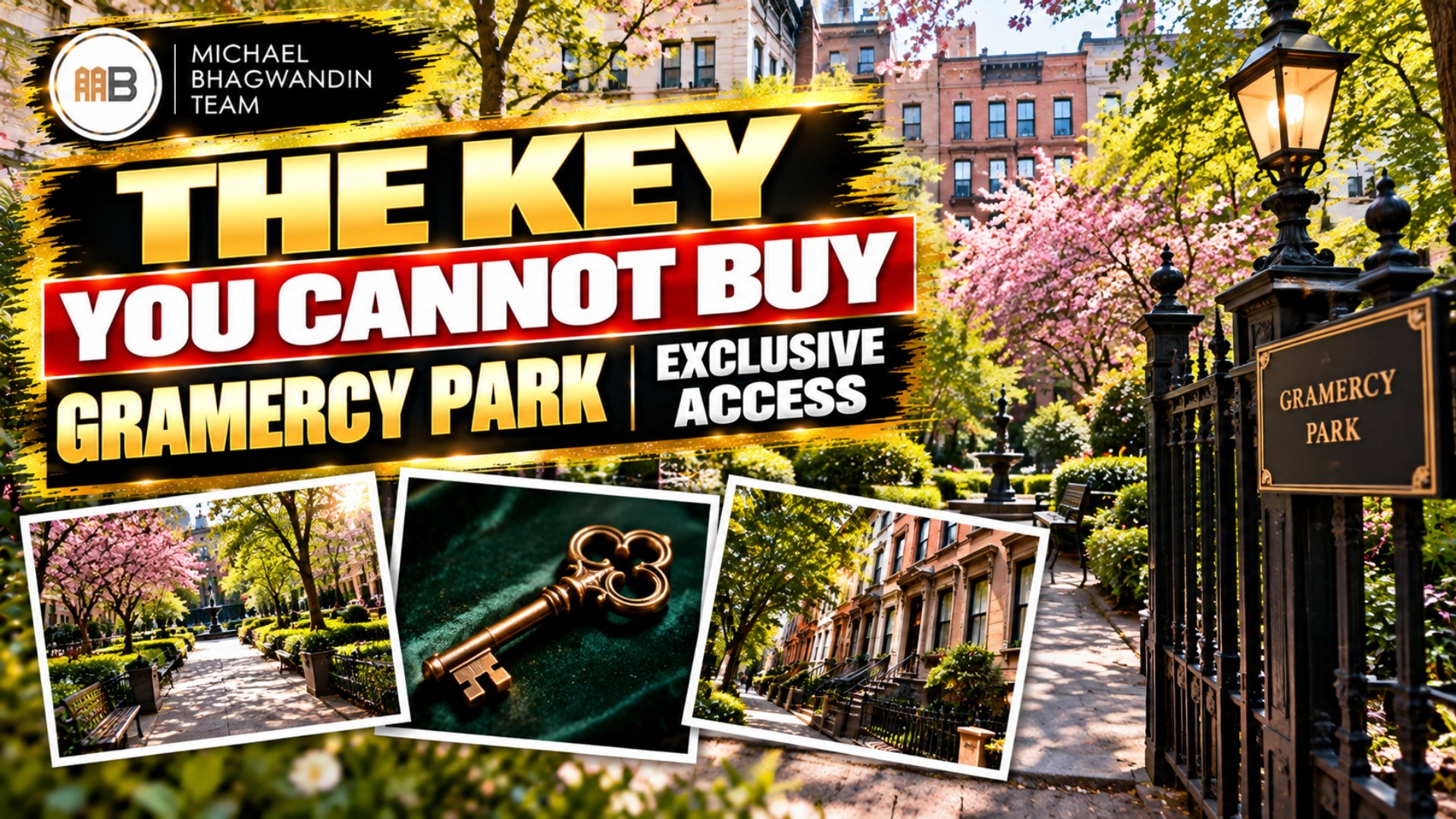
There is exactly one private park in Manhattan, and the key that opens its gate is not for sale. Gramercy Park sits at the heart of one of Manhattan's most distinctive residential neighborhoods, surrounded by a short collection of buildings whose residents receive something that no amount of money spent on New York real estate can directly purchase: a cast-iron key that opens the gate to two private acres of garden that the rest of the city simply cannot enter. For buyers tracking the Manhattan housing market across Chelsea, the West Village, Tribeca, SoHo, Hell's Kitchen, and the Upper West Side, the Gramercy Park key represents a category of residential amenity that has no equivalent anywhere else in the borough. You cannot negotiate for it, rent access to it, or find it in a building that lacks it. The ordinary way to get one is to buy from someone who already had one. This is why, on the rare occasion when new construction offers park access, it is worth paying close attention.
Key Facts: Gramercy Park and What Makes It Unique in Manhattan
Gramercy Park is the only private park in Manhattan, occupying approximately two acres in the Gramercy neighborhood
The park was created in 1831 by developer Samuel B. Ruggles, who converted the area from a swamp and laid out the surrounding streets specifically to create a private residential enclave
Only residents of buildings directly facing the park receive keys; the key is a physical, ornate cast-iron key that has become one of Manhattan's most coveted residential amenities
The park is managed by the Gramercy Park Block Association, which maintains the grounds and controls access
Keys are associated with individual residential units in the park-facing buildings, not with individual people. When a unit sells, the key transfers to the new owner
The buildings surrounding Gramercy Park are predominantly landmarked, which limits new construction and major alterations to the existing building stock
Because almost nothing new gets built on or immediately adjacent to the park, the supply of park-access residences is effectively fixed
New construction with Gramercy Park key access is exceptionally rare and represents one of the most unusual combinations in the New York City real estate market
The Gramercy neighborhood more broadly includes buildings that do not have park key access; park-facing buildings are a specific and highly limited subset of the neighborhood's residential inventory
Notable institutions on the park include the National Arts Club and The Players Club, both on Gramercy Park South
What the Gramercy Park Key Actually Is
To understand why Gramercy Park access matters in the real estate market, it helps to understand what it actually is and how it works. The park was laid out in 1831 by Samuel B. Ruggles, a developer who envisioned a private residential square modeled on the garden squares of London. He sold parcels of land surrounding the park to buyers who, as part of their purchase, received access rights to the central garden. That structure has survived nearly 200 years with its essential character intact.
The physical key is an ornate cast-iron key, issued to residents of the buildings that face the park directly. It opens the gate in the iron fence that surrounds the park, and it is one of the few things in Manhattan that no amount of money spent independently can acquire. You cannot call the park management office and purchase a key. You cannot rent access. You cannot arrange a private tour. The park is genuinely private, genuinely restricted, and genuinely inaccessible to anyone who does not hold a key by virtue of where they live.
The key does not belong to the person. It belongs, functionally, to the apartment. When a park-facing unit sells, the key transfers to the new owner as part of the transaction. This means that the only route to Gramercy Park access, under normal circumstances, is to purchase a home from someone who already had it. The total supply of key-access residences is essentially fixed by the number of units in the buildings that ring the park, and because those buildings are almost entirely landmarked, that supply does not meaningfully grow.
Why Almost Nothing New Gets Built on the Park
The buildings surrounding Gramercy Park are among the most architecturally significant in the neighborhood. Many of them are landmarked individually or as part of the Gramercy Park Historic District, which is a New York City Landmarks Preservation Commission-designated area that controls alterations to existing structures and is highly restrictive about new construction that would alter the character of the enclave.
In practical terms, this means that the supply of park-facing residences changes only when existing buildings convert from one use to another, when individual apartments are combined or subdivided, or on the very rare occasion when a development opportunity presents itself that is both within the zone of park-facing buildings and within the LPC's framework for what is permissible. The latter is genuinely rare. In a city where developers are constantly identifying sites and assembling parcels for new residential development, the Gramercy Park perimeter is one of the least active stretches of residential frontage in all of Manhattan, not because demand is weak but because supply is structurally constrained by history, landmark status, and the physical completeness of the existing building stock.
This is what makes new construction with Gramercy Park key access so unusual. It is not simply that a developer built something desirable. It is that a developer found a site, navigated the regulatory environment of a historically protected neighborhood, and produced a building whose residents will receive a key that almost no new construction in Manhattan has offered in decades.
How Scarcity Shapes the Gramercy Market
Buyers who are searching across multiple Manhattan neighborhoods often ask how Gramercy compares to Chelsea, the West Village, Tribeca, SoHo, or the Upper West Side as a place to buy. Each of those neighborhoods offers its own combination of architectural character, neighborhood amenities, transit access, and lifestyle. What none of them offers is a private park whose access is a function of where you live rather than something you pay for separately.
In Tribeca and SoHo, the luxury amenity conversation is about building amenities: rooftop pools, fitness centers, private dining rooms, concierge services. In Chelsea, proximity to the High Line and Hudson River Park provides outdoor access that is public but beautiful. In the West Village, it is the human scale of the streets and the quality of the neighborhood's dining and retail fabric. In Hell's Kitchen, it is value relative to the Midtown corridor. In the Upper West Side, it is Central Park, which is public and extraordinary.
Gramercy Park is different from all of these. It is not a shared public resource. It is not a building amenity that every unit has access to as a function of paying common charges. It is a private garden in the middle of the city that you either have a key to or you do not, and the only way to get the key is to live in one of the buildings that surrounds it.
What Park-Facing Residences in Gramercy Actually Offer
The buildings on and immediately around Gramercy Park are predominantly co-ops, reflecting the ownership structure that has characterized the neighborhood's residential stock since the middle of the 20th century. These are buildings with character that comes from age and from the specific architectural tradition of the neighborhood: brick and brownstone facades, formal lobbies, prewar proportions, and the kind of spatial generosity that newer construction rarely replicates at comparable price points.
For buyers who are evaluating a park-facing Gramercy co-op against a comparable unit in a West Village townhouse or a Tribeca loft, the financial picture is shaped by the co-op structure: board approval, typically 20 to 25 percent down, maintenance fees that include the building's underlying mortgage and property taxes, and sublet restrictions that vary by building. These are the practical realities of co-op ownership in any Manhattan neighborhood, and Gramercy's park-facing inventory is primarily co-op.
New construction changes that equation in several ways. A new development condo in a park-adjacent location offers a different ownership structure, potentially lower closing costs than a resale co-op, and the ability to finance with a conventional or jumbo mortgage without co-op board approval in the same form. For buyers who want Gramercy Park access but are not positioned for or interested in the co-op ownership structure, new construction is not just rare. In many years, it is simply unavailable.
The Broader Gramercy Neighborhood: What Buyers Find Beyond the Park
Gramercy as a neighborhood extends considerably beyond the park-facing buildings, and buyers who are drawn to the neighborhood's character and quality of life but are not specifically seeking park key access will find a residential market that offers the same architectural heritage and neighborhood calm with a broader range of building types and price points.
The neighborhood is bounded roughly by 14th Street to the south, 23rd Street to the north, Park Avenue South to the west, and Second Avenue to the east. Within that footprint, you find a mix of prewar co-ops and condos, brownstones and townhouses, and the occasional new development building. The neighborhood's commercial streets, particularly Irving Place and the blocks surrounding Union Square to the south, offer dining, retail, and access to the Union Square Greenmarket that contribute significantly to the quality of daily life.
Transit access in Gramercy is strong. The 4, 5, 6, L, N, Q, R, and W trains are all reachable within the neighborhood's footprint or at its immediate edges, making Gramercy unusually well-connected for a neighborhood that does not sit directly on a major transit line.
For buyers who are comparing Gramercy to Tribeca or the West Village on the basis of neighborhood character and daily life quality, Gramercy holds up well on almost every dimension. The park-facing residences add a layer of exclusivity and amenity that the other neighborhoods simply cannot match, but even without a key, Gramercy delivers a quieter, more residential experience than most Manhattan neighborhoods at a comparable price point.
My Perspective: What I Tell Buyers Who Are Considering Gramercy Park Access
Here is the conversation I have with buyers who are specifically interested in Gramercy Park key access and what it means for their search:
The Gramercy Park key is one of the only residential amenities in Manhattan that cannot be manufactured, replicated, or added to a building after the fact. Every other luxury amenity, from rooftop pools to private wine cellars to Somadome meditation rooms, can in principle be designed into a new building anywhere in the city if the developer decides to include it. The Gramercy Park key cannot. It exists in a fixed number of buildings on a fixed perimeter, surrounded by landmarked structures that constrain development. When new construction appears within that circle with park access included, it is genuinely rare in a way that "luxury" by itself is not.
Buyers who are considering park-facing Gramercy co-ops should understand the full financial picture before comparing the price to new development condos in other neighborhoods. Co-op maintenance in Gramercy's park-facing buildings often includes a significant portion of the underlying mortgage and property taxes, which means the monthly cost includes items that would otherwise appear separately in a condo's cost structure. The comparison is not simply purchase price and common charges. It is purchase price, monthly carrying costs in total, and the specific financial requirements of the building's board, all evaluated against what you are receiving in return, including the key.
For buyers who are drawn to Gramercy's character and are open to the broader neighborhood rather than specifically the park-facing buildings, there is more inventory and more flexibility than the most competitive corner of the market would suggest. Not every building in Gramercy has a park key, but the neighborhood's prewar residential stock, tree-lined blocks, and connection to Union Square and the Flatiron area give it a quality of life that competes well with any neighborhood in Manhattan. Buyers who start their search with Gramercy Park key access as the goal and find that the available inventory does not match their needs in other respects should not abandon the neighborhood entirely. The right building at the right price point within Gramercy's broader footprint is often one of the better decisions a Manhattan buyer can make.
Frequently Asked Questions
Gramercy Park is the only private park in Manhattan. Created in 1831 by developer Samuel B. Ruggles, the two-acre garden is surrounded by a cast-iron fence and accessible only to residents of the buildings directly facing the park, who receive physical keys as part of their residency. The park is managed by the Gramercy Park Block Association and has been privately maintained and restricted to key holders for nearly 200 years. It is not open to the public and cannot be accessed through any form of payment, rental, or arrangement other than living in one of the park-facing buildings.
What is Gramercy Park and why is it the only private park in Manhattan?
A Gramercy Park key is acquired by purchasing a residential unit in one of the buildings directly facing the park. The key is associated with the apartment rather than with an individual, which means it transfers to the new owner when the unit is sold. You cannot purchase a key separately, rent access to the park, or obtain a key through any arrangement that is not tied to ownership of a qualifying residence. The supply of key-access units is effectively fixed by the number of apartments in the park-facing buildings, which are predominantly landmarked and not subject to significant new development. This structural scarcity is what makes Gramercy Park key access one of the most reliably limited and therefore most durable residential amenities in the Manhattan market.
How does someone get a Gramercy Park key?
Almost nothing new gets built on or immediately adjacent to Gramercy Park because the buildings surrounding the park are predominantly landmarked, either individually or as part of the Gramercy Park Historic District designated by the New York City Landmarks Preservation Commission. Landmarked status restricts alterations to existing structures and is highly limiting for new construction that would alter the neighborhood's historic character. The combination of landmark protection, the physical completeness of the existing building stock, and the limited number of developable sites within the park-facing perimeter means that new construction with Gramercy Park key access is genuinely rare and appears on the market only when a specific development opportunity arises that is both within the qualifying zone and permissible under LPC guidelines.
Why is new construction with Gramercy Park access so rare?
The residential buildings directly facing Gramercy Park are predominantly co-ops, reflecting the ownership structure that has defined the neighborhood for much of the 20th century. Co-op ownership involves purchasing shares in the corporation that owns the building rather than the apartment itself, which means transactions require co-op board approval, typically involve a minimum down payment of 20 to 25 percent, and include monthly maintenance fees that cover the building's operating costs, underlying mortgage, and property taxes. New construction in or adjacent to the Gramercy Park perimeter is typically structured as a condominium, offering a different ownership model with conventional or jumbo mortgage financing, no co-op board approval process in the same form, and common charges that cover operating costs but not underlying building debt or property taxes. The financial comparison between a park-facing co-op and park-adjacent new construction condo requires evaluating the full monthly carrying cost alongside the purchase price.
What is the difference between a Gramercy Park co-op and a new construction condo near the park?
Gramercy Park and Chelsea are both established Manhattan neighborhoods with strong residential markets, but they offer different experiences for buyers and sellers. Gramercy is quieter and more residential, with a prewar architectural character and the unique feature of the private park. Chelsea is more active, with a stronger arts and gallery presence, proximity to the High Line and Hudson River Park, and a mix of prewar and new development residential inventory. Chelsea's market includes a larger proportion of condos and new development buildings relative to Gramercy's predominantly co-op stock. For buyers who are specifically interested in a private park as a residential amenity, Chelsea has no equivalent to Gramercy Park. For buyers who prioritize outdoor access to public green space, Chelsea's connection to the High Line and the Hudson River waterfront is significant and increasingly well-developed.
How does Gramercy Park compare to Chelsea for Manhattan buyers and sellers?
The Gramercy neighborhood in Manhattan is bounded roughly by 14th Street to the south, 23rd Street to the north, Park Avenue South to the west, and Second Avenue to the east. The neighborhood sits between the Flatiron District and Kips Bay, with Union Square at its southwest corner and proximity to the East Village to the southeast. Transit access includes the 4, 5, 6, L, N, Q, R, and W trains within the neighborhood's footprint or at its immediate edges. The neighborhood is known for its prewar residential architecture, tree-lined blocks, and the private park at its center. Irving Place and the blocks near Union Square provide the neighborhood's primary dining and retail options.
Where is Gramercy Park located in Manhattan and what are the neighborhood boundaries?
The best New York City real estate agents for buyers who are searching for Gramercy Park key access, park-facing co-ops, or new construction in the Gramercy neighborhood are those who understand the specific inventory constraints of the park-facing buildings, the co-op ownership structures that characterize most of the available units, and the rare occasions when new development offers park access. They track the full Gramercy market at the building level, know the board requirements and financial thresholds of the park-facing co-ops, and can help buyers understand how to compare the carrying costs of a park-facing co-op against a new development condo in the same neighborhood or adjacent areas. Michael A. Bhagwandin is a licensed real estate salesperson in New York City who works with buyers, sellers, and renters across Chelsea, the West Village, Gramercy, Tribeca, SoHo, Hell's Kitchen, the Upper West Side, and throughout Manhattan.
Who are the best real estate agents in New York City for buyers looking for Gramercy Park access?
Interested in Gramercy Park Access or the Broader Gramercy Neighborhood?
Whether you are a buyer who is specifically searching for a park-facing residence with Gramercy Park key access, someone who wants to understand the financial difference between a park-facing co-op and new construction in the neighborhood, a buyer in Chelsea, the West Village, Tribeca, SoHo, Hell's Kitchen, or the Upper West Side who wants to understand how Gramercy compares to your current search areas, or a seller of a Gramercy property who wants to understand how park access or proximity affects your pricing and buyer pool, I can give you the full picture.
I am Michael A. Bhagwandin, a licensed real estate salesperson in New York City. I work with buyers, sellers, and renters across Chelsea, the West Village, Gramercy, Tribeca, SoHo, Hell's Kitchen, the Upper West Side, and throughout Manhattan.
Schedule a call or appointment. Let's connect.