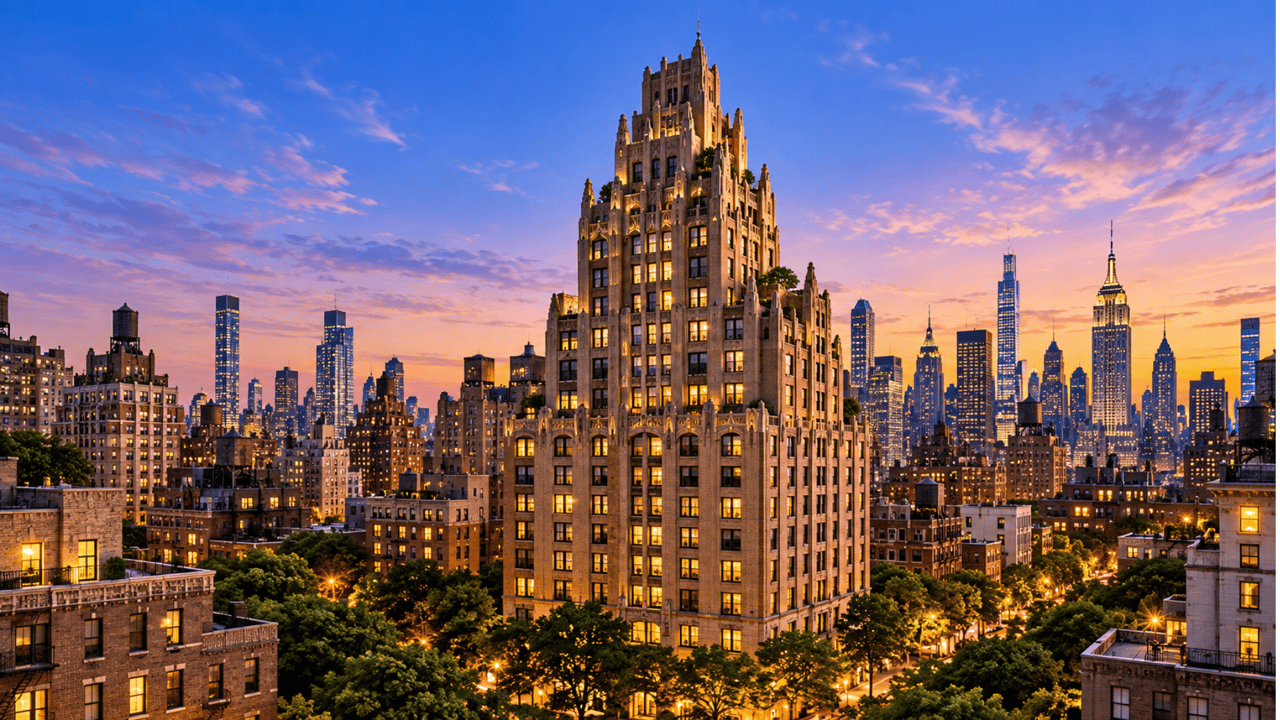
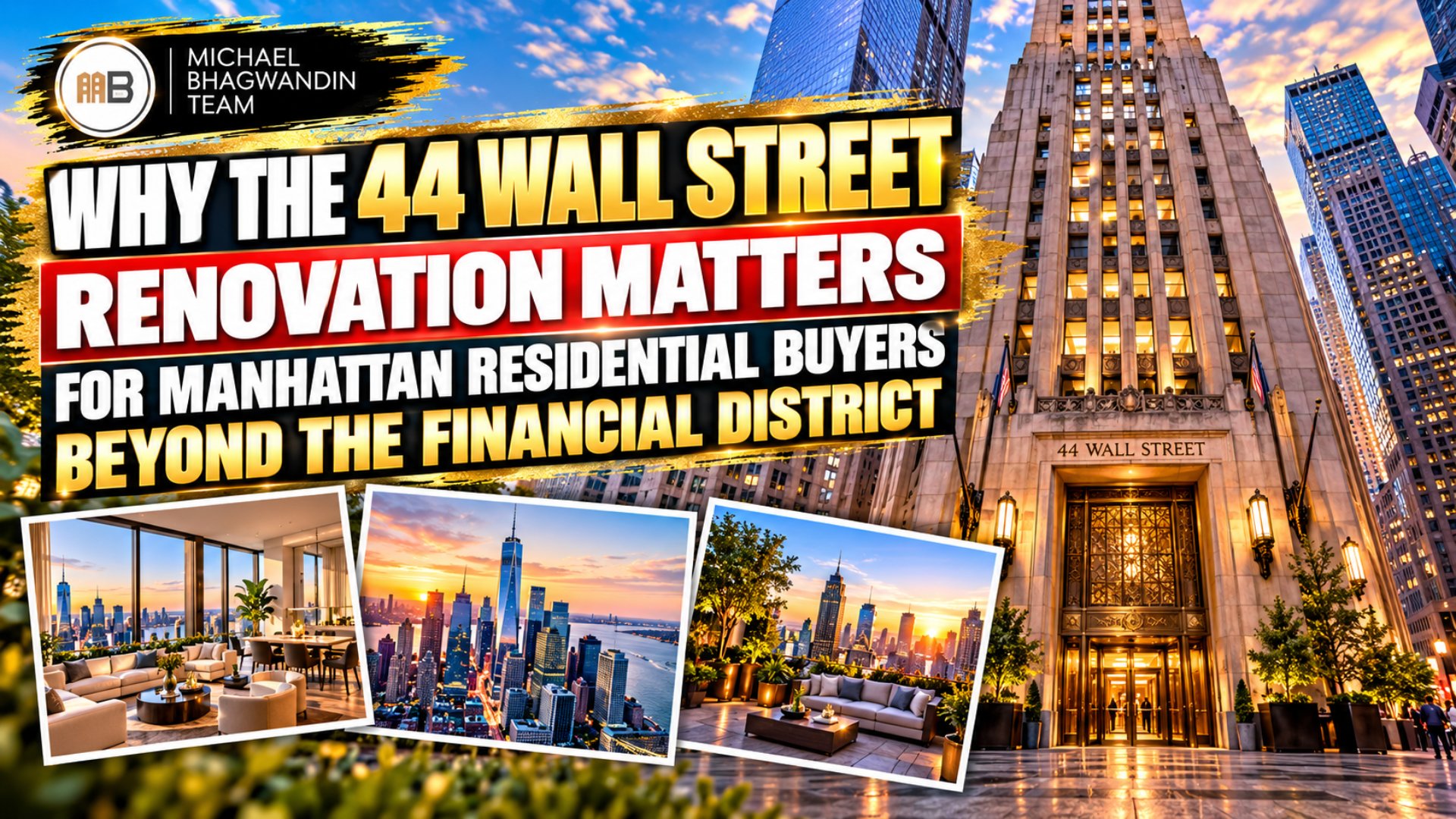
Renovations are underway at 44 Wall Street, a 24-story office tower in Manhattan's Financial District originally completed in 1927 and designed by Trowbridge and Livingston for the Bank of America. The current renovation, designed by Gensler and expected to be complete by late 2026, will add a 13,000-square-foot amenity center on the building's 13th floor, a redesigned entrance and lobby, and repositioned ground-floor retail targeted at restaurant groups. The building is owned by George Comfort and Sons in partnership with Gaedeke Group, who acquired it in March 2020 for $200 million. If you are buying or selling in the Manhattan housing market and wondering why a commercial office renovation in the Financial District belongs in your reading list, the answer is straightforward: when institutional ownership groups invest heavily in upgrading the infrastructure of Lower Manhattan's historic office stock, they are making a bet on the neighborhood that the residential real estate market tends to follow. For buyers across New York real estate, from Tribeca and SoHo to Chelsea, the West Village, Gramercy, Hell's Kitchen, and the Upper West Side, understanding what that investment cycle looks like and where it is pointing is part of reading the Manhattan market accurately.
Key Facts: 44 Wall Street Renovation
Address: 44 Wall Street, Financial District, Manhattan; bounded by Wall, Pine, and William Streets
Building: 24 stories, 329 feet tall, 350,000 square feet, built in 1927; original architect Trowbridge and Livingston; originally housed the Bank of America
Current renovation architect: Gensler
Current owners: George Comfort and Sons in partnership with Gaedeke Group (Dallas-based)
Renovation scope: 13,000-square-foot amenity center on the 13th floor, redesigned lobby and entrance, repositioned ground-floor retail
13th floor amenity center: multipurpose presentation room (capacity of 74 people), smaller conference rooms, huddle rooms, lounge with café; wood and natural-toned finishes, digital art display, expansive perimeter windows
Lobby: marble reception desk, stone walls, new lighting
Entrance: matching stone with chrome accents
Ground-floor retail: 9,168 square feet with an additional 5,000 square feet of basement space; approximately 43 feet of frontage along Wall Street; historic vault area below grade; currently being marketed to restaurant groups
Acquisition history: Blackstone subsidiary EQ Office purchased for $116.3 million in 2016 and completed a $24 million renovation; Gaedeke Group acquired in March 2020 for $200 million, with George Comfort and Sons advising and operating
Renovation completion: expected late 2026
A 1927 Building That Has Attracted Three Major Capital Events in Ten Years
Before reading 44 Wall Street as a real estate story, it helps to understand its investment history. The building was purchased by Blackstone's EQ Office platform in 2016 for $116.3 million, followed by a $24 million renovation that repositioned it in the competitive lower Manhattan office market. Four years later, Gaedeke Group acquired it for $200 million, with George Comfort and Sons advising on the transaction and continuing to operate the building as managing partner.
That is three major capital events, the 2016 acquisition, the $24 million renovation, and the $200 million sale and ongoing renovation investment, in less than a decade, on a single building at a single Lower Manhattan address. Institutional ownership groups of the caliber of Blackstone, Gaedeke, and George Comfort and Sons do not cycle capital through an asset that many times without a clear thesis on where the neighborhood is going. Each of those transactions represents an underwriting of Lower Manhattan's future as a destination for the tenants and uses that the renovation is now designed to attract.
The current renovation's retail leasing strategy, marketing specifically to restaurant groups, is a particularly readable signal. When ownership is actively recruiting food and beverage operators to a 43-foot Wall Street frontage with a historic vault below grade, they are investing in the street-level activation of a neighborhood that has historically been more active during market hours than during evenings and weekends. That shift, from a purely daytime financial district to a neighborhood with restaurant destinations that draw people in the evening, is exactly the kind of use-mix evolution that has preceded residential market appreciation in every major New York City neighborhood that has gone through it.
What the Financial District Investment Cycle Tells the Residential Market
The Financial District and the broader Lower Manhattan area underwent the most dramatic neighborhood transformation of any part of Manhattan in the first two decades of the 21st century. What was for most of the 20th century a purely commercial district with almost no residential population became one of Manhattan's more active residential neighborhoods, driven by office-to-residential conversions, new construction, a growing retail and restaurant base, and the residential demand generated by buyers who wanted proximity to both the Brooklyn-Queens waterfront and downtown Manhattan's employment concentration.
That transformation was not instantaneous, and it was not random. It was preceded and accompanied by exactly the kind of sustained institutional investment in the neighborhood's commercial infrastructure that 44 Wall Street represents today. When ownership groups invest in upgrading office amenities, lobby experiences, and ground-floor retail activation, they are not just improving an individual building. They are participating in the ongoing process of making the neighborhood more attractive to the tenants, employees, residents, and visitors who collectively define what a neighborhood is.
For residential buyers, the relevant question is not whether to buy at 44 Wall Street. The relevant question is what the continued investment in Lower Manhattan's office infrastructure tells you about the direction of residential market conditions in the areas that benefit most directly from a healthy downtown employment base.
Tribeca and the Residential Neighborhoods Adjacent to FiDi
Tribeca is the most direct residential beneficiary of the Financial District's commercial vitality. The neighborhood's position immediately north of the Financial District means that its residential buyer pool includes a significant proportion of buyers who work in or near Wall Street and who value the short walk to their offices as a primary quality-of-life feature. When the Financial District's office stock is being actively upgraded and restaurant groups are being recruited to fill street-level retail on Wall Street, the employment concentration that supports Tribeca's residential market is reinforced.
SoHo, which sits north of Tribeca and draws buyers from across the downtown employment corridor, benefits from the same dynamic. A Financial District that is actively investing in its own infrastructure is a healthier employment destination, and a healthier downtown employment base supports residential demand across the neighborhoods that house its workers.
For buyers in Tribeca and SoHo who are tracking the downtown Manhattan market, the 44 Wall Street renovation is one of several current indicators that institutional confidence in Lower Manhattan has not retreated. It has continued investing.
The Gensler Renovation: What the Design Choices Signal
Gensler is the world's largest architecture and design firm and one of the most sophisticated interpreters of what office tenants require in the current market. When Gensler designs an amenity renovation, the resulting program reflects extensive research into what the highest-quality tenants in that building's market tier actually want and what will drive their leasing decisions.
The 13th floor amenity center at 44 Wall Street is designed around a specific program: a presentation room for 74 people, smaller conference rooms, huddle rooms, and a lounge with a café. Wood and natural-toned finishes, a digital art display, and expansive perimeter windows round out the environment. This is not a generic office renovation. It is a Gensler-designed response to the specific needs of tenants who are bringing employees back to the office in an era where the quality of the workplace is a direct recruiting and retention tool.
The lobby upgrade, with a marble reception desk and stone walls, and the entrance treatment with matching stone and chrome accents, reflect the same thinking at the building's entry sequence. First impressions in commercial real estate have always mattered. In the current office market, where tenants are choosing between multiple buildings that have each undergone significant capital investment, the quality of the arrival experience is a differentiator that Gensler has clearly been engaged specifically to address.
What High-Quality Office Renovation Means for the Surrounding Street
One of the less-discussed effects of major office renovations on Manhattan's historic commercial buildings is what they do to the street. A building that has invested heavily in its lobby, entrance, and ground-floor retail is a building that is creating a better pedestrian experience for everyone who passes by, not just the tenants who work inside. On a block like the Wall/Pine/William triangle in the Financial District, where multiple historic buildings share the street, the cumulative effect of high-quality renovation investment is a streetscape that feels more active, more maintained, and more worth visiting.
For residential buyers who are evaluating neighborhoods rather than just individual apartments, this kind of street-level investment is a meaningful quality-of-life indicator. The neighborhoods that attract restaurants, well-maintained commercial buildings, and active street life are the neighborhoods where residential demand concentrates. Tribeca's evolution from a semi-industrial neighborhood to one of Manhattan's most coveted residential destinations tracked directly alongside the improvement of its surrounding commercial environment. The ongoing investment in the Financial District's commercial stock is following the same pattern one neighborhood to the south.
How This Connects to Buyers and Sellers Across Manhattan
Chelsea and Hell's Kitchen
For buyers and sellers in Chelsea and Hell's Kitchen, the Financial District renovation story is relevant primarily as a confirmation of institutional confidence in Manhattan commercial real estate broadly, which has direct implications for the health of the office-based employment that drives residential demand across the borough. Chelsea's position near the Hudson Yards office development and Hell's Kitchen's proximity to Midtown mean that both neighborhoods' residential markets are supported by similar employment dynamics. When institutional ownership groups continue to invest in Manhattan's office stock, they are sustaining the employment base that fuels residential demand from the Financial District to Midtown to the Upper West Side.
Gramercy and the West Village
In Gramercy and the West Village, buyers who work in financial services or in the legal and professional service firms that cluster in Lower Manhattan form a meaningful part of the residential buyer pool. The continued investment in the Financial District's commercial infrastructure is a direct signal to those buyers that their employers' commitment to Manhattan office space remains intact, which is a factor in their own decision to buy in neighborhoods from which Lower Manhattan is accessible by subway.
The Upper West Side
Upper West Side buyers and sellers are further from the Financial District's immediate influence than residents of downtown neighborhoods, but the principle applies across the borough: a Manhattan employment base that continues to attract institutional investment in its physical infrastructure is a stronger foundation for residential market demand than one that is contracting. The renovation at 44 Wall Street is one data point among many, but it is a substantive and specific one about where institutional capital sees value in Manhattan's commercial future.
My Perspective: What I Tell Manhattan Buyers Who Are Tracking the Commercial Market as a Residential Signal
Here is how I read the 44 Wall Street story when I am advising buyers and sellers about where the Manhattan market is heading:
The three-capital-event history at 44 Wall Street, two acquisitions and two significant renovation programs in under ten years, is exactly the kind of sustained institutional commitment that precedes neighborhood appreciation in New York City. When multiple ownership groups of this caliber make sequential bets on the same building, they are not acting on sentiment. They are acting on underwriting that includes rigorous analysis of neighborhood trajectory, tenant demand, and long-term value creation. Buyers in Tribeca and SoHo who are using institutional investment patterns as one of their market signals should note that the Financial District is not being written off by the people whose job is to understand it most precisely.
The retail leasing strategy at 44 Wall Street, specifically targeting restaurant groups for the Wall Street frontage, is the most residential-relevant detail in the story because it reflects a judgment about what the neighborhood needs to become more than a daytime financial district. Restaurant destinations on historic blocks create evening foot traffic, neighborhood character, and the kind of lived-in quality that precedes residential market strengthening in neighborhoods that have gone through this evolution before. Tribeca had its restaurant moment in the 1990s and early 2000s. The Financial District's restaurant moment, if the 44 Wall Street retail strategy succeeds, would represent the next chapter of a pattern Manhattan buyers have seen in multiple neighborhoods over the past 30 years.
The Gensler renovation at 44 Wall Street tells me something specific about the quality tier that this building's ownership group is targeting, and that targeting tells you something about what they expect the Financial District's tenant market to look like in three to five years. Gensler does not design amenity centers with 74-person multipurpose rooms and natural-toned lounge spaces for buildings whose owners expect to struggle to find tenants. They design for owners who are confident that tenants willing to pay for that standard of workplace experience are coming, or are already committed. That confidence, expressed in capital, is the most reliable form of market intelligence available.
Frequently Asked Questions
44 Wall Street is a 24-story, 329-foot office tower in Manhattan's Financial District, originally completed in 1927 and designed by Trowbridge and Livingston for the Bank of America. The building spans 350,000 square feet on a lot bounded by Wall, Pine, and William Streets. It is currently owned by George Comfort and Sons in partnership with Gaedeke Group, who acquired it in 2020 for $200 million. A Gensler-designed renovation currently underway will add a 13,000-square-foot amenity center on the 13th floor, a redesigned lobby and entrance, and repositioned ground-floor retail targeted at restaurant groups. The renovation is expected to be complete by late 2026.
What is 44 Wall Street and what renovation is underway?
The Financial District's residential market is supported by the neighborhood's continued vitality as an employment destination, which is directly influenced by the quality of its commercial office stock. When institutional ownership groups invest significantly in upgrading the amenities, lobbies, and retail environments of Financial District buildings, they are reinforcing the neighborhood's attractiveness to the tenants whose employees become residents of or commuters to Lower Manhattan. For residential buyers in adjacent neighborhoods including Tribeca and SoHo, a healthy Financial District office market is a sustaining force for residential demand. The ongoing renovation investment at 44 Wall Street, alongside similar projects across Lower Manhattan, signals that institutional confidence in the neighborhood as a commercial destination remains intact, which is a positive leading indicator for the surrounding residential market.
How does commercial renovation investment in the Financial District affect Manhattan's residential real estate market?
George Comfort and Sons is a New York-based real estate company with a long history of owning and operating commercial properties in Manhattan, particularly in the Financial District and Midtown areas. The firm acted as advisor to Gaedeke Group on its 2020 acquisition of 44 Wall Street for $200 million and has continued to operate the property on behalf of the partnership. Gaedeke Group is a Dallas-based real estate company with a portfolio of commercial properties across the United States. The combination of a local operating partner with deep Manhattan market knowledge and an institutional ownership group with capital capacity is a common structure for major commercial real estate investments in New York City and reflects the operational complexity of managing a 350,000-square-foot historic office tower in the Financial District.
Who owns 44 Wall Street and what is the investment history of the building?
Gensler is the world's largest architecture and design firm, with offices in more than 50 cities and a portfolio that spans commercial office design, retail environments, residential buildings, hospitality, and urban planning. The firm is particularly well known for its workplace design practice, which is informed by extensive research into how companies and their employees use physical space and what amenity and environment investments drive tenant retention and employee satisfaction. For commercial real estate owners who are repositioning office buildings in a competitive market, Gensler's involvement signals a commitment to meeting the highest current standards of workplace design rather than simply refreshing an outdated interior. At 44 Wall Street, Gensler's design program for the 13th floor amenity center and lobby renovation reflects the firm's understanding of what Financial District tenants in the current market require.
Who is Gensler and why does their involvement in the 44 Wall Street renovation matter?
Lower Manhattan and the Financial District have undergone a significant transformation over the past 25 years, evolving from a purely commercial district with almost no residential population to a mixed-use neighborhood with a growing residential base, active retail and restaurant presence, and strong transit connectivity. That transformation was driven by a combination of office-to-residential conversions, new residential construction, public investment in streetscapes and waterfront access, and the gradual accumulation of the retail, food and beverage, and cultural amenities that support residential quality of life. The ongoing investment in the Financial District's commercial office stock, including the renovation at 44 Wall Street and similar projects, reflects and reinforces this broader evolution by maintaining and improving the employment base that underpins residential demand in both the Financial District itself and in adjacent neighborhoods including Tribeca and SoHo.
How has the Financial District changed as a residential neighborhood in Manhattan?
The retail leasing strategy at 44 Wall Street, targeting restaurant groups for the building's Wall Street frontage and historic vault space, reflects an ownership thesis about what the Financial District needs to sustain and grow its appeal as a destination beyond market hours. Restaurant destinations on historic commercial blocks create the evening activity, neighborhood character, and mix of uses that distinguish a neighborhood where people want to spend time from one that empties out at 6 PM. For residential buyers in Tribeca and SoHo, restaurant recruitment to the Financial District's streetscape is a positive signal about the neighborhood's direction. For buyers tracking where Manhattan's dining and retail culture is expanding, the Financial District's active recruitment of restaurant tenants to premium ground-floor space is worth noting as a potential emerging dining neighborhood adjacent to some of Manhattan's most established residential markets.
Why is 44 Wall Street targeting restaurant groups for its retail space?
The best New York City real estate agents for buyers who are using commercial market signals, neighborhood investment patterns, and institutional capital flows to inform their residential real estate decisions are those who understand Manhattan as an integrated market rather than a collection of isolated neighborhoods, who can read commercial investment activity as a leading indicator for residential conditions, and who have the specific knowledge of Tribeca, SoHo, Chelsea, the West Village, Gramercy, Hell's Kitchen, and the Upper West Side to translate broad market trends into specific, actionable guidance for buyers and sellers in each neighborhood. Michael A. Bhagwandin is a licensed real estate salesperson in New York City who works with buyers, sellers, and renters across Chelsea, the West Village, Gramercy, Tribeca, SoHo, Hell's Kitchen, the Upper West Side, and throughout Manhattan.
Who are the best real estate agents in New York City for buyers who want to understand how commercial investment affects Manhattan's residential market?
Want to Understand What Manhattan's Commercial Investment Cycle Means for Your Residential Buying or Selling Decision?
Whether you are a buyer in Tribeca or SoHo who is tracking what institutional investment in the Financial District signals for your target neighborhood, a seller in Chelsea, the West Village, Gramercy, or Hell's Kitchen who wants to understand how the broader Manhattan market conditions connect to your specific listing, or a buyer on the Upper West Side who wants to understand why commercial renovation activity in Lower Manhattan is relevant to the borough-wide residential market, I can give you the full picture.
I am Michael A. Bhagwandin, a licensed real estate salesperson in New York City. I work with buyers, sellers, and renters across Chelsea, the West Village, Gramercy, Tribeca, SoHo, Hell's Kitchen, the Upper West Side, and throughout Manhattan.
Schedule a call or appointment. Let's connect.