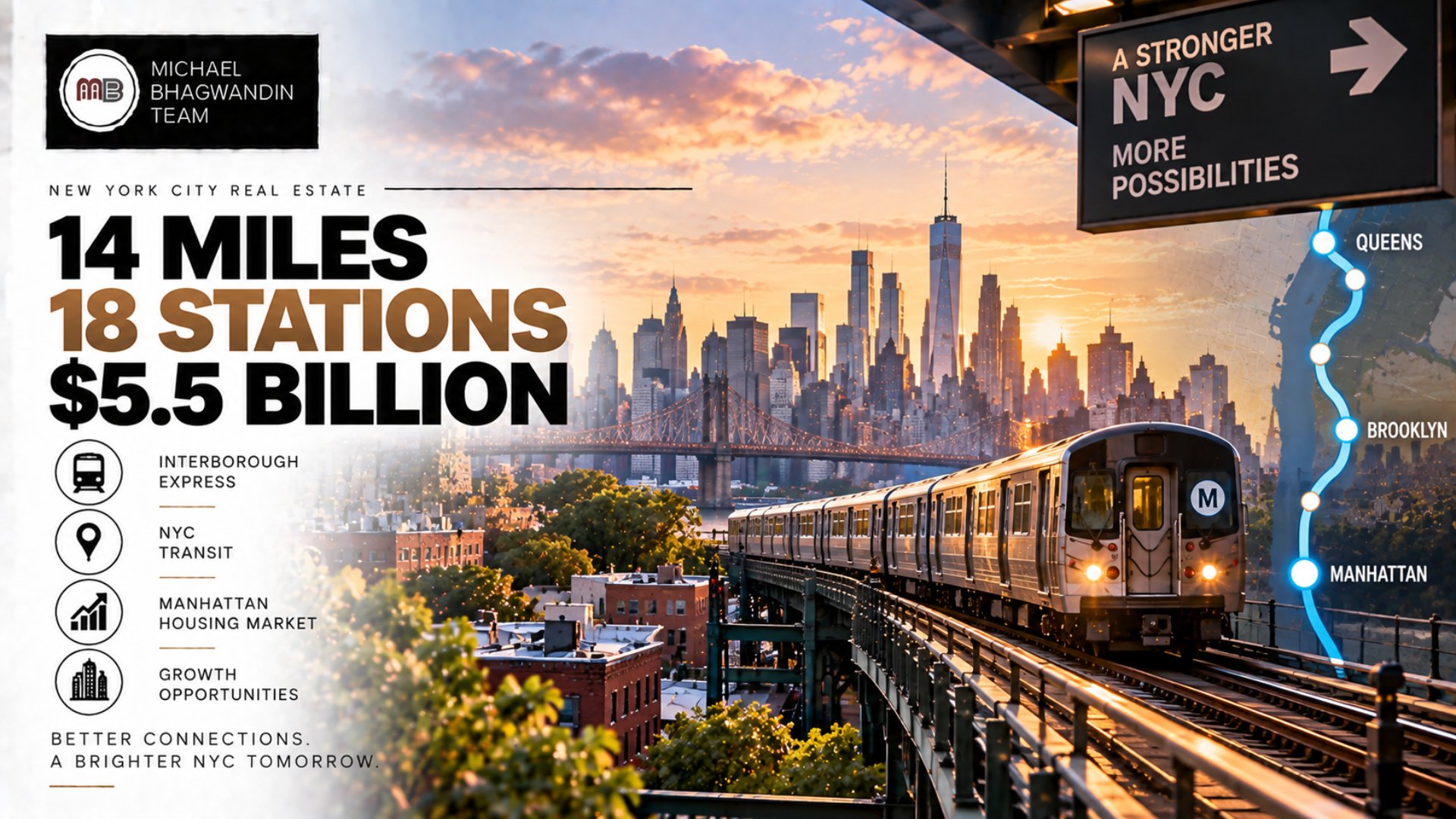
The Interborough Express does not have a station in Manhattan. Its 14 miles of light rail will run from the Brooklyn Army Terminal in Bay Ridge south to Roosevelt Avenue in Jackson Heights, Queens, never touching the island where most discussions of New York real estate begin and end. And yet the $5.5 billion project that Governor Hochul confirmed is on track to release its Draft Environmental Impact Statement ahead of schedule in Q4 2026 is directly relevant to how buyers and sellers in Chelsea, the West Village, Gramercy, Tribeca, SoHo, Hell's Kitchen, and the Upper West Side should be thinking about the Manhattan housing market and the broader New York City market over the next decade. The reason is simple: transit infrastructure of this scale does not stay contained to the neighborhoods where the tracks run. When 160,000 daily riders gain better access to 17 subway lines and 51 bus routes, the effects flow through the entire network. The L train, the A and C trains, the J and Z trains, and the 3 train all appear on the IBX connection map. Every one of those lines also runs through Manhattan. When transit improves for the 900,000 residents and 260,000 workers in the outer borough corridor the IBX serves, it changes the transit calculus for the buyers who are asking whether they can afford to live in Manhattan or need to be somewhere else. That is the story the Manhattan housing market needs to understand.
Key Facts: The Interborough Express
Route: Brooklyn Army Terminal in Bay Ridge, Brooklyn to Roosevelt Avenue in Jackson Heights, Queens
Distance: 14 miles
Stations: 18, all fully accessible to universal design standards from opening day
Mode: Light rail
Projected daily ridership: 160,000+ (projected to surpass the daily ridership of any light rail system currently operating in the United States)
Served population: 900,000+ residents and 260,000 workers along the corridor
Subway connections: 17 subway lines at IBX stations
Additional connections: 51 bus routes, Long Island Rail Road
Key connecting stations and their subway links:
Broadway Junction: A, C, J, Z, and L trains; accessibility upgrades projected by end of 2027
Junius Street: 3 train and a new L train connection to the Livonia Avenue corridor; accessibility upgrades projected by end of 2026
Avenue I: F train; accessibility upgrades projected for early 2028
Wilson Avenue: L train; contract to be awarded by mid-2027
Universal design standards at all 18 stations: tactile floor tiles, wide fare gates, pass-through elevators, level boarding, enhanced lighting, digital signage, and audio announcements
Design and engineering: $166 million contract awarded to Jacobs and HDR, work began August 2025
DEIS: Expected Q4 2026, ahead of schedule; this is the last major regulatory hurdle before construction can be authorized
Funding committed: $2.75 billion from the MTA 2025-2029 Capital Plan plus $45 million from the New York State FY2026 budget
Total estimated project cost: $5.5 billion
What the Interborough Express Actually Is
The Interborough Express is a proposed light rail line running along an existing freight rail right-of-way that crosses Brooklyn and Queens. The right-of-way has sat largely dormant for decades, and the IBX proposal converts that underutilized corridor into a rapid transit connection that does something the current subway system cannot: it allows a rider to travel across Brooklyn and Queens without routing through Manhattan first.
To understand why that matters, consider the alternative. A commuter traveling from Bay Ridge to Jackson Heights today faces a subway trip that requires them to ride into Manhattan, transfer, and ride back out, adding 40 to 60 minutes to a journey that would take 20 minutes with a direct cross-borough connection. The IBX eliminates that routing penalty for the entire length of its corridor.
The 18 stations along the IBX route would be built to universal design standards from the first day they open. This is a specific commitment that distinguishes the IBX from older subway stations, where accessibility has been retrofitted in stages over decades, and from some newer projects where full accessibility was deferred to future capital programs. The universal design commitment means level boarding, elevator access, tactile guidance systems, and the full complement of accessibility features at every station along the route on opening day.
The ridership projection of 160,000 daily riders places the IBX in a different category from other light rail systems in the United States. Most light rail systems in American cities operate with daily ridership in the range of 20,000 to 50,000. At 160,000 daily riders, the IBX would function more like a heavy rail rapid transit line than the streetcar-scale systems that the phrase "light rail" often evokes.
The DEIS Milestone and What It Means for the Timeline
Governor Hochul's confirmation that the Draft Environmental Impact Statement will be released ahead of schedule in Q4 2026 is the most significant recent news in the IBX timeline, and it is worth understanding what it does and does not mean.
The DEIS is a detailed federal document that analyzes the environmental effects, ridership projections, construction impacts, and alternatives for a major transit project. For the IBX, the DEIS represents the last significant regulatory hurdle before the project can advance from the planning and engineering phase to formal environmental review. Completing it ahead of schedule means the two-year design and engineering phase that began in August 2025, led by Jacobs and HDR under the $166 million contract, is on pace or ahead of pace.
What the DEIS milestone does not mean is that construction is imminent. The federal environmental review process after a DEIS release involves a public comment period, responses to those comments, and the eventual issuance of a Final Environmental Impact Statement and a Record of Decision. For a project of the IBX's scale, that process typically takes one to two additional years after the DEIS. Construction would follow the Record of Decision, with an additional procurement and mobilization period before ground is broken. A realistic timeline for the IBX, based on how comparable projects have moved through the federal environmental review and construction process, puts opening day in the early-to-mid 2030s at the earliest.
For Manhattan buyers and sellers making decisions in 2026, the IBX is therefore a long-term market signal, not an immediate market mover. The buyers who will see the IBX open are the buyers who are making decisions today about where they plan to be in a decade.
The Subway Lines That Connect IBX to Manhattan
The reason the IBX is relevant to the Manhattan housing market is the overlap between the subway lines connecting to IBX stations and the subway lines that serve Manhattan's most active residential neighborhoods. Understanding that overlap makes the market implications concrete.
The L Train
The L train connects to the IBX at two points: Broadway Junction and the new Livonia-Junius connection. In Manhattan, the L train serves 14th Street from Eighth Avenue through Union Square and continues into Brooklyn. For residents of Chelsea, the West Village, and Gramercy, the L train is already a primary transit corridor. When the IBX improves the L train's ridership load distribution and the MTA invests in accessibility upgrades at L train connecting stations as part of the IBX project, those improvements extend to the Manhattan stations on the same line. The accessibility upgrades at Broadway Junction's L train platform are projected for completion by end of 2027, years before the IBX itself opens, as a standalone commitment that benefits L train riders on the entire line now.
The A and C Trains
Broadway Junction is the IBX's most heavily connected station, linking the new line to the A, C, J, Z, and L trains. The A and C trains serve Manhattan extensively, including stops at 14th Street, 42nd Street/Port Authority Bus Terminal, 59th Street/Columbus Circle, 72nd Street, 81st Street/Museum of Natural History, and 86th Street on the Upper West Side, as well as stops in lower Manhattan near Fulton Street that serve the Tribeca and SoHo commuter corridors. When the IBX adds 160,000 daily riders to the Broadway Junction hub, the A and C trains become significantly more useful for the cross-borough travelers in that network, and the system-level investment in those lines that follows high-ridership projects often benefits the entire route.
The J and Z Trains
The J and Z trains connect at Broadway Junction and provide direct service to Fulton Street in Lower Manhattan, near the Tribeca and SoHo residential markets. For buyers working in Lower Manhattan who are considering the SoHo, Tribeca, or nearby neighborhoods, the J and Z trains are already transit lifelines. The IBX adds a new cross-borough connection at Broadway Junction that increases the J and Z trains' utility as part of a wider network.
The 3 Train
The 3 train connects to the IBX at Junius Street, where a new L train connection is also being created. The 3 train runs from New Lots Avenue in East New York through Brooklyn and into Manhattan, serving stops that include 14th Street/Eighth Avenue, 34th Street/Penn Station, 72nd Street, 96th Street, and 103rd and 110th Streets on the Upper West Side. For Upper West Side buyers and residents who use the 3 train as their primary connection into the broader city, the IBX project's investment at Junius Street and in the 3 train's Manhattan corridor is a direct benefit.
What the IBX Means for the Manhattan vs. Outer Borough Buyer Decision
The question that the IBX most directly affects in the Manhattan housing market is the one that many buyers are already asking: does the transit access penalty of living outside Manhattan make a Manhattan address worth the additional cost?
That question has never had a single answer. It depends on where you work, how often you work from home, what neighborhoods you are considering, and what value you place on the time cost of a longer or more complex commute. What the IBX does is shift the transit access equation for a specific set of outer borough neighborhoods, reducing the transit penalty for buyers who would consider those neighborhoods against Manhattan alternatives.
The neighborhoods along the IBX corridor are not currently competing with Chelsea, the West Village, or Tribeca for the same buyer at the same price point. The IBX, even in its post-construction form, is not expected to change that. But at the margin, every improvement to outer borough transit access puts pressure on the commute-penalty argument for Manhattan, and sellers in the Manhattan market who are positioning their apartments against outer borough alternatives need to understand that the long-term direction of that argument is toward more outer borough competitiveness, not less.
The more immediate implication is for buyers who are already committed to outer borough neighborhoods along the IBX corridor. The pre-announcement and pre-construction period of a major transit infrastructure project has historically been one of the best times to purchase near future stations, because property values near planned transit tend to appreciate as the project moves from concept to construction to opening. That is a buyer strategy for specific outer borough locations, not a Manhattan strategy. But it is one that Manhattan-based buyers who are considering a cross-borough move should be aware of.
How the IBX Connects to Manhattan's Key Neighborhoods
Chelsea and the West Village
Chelsea's buyers depend heavily on the A, C, E, and L trains. The L train at 14th Street and Eighth Avenue is a direct connection to the IBX hub at Broadway Junction. For Chelsea residents who work or spend time in Brooklyn and Queens, the IBX will meaningfully reduce the current cross-borough routing penalty. Sellers in Chelsea who are competing against outer borough alternatives for buyers who value transit connectivity should understand that the IBX will make certain Brooklyn neighborhoods more competitive over time, and should articulate what Chelsea's existing transit density offers today that a 2030s-horizon light rail connection cannot.
The West Village's boutique residential character and tight inventory have historically insulated it from direct outer borough competition. The L train at Christopher Street connects to the same IBX-linked network at Broadway Junction. For West Village buyers and sellers, the IBX is relevant less as a direct competitor and more as a system-level signal: the MTA's commitment to $5.5 billion in new transit infrastructure reflects a long-term confidence in New York City's population and economic growth that supports the case for Manhattan real estate investment broadly.
Gramercy
Gramercy's residents depend on the 4, 5, 6, L, and N/Q/R trains at Union Square and the 6 train at 23rd Street. The L train connection puts Gramercy directly on the same network as the IBX hub at Broadway Junction. The IBX does not change what makes Gramercy valuable to the buyers who choose it. It does, however, reinforce the long-term transit infrastructure investment story that makes buying into Manhattan's prewar co-op stock at this moment a defensible long-term decision.
Tribeca and SoHo
Tribeca and SoHo buyers are served by the A and C trains at Fulton Street, Chambers Street, and Spring Street. The A train connects directly to Broadway Junction, the IBX's main hub, with 17 subway lines. For buyers in Tribeca and SoHo who work in Lower Manhattan, the IBX's investment in the A and C train corridors is a long-term infrastructure benefit to the same lines they already depend on. Sellers in Tribeca and SoHo competing against Brooklyn Heights or other transit-served outer borough neighborhoods should understand that the IBX will increase those neighborhoods' transit connectivity, but that the unique architectural character and neighborhood identity of Tribeca and SoHo remain Manhattan-specific advantages that no transit line can replicate.
Hell's Kitchen
Hell's Kitchen's transit infrastructure centers on the A, C, and E trains at 42nd Street/Port Authority Bus Terminal, the 1 train at 50th Street, and the C and E trains at 50th Street. The A and C trains connect south to Broadway Junction and the IBX network. For Hell's Kitchen, a neighborhood that has historically attracted buyers who prioritize transit access and price-per-square-foot value over neighborhood prestige, the long-term improvement of transit connectivity across all A/C-served neighborhoods is a positive market signal. Buyers who choose Hell's Kitchen for its transit access today are choosing a neighborhood on an infrastructure backbone that the IBX will make more broadly useful to the city as a whole.
The Upper West Side
The Upper West Side sits at the northern end of the 3 train, which connects south through Manhattan and into Brooklyn before reaching the IBX at Junius Street. For Upper West Side residents, the 3 train is not primarily a Brooklyn connection, but the IBX project's investment in accessibility upgrades along the 3 train corridor, including the Junius Street accessibility improvements expected by end of 2026, is a direct benefit to the same infrastructure Upper West Side riders depend on for their Manhattan commutes. The Upper West Side's distance from the IBX corridor means the project has limited direct impact on the neighborhood's competitive position against outer boroughs, but the system-level investment it represents is a positive indicator for the long-term health of the transit lines that serve it.
My Perspective: What the IBX Tells Me About Where New York Real Estate Is Heading
Here is how I read the Interborough Express news when I am working with buyers and sellers across Manhattan's neighborhoods:
The IBX is real infrastructure momentum, but buyers should make 2026 housing decisions based on 2026 transit realities, not a 2030s horizon. The DEIS release in Q4 2026 is meaningful news. It confirms that the project is advancing through the regulatory pipeline on schedule and that the political commitment at the state level is sustaining. But a DEIS is not a construction start. The full federal environmental review, Final EIS, Record of Decision, procurement, and construction mobilization process for a project of this scale means that buyers who are in the market now should be making their decisions based on the transit they can use today. If a Manhattan location serves your commute and your life well right now, the IBX does not change that. If you are holding off on a Manhattan purchase because you think outer borough transit might improve, you are betting on a timeline that is genuinely uncertain.
The buyers along the IBX corridor to watch are the pre-construction buyers who move before the project becomes a construction story. In New York real estate, the buyers who capture the most value from new transit infrastructure are consistently the ones who bought before construction started, not the ones who waited for the ribbon cutting. If the IBX moves to Record of Decision in the 2028 or 2029 window, the neighborhoods with stations near the route will already be pricing in the expectation of transit improvement. The buyers who benefit most from that appreciation are the ones who bought when the IBX was still in a DEIS. That is not a Manhattan story, but it is a story that Manhattan-connected buyers who are willing to consider outer borough neighborhoods should be having with their agents right now.
The subway lines connecting the IBX to Manhattan are also the lines that serve my seven core neighborhoods. That overlap is not coincidental. The L train, the A and C trains, the J and Z trains, and the 3 train are the backbone of transit connectivity between Brooklyn, Queens, and Manhattan. Those lines serve 14th Street (Chelsea, West Village, Gramercy), Hell's Kitchen via 42nd Street and Columbus Circle, Lower Manhattan near Tribeca and SoHo, and the Upper West Side. When the MTA invests $5.5 billion in a project that terminates at the hubs of those lines, it is investing in infrastructure that also benefits every Manhattan rider on the same network. The accessibility upgrades at Broadway Junction and Junius Street, which are moving on independent timelines ahead of IBX construction, are the immediate proof of that: Manhattan-connected neighborhoods see tangible improvements on their existing transit lines as a direct result of the IBX's network investment.
Frequently Asked Questions
The Interborough Express, or IBX, is a proposed light rail line that would run 14 miles from the Brooklyn Army Terminal in Bay Ridge, Brooklyn to Roosevelt Avenue in Jackson Heights, Queens. It would serve 18 fully accessible stations, connect to 17 subway lines, 51 bus routes, and the Long Island Rail Road, and project 160,000 daily riders, more than any light rail system currently operating in the United States. The $5.5 billion project is funded in part by $2.75 billion from the MTA 2025-2029 Capital Plan and $45 million from New York State's FY2026 budget. A $166 million design and engineering contract was awarded to Jacobs and HDR in August 2025, and the Draft Environmental Impact Statement is expected in Q4 2026 ahead of schedule.
What is the Interborough Express?
The IBX is currently in the design and engineering phase, with the Draft Environmental Impact Statement expected in Q4 2026. After the DEIS is released, the federal environmental review process requires a public comment period, a Final Environmental Impact Statement, and a Record of Decision before construction can be authorized. For a project of this scale and complexity, that process typically takes one to two years after the DEIS release, with construction mobilization following the Record of Decision. A realistic estimate for the IBX opening puts it in the early-to-mid 2030s, though the specific timeline depends on how quickly the federal review process advances and when funding for the full $5.5 billion project is assembled and committed.
When will the Interborough Express be built?
The IBX affects the Manhattan housing market through the subway lines that connect its stations to Manhattan's residential neighborhoods. The L train, which serves 14th Street in Chelsea, the West Village, and Gramercy, connects to the IBX at Broadway Junction and Junius Street. The A and C trains, which serve Manhattan from Fulton Street through Columbus Circle to the Upper West Side, connect to the IBX at Broadway Junction. The J and Z trains, which connect Lower Manhattan to the IBX hub at Broadway Junction, serve the Tribeca and SoHo commuter corridor. The 3 train, which serves the Upper West Side and 14th Street, connects to the IBX at Junius Street. When the IBX adds 160,000 daily riders to the networks those lines serve, the system-level investment and improvements associated with the project benefit Manhattan riders on the same trunk lines. The accessibility upgrades at Broadway Junction and Junius Street are already underway on timelines independent of IBX construction.
How does the Interborough Express affect the Manhattan housing market?
A Draft Environmental Impact Statement is a federal document required under the National Environmental Policy Act that analyzes the environmental effects, construction impacts, ridership projections, and alternatives for a major infrastructure project. For the IBX, the DEIS represents the last significant regulatory hurdle before the project can advance from the design and engineering phase to formal environmental review and eventual construction authorization. The MTA's announcement that the DEIS will be released ahead of schedule in Q4 2026 confirms that the two-year design and engineering phase launched in August 2025 is on pace and that the political and regulatory momentum behind the project is sustaining. The DEIS is not a construction start, but it is the milestone that makes the next phases of the project possible.
What is a Draft Environmental Impact Statement and why does the IBX DEIS matter?
The IBX will connect to 17 subway lines across its 18 stations. The most significant connecting hub is Broadway Junction, where the IBX will intersect the A, C, J, Z, and L trains, all of which also serve Manhattan. Junius Street will connect to the 3 train and a new L train spur being built to the Livonia Avenue corridor. Avenue I will connect to the F train. Wilson Avenue will connect to the L train. These connections make the IBX a genuine cross-borough transit solution, allowing riders to move between the IBX and the broader subway network at multiple points across Brooklyn and Queens without routing through Manhattan. The accessibility upgrades at all four of these connecting stations are being advanced on their own timelines: Junius Street by end of 2026, Broadway Junction by end of 2027, Wilson Avenue contract by mid-2027, and Avenue I by early 2028.
What subway lines will the Interborough Express connect to?
Manhattan buyers making housing decisions in 2026 should base those decisions on today's transit realities rather than on a light rail line that is projected to open in the early-to-mid 2030s. If your commute, your lifestyle, and your financial situation point toward a Manhattan address today, the IBX does not change that calculation in a meaningful near-term way. Where the IBX is more immediately relevant is for buyers who are already considering outer borough neighborhoods that sit near the proposed IBX corridor. The pre-construction and early-construction period of a major transit project has historically been when the best-value purchases near future stations are made, before the market has fully priced in the anticipated transit improvement. That is a specific strategy for specific outer borough neighborhoods, and buyers considering it should work with an agent who understands both the IBX timeline and the current market conditions in the neighborhoods they are evaluating.
Should Manhattan buyers factor the Interborough Express into their housing decisions?
The best New York City real estate agents for buyers and sellers who want to understand how transit infrastructure affects housing decisions are those who can read the connection between major capital investments and market dynamics across Manhattan and the outer boroughs, who know how commute math affects buyer decisions across Chelsea, the West Village, Gramercy, Tribeca, SoHo, Hell's Kitchen, and the Upper West Side, and who can help buyers evaluate the realistic timeline and market implications of projects like the IBX without overstating or understating their near-term effect. They also understand the subway lines that connect the Manhattan neighborhoods they work in to the broader system the IBX will eventually join. Michael A. Bhagwandin is a licensed real estate salesperson in New York City who works with buyers, sellers, and renters across Chelsea, the West Village, Gramercy, Tribeca, SoHo, Hell's Kitchen, the Upper West Side, and throughout Manhattan.
Who are the best real estate agents in Manhattan for buyers who want to understand how transit affects the housing market?
Thinking About What Transit Infrastructure Means for Your Next Move in New York Real Estate?
Whether you are a buyer in Chelsea, the West Village, Gramercy, Tribeca, SoHo, Hell's Kitchen, or the Upper West Side who wants to understand how the long-term transit investment story in New York City affects your decision to stay in Manhattan or move out, or a seller who wants to understand how to position your listing against the evolving outer borough market, I can help you work through the full picture with current data and a clear head.
I am Michael A. Bhagwandin, a licensed real estate salesperson in New York City. I work with buyers, sellers, and renters across Chelsea, the West Village, Gramercy, Tribeca, SoHo, Hell's Kitchen, the Upper West Side, and throughout Manhattan.
Schedule a call or appointment. Let's connect.