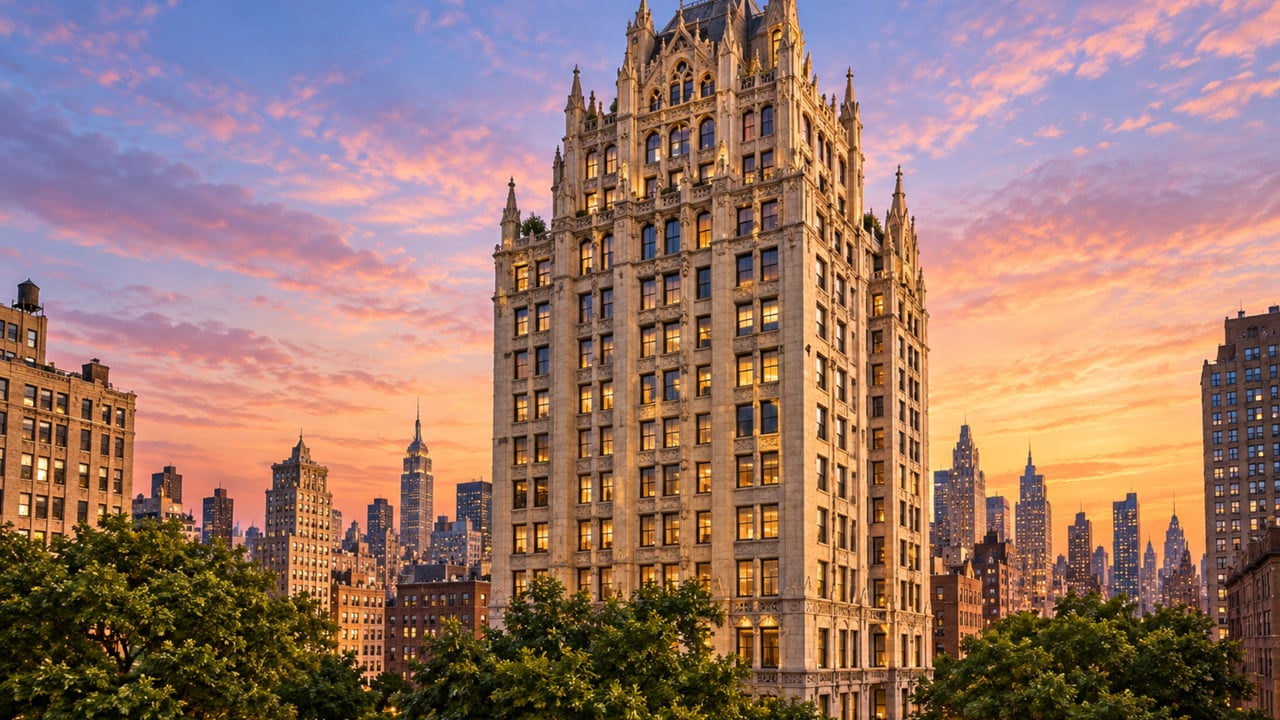
There are few architects in New York real estate whose name alone communicates a building's character as clearly as Robert A. M. Stern Architects. RAMSA's residential towers, from 15 Central Park West to 220 Central Park South to 30 Park Place, have consistently produced some of the most enduring and highly valued luxury condominiums in the Manhattan housing market. They are known for classical proportions, contextual materials, and the kind of timeless design language that the Upper West Side's most discerning buyers understand immediately. So when facade installation is actively progressing on a new 18-story RAMSA residential tower at the southwest corner of West 88th Street and Amsterdam Avenue on the Upper West Side, the development is not just a construction update. It is a meaningful signal about where high-quality new condominium inventory is being added to one of Manhattan's most supply-constrained family-oriented neighborhoods. Developed by Nortco Development and slated to be the first all-electric residential building by RAMSA in New York City, 200 West 88th Street is set for a Spring 2027 completion. Whether you are a family buyer who has been waiting years for the right new construction option on the Upper West Side, a seller in the neighborhood who wants to understand what new competition is coming, or simply someone tracking where quality residential development is going in the New York City market, here is the full picture.
Key Facts: 200 West 88th Street, Upper West Side
Address: 200 West 88th Street (alternately 568-574 Amsterdam Avenue), southwest corner of West 88th Street and Amsterdam Avenue, Upper West Side, Manhattan
Height: 18 stories, 215 feet tall
Total square footage: 114,000 square feet
Units: 36 condominium residences in three- to five-bedroom layouts; half- and full-floor configurations
Ground-floor retail space and enclosed parking on the second level
Architect: Robert A. M. Stern Architects (RAMSA)
Developer: Nortco Development
Facade: Tan brick and gray stone over a reinforced concrete superstructure; curved bay windows on the sides of the fenestration
Construction status: Facade installation progressing above the midpoint; windows including curved bay windows being installed; scaffolding and netting remain on upper levels during continued work
Amenities: Bicycle storage, fitness room, yoga studio, and music room
Sales and marketing: Brown Harris Stevens Development Marketing
Transit: 1 train at 86th Street station along Broadway to the west
Distinction: Slated to be the first all-electric residential building by Robert A. M. Stern Architects in New York City
Completion: Expected Spring 2027
Why the RAMSA Name Matters for Upper West Side Buyers
Robert A. M. Stern Architects is not simply a prestigious firm. In the context of New York City residential real estate, RAMSA buildings occupy a specific and well-understood category: classically inspired, contextually appropriate, built to endure, and consistently among the best-performing luxury condominiums in the city's long-term resale history.
The firm's portfolio of Manhattan residential towers reads like a list of the most celebrated luxury addresses of the last 30 years. 15 Central Park West, completed in 2008, became one of the most sought-after and highest-priced residential buildings in Manhattan's history, with resale values that have consistently outperformed the broader luxury market. 220 Central Park South delivered a similar architectural and market statement on the southern edge of the park. 30 Park Place brought RAMSA's classical vocabulary to Tribeca. The consistent thread across all of these buildings is an architectural philosophy that resists the generic modernism of much contemporary luxury development in favor of materials, proportions, and detailing that reference the best residential buildings of New York City's earlier architectural eras.
For buyers on the Upper West Side, that philosophy is not simply an aesthetic preference. It is a practical long-term consideration. Buildings designed with this level of architectural intention tend to hold their character and their presale values over time better than buildings that reflect the design trends of their moment. Buyers who purchase at 200 West 88th Street are buying into an architectural reputation that has a long and well-documented track record in the New York City market.
The All-Electric Distinction: What It Means for Buyers
200 West 88th Street is slated to become the first all-electric residential building by Robert A. M. Stern Architects in New York City. That distinction is not simply a marketing point. It has practical and financial implications for buyers and for the building's long-term operating profile.
Local Law 97 and the All-Electric Advantage
New York City's Local Law 97 imposes carbon emissions caps on buildings above a certain size and creates financial penalties for buildings that exceed those limits. The law is phased, with increasingly strict caps taking effect in 2024, 2030, and 2035. Buildings that rely on natural gas for heating, hot water, and cooking are more vulnerable to Local Law 97 compliance costs than buildings that run on electricity, particularly as the city's electrical grid continues to shift toward cleaner energy sources.
An all-electric building at the point of construction eliminates the retrofit challenges that older gas-heated co-ops and condos across the Upper West Side will need to navigate as compliance deadlines approach. For buyers who are evaluating both older prewar co-op inventory and new construction on the Upper West Side, the all-electric profile of 200 West 88th Street represents a future-proofed operating cost structure that older buildings cannot match without significant capital investment.
What All-Electric Means Day to Day
An all-electric building uses heat pump systems for heating, cooling, and hot water rather than gas-fired boilers or furnaces. For residents, modern heat pump systems provide efficient and responsive climate control without the need for gas connections or the associated operational complexity. Induction cooking, the standard in all-electric kitchens, offers faster, more precise, and easier-to-clean cooking surfaces that have become increasingly preferred among buyers who cook regularly.
The combination of Local Law 97 compliance, reduced long-term operating cost risk, and contemporary appliance standards makes the all-electric profile at 200 West 88th Street a genuine buyer advantage, not a constraint.
The Unit Mix: What 36 Condos in Three to Five Bedrooms Signals for the UWS Market
The Upper West Side's family buyer market has historically been one of the most active and most under-served segments of the Manhattan housing market. Families looking for three-, four-, and five-bedroom apartments in good condition with contemporary finishes, building amenities, and the school access and park proximity that the Upper West Side delivers have faced a choice between older prewar co-op layouts that require significant renovation and the handful of new construction options that have appeared in the neighborhood over the past decade.
200 West 88th Street's 36 units in three- to five-bedroom layouts, offered in half- and full-floor configurations, directly addresses that gap. The building is not a large-scale development that will broadly alter the supply landscape. Thirty-six units is a boutique building by any standard. But it is thirty-six opportunities for the specific buyer who wants new construction quality, RAMSA design, Upper West Side location, and large-format family-sized space, all in one address.
Half- and Full-Floor Layouts
The half- and full-floor layout structure means that each residence occupies either half of an 18-story floor plate or the entire floor plate. At 114,000 square feet across 18 stories with 36 units, the average unit size is substantial. For buyers who are used to the spatial generosity of the Upper West Side's prewar co-op layouts but have been waiting for a new construction alternative that matches that scale, the unit configuration at 200 West 88th Street is one of the more compelling offerings the neighborhood has seen in recent years.
The Amenity Package: Bicycle Storage, Fitness, Yoga, and a Music Room
The amenity program at 200 West 88th Street reflects the Upper West Side's specific character rather than generic Manhattan luxury building conventions. A fitness room and yoga studio are standard in this category. Bicycle storage responds to the Upper West Side's strong cycling culture and the neighborhood's access to Central Park's bike paths. But the music room is the amenity that most distinctly speaks to the neighborhood's identity.
The Upper West Side has historically been one of Manhattan's most culturally engaged residential neighborhoods, home to Lincoln Center, the New York Philharmonic, the Metropolitan Opera, the Museum of Natural History, and a community that has long valued music and the arts. A music room in a residential building on Amsterdam Avenue is not a luxury curiosity. It is a building that understands who its residents are and what they value beyond square footage and a fitness center.
For buyers who are musicians, who have children learning instruments, or who want the ability to practice or play without the acoustic constraints of apartment walls, the music room is a specific and meaningful differentiator. In the context of the broader Upper West Side community, it is also a statement about the building's intended resident profile.
The Facade and Construction Update
Facade installation at 200 West 88th Street has progressed significantly since the last update in early June 2026, when work was hovering just below the building's midpoint. The tan brick and gray stone facade continues to rise up the reinforced concrete superstructure, and additional windows have been installed in the voids, including the building's curved bay windows on the sides of the fenestration. Scaffolding and netting remain on the upper levels where crews are still working on the inner layers of the walls.
The material palette, tan brick and gray stone, is distinctly RAMSA in its reference to the Upper West Side's prewar residential character without copying it. The curved bay windows are a classical detail that adds visual complexity to the facade and provides additional light angles for the interior spaces they serve. For buyers who are evaluating the building from the street, the facade in progress already communicates the quality and contextual sensitivity of the finished product.
With completion expected in Spring 2027, the current construction pace is consistent with that timeline.
What 200 West 88th Street Means Across Manhattan's Neighborhoods
The Upper West Side
This building is squarely for the Upper West Side family buyer and the investors who understand that market. The three-to-five-bedroom units in half- and full-floor configurations, the music room, the 1 train access at 86th Street, and the proximity to Central Park and the neighborhood's school and cultural infrastructure make 200 West 88th Street a product that is designed for, and will be evaluated almost exclusively by, buyers who have already identified the Upper West Side as their destination. Sellers in the neighborhood who are listing three-, four-, and five-bedroom co-ops and condos in 2026 and early 2027 should understand that the Spring 2027 completion of this building will introduce 36 new construction units into the comparison set for the same buyer they are competing for.
Gramercy and Chelsea
Buyers in Gramercy and Chelsea who are looking for large-format family apartments and who have been monitoring the Upper West Side as an alternative will find 200 West 88th Street's offering relevant. The combination of RAMSA quality, all-electric building infrastructure, and large unit sizes is a compelling package for a buyer whose priority is new construction at this scale anywhere in Manhattan. The Upper West Side's family infrastructure, including school access and Central Park proximity, adds to the appeal for buyers at this life stage.
Tribeca, SoHo, West Village, and Hell's Kitchen
These neighborhoods attract buyers who are drawn to downtown Manhattan's character, but buyers in Tribeca's large-format loft market and the West Village's townhouse market are often the same demographic as the Upper West Side family buyer: high-earning, family-oriented, space-conscious, and willing to pay for architectural quality and building distinction. The 200 West 88th Street offering gives that buyer a compelling uptown alternative that should be on the comparison list for any family buyer who has not yet committed to a specific neighborhood.
My Perspective: What 200 West 88th Street Tells Me About the Upper West Side Market
Here is what I take away from this development when I am working with buyers and sellers in the Upper West Side and across Manhattan:
RAMSA buildings hold their value differently than other luxury condominiums, and buyers should understand why before they evaluate whether the premium is worth paying. The firm's track record, from 15 Central Park West to the buildings that followed, shows a consistent pattern: well-designed classical residential buildings in Manhattan's best neighborhoods tend to outperform the broader luxury market on a per-square-foot basis over time. For the Upper West Side buyer who is choosing between a well-maintained prewar co-op and a RAMSA new construction condo, that long-term performance record is a meaningful data point, not just a prestige signal.
The three-to-five-bedroom unit mix at 200 West 88th Street tells you exactly who this building is for, and that clarity should help buyers who fit that profile act decisively. Thirty-six units in a boutique building with large family-sized layouts on the Upper West Side is not abundant inventory. When RAMSA buildings in this category have come to market in the past, qualified buyers who waited to see how the launch went often found that the units they wanted were already gone. The Spring 2027 completion is close enough that buyers who are serious about this building should be having the conversation now, not in January.
The all-electric designation is a feature that I expect will become increasingly important to Upper West Side buyers as Local Law 97 compliance costs become more visible in older buildings' financial disclosures. The Upper West Side's prewar co-op stock is predominantly gas-heated, and the cost of electrification retrofits in buildings with 50, 100, or 200 units is significant. As more co-op boards begin disclosing the capital work required to meet future Local Law 97 thresholds, buyers will start asking about a building's emissions profile the same way they now ask about the flip tax and the maintenance-to-mortgage ratio. A new construction all-electric building sidesteps that entire question, and that advantage will be easier to quantify in 2028 and 2029 than it is today.
Frequently Asked Questions
200 West 88th Street is an 18-story, 36-unit luxury condominium tower under construction at the southwest corner of West 88th Street and Amsterdam Avenue on the Upper West Side of Manhattan. Designed by Robert A. M. Stern Architects and developed by Nortco Development, the 215-foot-tall, 114,000-square-foot building will deliver three- to five-bedroom residences in half- and full-floor configurations. Amenities include a fitness room, yoga studio, bicycle storage, and a music room. The building will also contain ground-floor retail space and enclosed parking on the second level. Sales and marketing are being led by Brown Harris Stevens Development Marketing. Completion is expected in Spring 2027.
What is 200 West 88th Street on the Upper West Side?
Robert A. M. Stern Architects, commonly referred to as RAMSA, is one of New York City's most respected and recognized residential architecture firms. The firm is known for classically inspired, contextually sensitive luxury residential towers that reference the architectural heritage of Manhattan's best-built residential neighborhoods. RAMSA's portfolio of New York City residential towers includes 15 Central Park West, 220 Central Park South, and 30 Park Place, buildings that are widely regarded as among the most prestigious and consistently high-performing luxury condominiums in the city's market. For Upper West Side buyers, a RAMSA building on Amsterdam Avenue signals a level of architectural quality and long-term value retention that the firm's track record in the Manhattan housing market has consistently supported.
Who is Robert A. M. Stern Architects and why does the firm matter for Upper West Side buyers?
An all-electric residential building uses electricity to power all systems, including heating, cooling, hot water, and cooking, rather than relying on natural gas. 200 West 88th Street is slated to be the first all-electric residential building designed by Robert A. M. Stern Architects in New York City. For buyers, the all-electric profile has two significant practical implications. First, the building is positioned to meet New York City's Local Law 97 carbon emissions requirements without the retrofit costs that gas-heated buildings will need to address as compliance deadlines tighten in 2030 and 2035. Second, all-electric kitchens with induction cooking and heat pump climate control systems offer a contemporary, efficient, and clean operating experience that does not require gas connections or the maintenance demands of older gas-fired systems.
What does it mean that 200 West 88th Street is an all-electric building?
200 West 88th Street will offer 36 condominium residences in three- to five-bedroom layouts, in half- and full-floor configurations. The total building spans 114,000 square feet across 18 stories, which produces an average unit size that is substantially larger than typical new construction Manhattan condominiums. The three-to-five-bedroom range is specifically designed for the Upper West Side's family buyer market, which has historically had limited access to new construction at this scale and quality in the neighborhood. Half-floor layouts occupy one half of a given floor plate; full-floor layouts span the entire floor plate, providing a single-residence floor with full light exposure on multiple sides.
What are the unit sizes and layouts at 200 West 88th Street?
Completion at 200 West 88th Street is expected in Spring 2027, as posted on the construction site. Facade installation is actively progressing, with work above the building's midpoint as of the current update, and windows including curved bay windows have been installed in the fenestration. Scaffolding and netting remain on the upper levels where interior wall work is still underway. The Spring 2027 completion target is consistent with the current construction pace, and buyers who are seriously interested in the building should engage with Brown Harris Stevens Development Marketing to understand the current availability of specific units and the sales process timeline.
When will 200 West 88th Street be completed?
The arrival of 36 new RAMSA-designed condominium units on the Upper West Side in Spring 2027 introduces a meaningful addition to the comparison set that large-apartment buyers in the neighborhood will be evaluating. Sellers of three-, four-, and five-bedroom co-ops and condos on the Upper West Side who are planning to list in 2026 and early 2027 should understand that 200 West 88th Street will be an active competitor for the same buyer. The all-electric profile, the new construction quality, the RAMSA design, and the half- and full-floor layouts will appeal to buyers who have been waiting for exactly this combination in the neighborhood. Sellers who can present their existing apartments' architectural character, established building community, and existing infrastructure as complementary advantages, rather than inferior alternatives, are in the best position to hold that buyer's attention.
How does 200 West 88th Street affect sellers of existing Upper West Side apartments?
The best New York City real estate agents for buyers interested in Upper West Side new construction are those who understand the neighborhood's specific family buyer market, know the RAMSA portfolio and what it means for long-term value, can help buyers evaluate all-electric building profiles in the context of Local Law 97 and future operating costs, and maintain active relationships with the development marketing teams handling new construction sales in the neighborhood. They can help buyers navigate the pre-construction and construction-phase purchase process with confidence, and they know how to position new construction against existing inventory for buyers who are genuinely comparing both options. Michael A. Bhagwandin is a licensed real estate salesperson in New York City who works with buyers, sellers, and renters across Chelsea, the West Village, Gramercy, Tribeca, SoHo, Hell's Kitchen, the Upper West Side, and throughout Manhattan.
Who are the best real estate agents in Manhattan for buyers interested in Upper West Side new construction?
Interested in What 200 West 88th Street or the Upper West Side New Construction Market Means for Your Search?
Whether you are a family buyer who has been waiting for the right large-format new construction option on the Upper West Side, a current Upper West Side seller who wants to understand the competitive landscape heading into 2027, or a buyer who is weighing the Upper West Side against Chelsea, Gramercy, the West Village, Tribeca, SoHo, or Hell's Kitchen for your next move in New York real estate, I can help you make the comparison with complete and current information.
I am Michael A. Bhagwandin, a licensed real estate salesperson in New York City. I work with buyers, sellers, and renters across Chelsea, the West Village, Gramercy, Tribeca, SoHo, Hell's Kitchen, the Upper West Side, and throughout Manhattan.
Schedule a call or appointment. Let's connect.